Rent vs Buy in the UK: How to Compare Costs (Without Guesswork)
If you pay rent every month and quietly wonder whether you’re “throwing money away”, you’re not the only one. The tricky part is that “cheaper” depends on how long you’ll stay, the upfront fees you’ll pay, and what happens to rent and mortgage rates over time.
This guide walks you through a straightforward way to compare the total cost of renting with the total cost of owning, tax rules, scenarios, and leasehold. So you can spot your break-even point with confidence.
Quick Answer
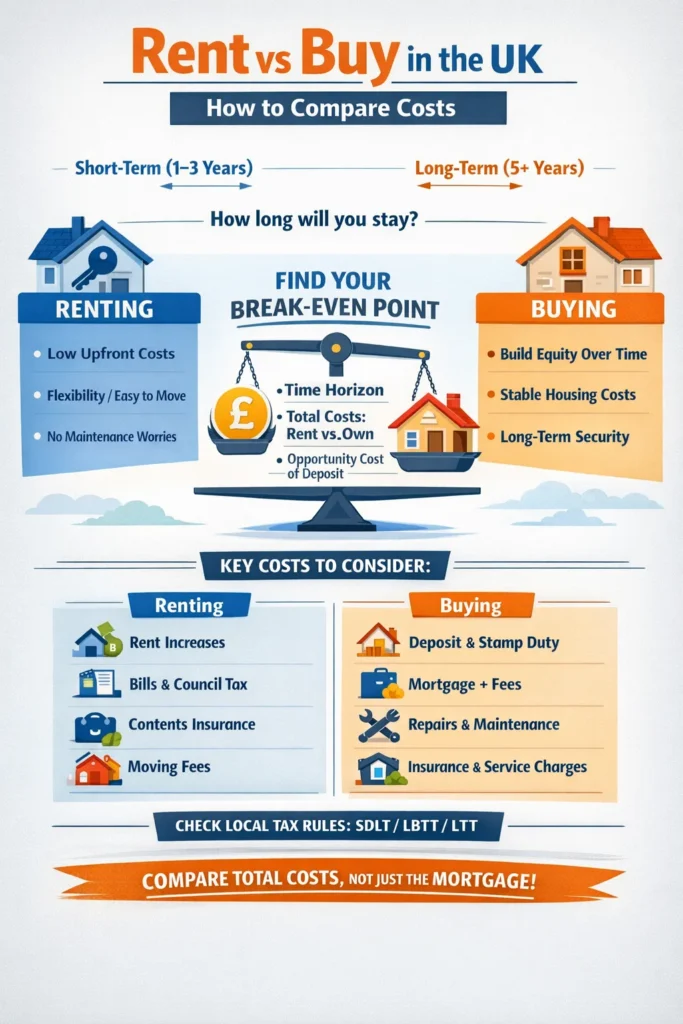
Most people make a better decision when they answer two questions first: “How long will I stay?” and “What will I pay upfront?”
- Renting often works out better if you expect to move within 2–3 years, because buying comes with heavy upfront costs (legal fees, taxes, moving, set-up).
- Buying often works out better if you plan to stay longer, because you can build equity and spread one-off costs over more years.
- Compare the total cost of ownership, not just the mortgage payment (include repairs, insurance, service charges, and fees).
- Factor in the opportunity cost of your deposit (what that money could have earned elsewhere).
- Stress-test your mortgage payment for rate changes, especially if you’re on a variable rate or your fixed deal ends soon.
- Use local data for a fair comparison, ideally rent and purchase prices for similar homes in the same area.
Most common reason renting wins: flexibility (no selling costs and usually lower upfront fees).
Most common reason buying wins: equity building (part of your payment can become ownership, not pure expense).
Renting Costs (Upfront + Ongoing)
| Cost | When it hits | What it means |
|---|---|---|
| Tenancy deposit | Upfront | Usually refundable if you meet the terms and there’s no damage beyond fair wear and tear. |
| Holding deposit | Upfront | Often used to reserve a property while checks are done (rules can vary). |
| Moving costs | Upfront | Van hire, removals, storage, travel. |
| Rent | Monthly | Your main housing cost and usually the biggest outgoing. |
| Rent increases | Yearly/renewal | Rent can rise at renewal or via permitted mechanisms. |
| Bills + Council Tax | Monthly | Not always included, so compare like-for-like. |
| Contents insurance | Monthly/yearly | Covers your belongings, not the building. |
Buying Costs (Upfront + Ongoing + Often Forgotten)
| Cost | When it hits | What it means |
|---|---|---|
| Deposit | Upfront | Your cash contribution; it affects your loan-to-value (LTV) and often your mortgage rate. |
| Conveyancing / legal fees | Upfront | Solicitor fees for the purchase, searches, and legal work. |
| Survey fee | Upfront | Checks the property’s condition and can prevent expensive surprises later. |
| Mortgage arrangement / product fee | Upfront or added | A lender fee for the mortgage deal. |
| Broker fee (if used) | Upfront/ongoing | Some brokers charge; others don’t. |
| Stamp duty / SDLT (or LBTT/LTT) | Upfront | Property purchase tax, and the rules differ across the UK. |
| Buildings insurance | Ongoing | Covers the structure and is often required by the lender. |
| Maintenance and repairs | Ongoing | Boiler, roof, damp, electrics, and general wear and tear. |
| Service charge + ground rent (leasehold) | Ongoing | Common with flats and can change over time. |
| Moving costs | Upfront | Similar to renting, sometimes higher. |
| Selling costs later | Later | Estate agent fees, legal fees, and possible early repayment charges. |
A simple rule keeps the maths honest: if you wouldn’t ignore a cost as a renter, don’t ignore it as an owner. The comparison falls apart when you only look at “rent vs mortgage payment”.
How to Compare Costs Step by Step (Simple Method)
Step 1: Choose your time horizon
If you’re unsure, run the numbers for 2, 5, and 10 years. Short horizons often favour renting because buying costs are front-loaded.
Step 2: Estimate your rent path
Start with today’s rent and add a sensible annual increase. Keep it simple by testing two or three rent-increase assumptions.
Step 3: Estimate your all-in buying costs
Start with your monthly mortgage payment, then add:
- buildings insurance
- maintenance and repairs
- service charge/ground rent if leasehold
- one-off fees spread across your time horizon (legal, survey, mortgage fees, moving)
Step 4: Add the opportunity cost of your deposit
If you put £30,000 into a deposit, you can’t use it elsewhere. Treat that as a “missing return” that should at least be part of your thinking.
Step 5: Compare totals and find your break-even point
Calculate:
- Total rent paid over your horizon
- Total owner costs paid over your horizon
Then adjust for what you could get back when you sell: equity minus selling costs.
Example only (simple numbers, not advice)
Assume you’re deciding between:
- Rent: £1,400 per month
- Buy: £300,000 home, 10% deposit (£30,000), repayment mortgage
- One-off buying fees: £4,000 (legal + survey + mortgage fees)
- Maintenance + insurance: £250 per month (combined placeholder)
Rent for 5 years: £1,400 × 60 = £84,000 (plus moving and bills).
Own for 5 years: (mortgage payment × 60) + (£250 × 60) + £4,000 (plus tax if due).
Now compare that with your likely equity at year 5 (how much capital you repaid plus any house price change), then subtract selling costs.
For a quick reality check, run the same calculation for 2 years. Buying often looks poor at 2 years because the upfront fees haven’t had time to spread out.
UK-Specific Taxes and Rules You Should Account For
Tax rules can change, so treat this as guidance as 2026, and check official calculators for your exact situation.
England & Northern Ireland: SDLT (Stamp Duty Land Tax)
- SDLT usually starts above £125,000 for main residential purchases.
- First-time buyers typically pay 0% up to £300,000, then 5% on the portion from £300,001 to £500,000, and relief doesn’t apply above £500,000.
- If buying means you’ll own more than one property, you usually pay an extra 5% on top (higher rates for additional dwellings).
Scotland: LBTT
- Scotland uses LBTT with its own bands (for example, 0% up to £145,000, then higher bands above that).
- First-time buyer relief can increase the nil-rate band to £175,000 (reducing tax by up to £600).
Wales: LTT
- Wales uses LTT with different bands (for example, 0% up to £225,000 on the portion in that band, with effective dates depending on the rules in force).
- Wales also has higher residential rates for additional properties, and these can change over time.
When you compare rent vs buy, treat property tax as part of your upfront buying cost. It can shift your break-even point by years.
Scenarios (So You Can Spot Yourself Quickly)
First-time buyer with a small deposit
Rent tends to suit when
- you’re still building your deposit and emergency fund
- you’d need a very high LTV and feel stretched
Buy tends to suit when
- you can afford the payment even if rates rise at remortgage
- you plan to stay put and want stable housing costs
Likely to move in 2–3 years
Rent tends to suit when
- your job or family plans might change your location
- you don’t want selling risk and selling fees so soon
Buy tends to suit when
- you’re genuinely confident you’ll stay longer than expected
- your buying costs are unusually low (less common, but possible)
Stable location for 7–10 years
Rent tends to suit when
- you value flexibility and prefer investing savings elsewhere
- you want predictable responsibility (the landlord handles major repairs)
Buy tends to suit when
- you want long-term stability
- you can handle repairs without it wrecking your budget
Leasehold flat (service charge + ground rent)
Rent tends to suit when
- service charges look unpredictable or rising
- the building has known major works coming
Buy tends to suit when
- you understand the lease terms and service charge history
- the flat’s total running costs still beat renting comparable flats
Choosing between “cheaper now” and “safer later”
Rent tends to suit when
- you need short-term affordability
- you’re rebuilding finances or paying down other debts
Buy tends to suit when
- you want long-term housing security
- you can stress-test the mortgage and still afford it
Tools and Calculators
If you rent right now, start with a clear monthly rent budget (rent + bills + Council Tax). Then compare it with a mortgage budget that you’ve stress-tested for higher rates.
To check whether your rent level really fits your take-home pay and bills, use a simple budgeting tool like a Rent Affordability Calculator.
For buying taxes, use official calculators for SDLT/LBTT/LTT because the rules differ across the UK.
FAQs
Is it cheaper to rent or buy in the UK right now?
It depends on your area, your mortgage rate, and how long you’ll stay. Short stays often favour renting because buying has high upfront costs.
How long should I stay for buying to make sense?
Use break-even rather than a fixed rule. If your upfront buying costs are high, break-even usually moves further out.
What do first-time buyers forget most often?
Legal fees, surveys, mortgage product fees, and moving costs catch people out. Many also underestimate repairs and set-up costs in the first year.
Conclusion
Renting vs buying isn’t about a slogan. It comes down to your time horizon, your all-in costs, and whether your budget can handle rate changes and repairs.
Next steps (quick checklist):
- Choose a horizon: 2, 5, and 10 years.
- List all rent costs (including bills and likely increases).
- List all buying costs (fees, tax, repairs, insurance, service charges).
- Stress-test your mortgage payment for a higher rate at remortgage.
- Compare totals and identify your break-even point.
If you want extra clarity, run the numbers twice: once optimistic and once cautious. When both versions point the same way, the decision usually feels much easier.