University Evaluation: Meaning, Process, Criteria, and Checklist
What Is University Evaluation?
University evaluation is the process of assessing how well a university, course, department, teaching method, student support service, or academic programme is performing.
In simple words, it helps answer one important question:
Is the university doing what it promises, and is it helping students succeed?
University evaluation can look at many areas, including teaching quality, course content, assessment methods, student support, facilities, graduate outcomes, inclusivity, value for money, and the overall student experience.
The University of Plymouth explains evaluation as a way to determine whether an initiative has delivered what was intended and to inform future improvements. In higher education, that idea applies to everything from one module survey to a full institutional quality review.
A good university evaluation is not just about collecting feedback. It is about using evidence to make better decisions.
Why University Evaluation Matters
University evaluation matters because students, parents, educators, and university leaders all need reliable information before making decisions.
For students, evaluation helps answer questions such as:
- Is this university worth choosing?
- Is the course well taught?
- Will I receive proper academic and personal support?
- Are graduates getting good outcomes?
- Is the cost fair compared with the value?
For universities, evaluation helps answer questions such as:
- Are students learning what they are expected to learn?
- Are courses still relevant?
- Are teaching methods effective?
- Are students from all backgrounds getting fair opportunities?
- What needs to improve?
The Office for Students connects evaluation with evidence-based improvement, especially in access and participation work, where providers are expected to measure the impact of activities designed to improve equality of opportunity.
In short, university evaluation helps turn opinions, data, and feedback into action.
University Evaluation vs Course Evaluation vs Module Evaluation
These terms are connected, but they do not mean exactly the same thing.
| Type of Evaluation | What It Looks At | Who Uses It | Example |
|---|---|---|---|
| University evaluation | Overall university quality, support, outcomes, facilities, reputation, inclusion, and value | Students, parents, regulators, university leaders | Comparing three universities before applying |
| Course evaluation | A full degree or academic programme | Course leaders, departments, students | Evaluating a BSc Computer Science programme |
| Module or unit evaluation | One specific module, unit, or class | Students, lecturers, quality teams | End-of-semester feedback on one module |
| Teaching evaluation | Teaching style, clarity, engagement, feedback, and support | Lecturers, departments, students | Students rate how clearly a lecturer explains topics |
| Support service evaluation | Academic advice, wellbeing, disability support, careers, finance, and international student support | Student services and university leaders | Reviewing how helpful career support is |
A student searching for “university evaluation” may be looking for a way to compare universities. A lecturer may be looking for ways to improve a course. A quality assurance officer may be looking for evidence to support an institutional review.
That is why university evaluation should be understood as a broad process, not just a student survey.
Main Types of University Evaluation
1. Course Evaluation
Course evaluation looks at the full learning experience across a degree or academic programme. It may include teaching quality, module structure, workload, assessment methods, feedback, resources, student satisfaction, and graduate outcomes.
A good course evaluation asks:
- Is the course content relevant and up to date?
- Are the modules well connected?
- Are students being assessed fairly?
- Do students receive useful feedback?
- Does the course prepare students for further study or employment?
2. Module or Unit Evaluation
Module evaluation focuses on one specific unit of study. This is usually done through a student survey near the end of a semester or teaching block.
Students may be asked about:
- Teaching clarity
- Learning materials
- Workload
- Assessment fairness
- Feedback quality
- Organisation
- Access to resources
Module evaluation is useful because it gives course teams specific feedback on what is working and what needs to change.
3. Teaching Evaluation
Teaching evaluation focuses on the quality of teaching. It may include student feedback, peer observation, assessment results, attendance, engagement, and learning outcomes.
Useful teaching evaluation should not only ask whether students “liked” a teacher. It should look at whether teaching helped students understand, think critically, apply knowledge, and make progress.
4. Student Support Evaluation
A university can have strong teaching but weak student support. That is why student support should be part of any serious university evaluation.
This includes:
- Academic advising
- Personal tutoring
- Mental health and wellbeing support
- Disability support
- Financial support
- International student support
- Career guidance
- Library and study skills support
Support services are especially important for students who face extra barriers, including disabled students, mature students, care-experienced students, commuter students, and students from lower-income backgrounds.
5. Institutional Evaluation
Institutional evaluation looks at the university as a whole. It may include academic standards, governance, student experience, facilities, staff resources, research environment, partnerships, complaints, appeals, and quality assurance systems.
The QAA UK Quality Code is one important reference point in the UK because it sets out principles for securing academic standards and assuring and enhancing quality in higher education.
6. Access and Participation Evaluation
Access and participation evaluation looks at whether a university is helping students from underrepresented or disadvantaged backgrounds access higher education, succeed during their studies, and progress after graduation.
The Office for Students explains that access and participation plans set out how providers will improve equality of opportunity, including how they will evaluate the impact of their work.
This type of evaluation matters because a university should not only attract students. It should also help them stay, succeed, and move forward.
7. Graduate Outcomes Evaluation
Graduate outcomes evaluation looks at what happens after students complete their course. It can include employment, further study, professional progression, salary indicators, career satisfaction, and whether graduates feel their current activity is meaningful.
Graduate outcomes should not be the only measure of university quality, but they are important. A course may be enjoyable, but students also need to know whether it can support their future goals.
University Evaluation Criteria: What Should You Assess?
A useful university evaluation should look at several areas together. One single factor, such as ranking or reputation, is not enough.
| Evaluation Area | Why It Matters | Evidence to Check |
|---|---|---|
| Teaching quality | Good teaching affects understanding, confidence, and progress | Student feedback, teaching surveys, peer review, contact hours |
| Course content | The course should be current, relevant, and well structured | Module list, learning outcomes, accreditation, reading lists |
| Assessment methods | Students need fair and transparent assessment | Marking criteria, feedback speed, assessment variety |
| Student support | Support affects retention, wellbeing, and success | Tutoring, wellbeing services, disability support, academic advice |
| Graduate outcomes | Shows how students progress after graduation | Employment data, further study, alumni stories, career support |
| Facilities | Learning depends on access to libraries, labs, study spaces, and technology | Campus visits, student reviews, course facilities |
| Cost and value | Students need to understand the return on their investment | Tuition fees, scholarships, living costs, financial support |
| Employability | Courses should help students build career-ready skills | Internships, placements, employer links, career workshops |
| Inclusivity and accessibility | A strong university supports different student needs | Accessibility services, inclusive teaching, widening participation |
| Student voice | Feedback should lead to real improvements | “You said, we did” updates, student representation, survey results |
How the University Evaluation Process Works
A strong evaluation process is systematic. It should not be random, rushed, or based only on opinions.
The TASO Monitoring and Evaluation Framework describes evaluation planning through stages such as diagnosing the issue, planning the evaluation, measuring impact, and reflecting on findings. A practical university evaluation process can follow a similar cycle.
Step 1: Define the Purpose
Before collecting feedback or data, decide what you are trying to evaluate.
For example:
- Are we evaluating a university before applying?
- Are we evaluating a course after one academic year?
- Are we evaluating student support services?
- Are we checking whether an intervention improved student retention?
- Are we reviewing teaching quality in one department?
Without a clear purpose, evaluation becomes too broad and confusing.
Step 2: Choose the Criteria
Next, decide what matters most.
A prospective student may focus on teaching, cost, employability, location, and student support.
A university department may focus on learning outcomes, assessment, student feedback, progression, and external examiner comments.
A quality assurance team may focus on standards, policies, data, complaints, student outcomes, and equality of opportunity.
Step 3: Collect Evidence
Evidence can come from several sources:
- Student surveys
- Focus groups
- Interviews
- Module evaluation forms
- Graduate outcome data
- Assessment results
- Attendance or engagement data
- External examiner reports
- Complaints and appeals
- Accreditation reports
- Student support usage data
The National Student Survey is one example of large-scale student feedback in the UK, giving students a chance to reflect on areas such as teaching, resources, and student voice.
Step 4: Analyse the Results
Good evaluation looks for patterns. One negative comment does not prove that a course is poor. One positive score does not prove that everything is perfect.
When analysing results, ask:
- Are several students reporting the same issue?
- Are results improving or declining over time?
- Are some student groups having a worse experience?
- Are low scores connected to specific modules or services?
- Is the response rate high enough to trust the result?
- Do survey results match other evidence?
Step 5: Compare Against Goals or Standards
Evaluation should compare results against something meaningful.
This could be:
- Course learning outcomes
- University strategy
- Quality standards
- Student expectations
- Professional body requirements
- Previous year results
- Similar courses
- Access and participation targets
Comparison helps turn raw data into useful judgement.
Step 6: Create an Action Plan
Evaluation is weak if it ends with a report that nobody uses.
A good action plan should explain:
- What needs to change
- Who is responsible
- When the change will happen
- What resources are needed
- How success will be measured
- How students will be updated
Step 7: Communicate the Findings
Students are more likely to trust evaluation when they can see what happened after they gave feedback.
A simple “You said, we did” update can show students that their views were heard.
For example:
| You Said | We Did |
|---|---|
| Feedback on assignments arrived too late | We introduced a 15-working-day feedback target |
| The module reading list was too long | We separated essential and optional readings |
| Students wanted more career examples | We added employer-led case studies |
| Timetables changed too often | We improved timetable communication |
Step 8: Review Again
Evaluation should be a cycle, not a one-time task.
After changes are made, the university should check whether those changes worked. If the problem continues, the action plan needs to be improved.
University Evaluation Checklist for Students
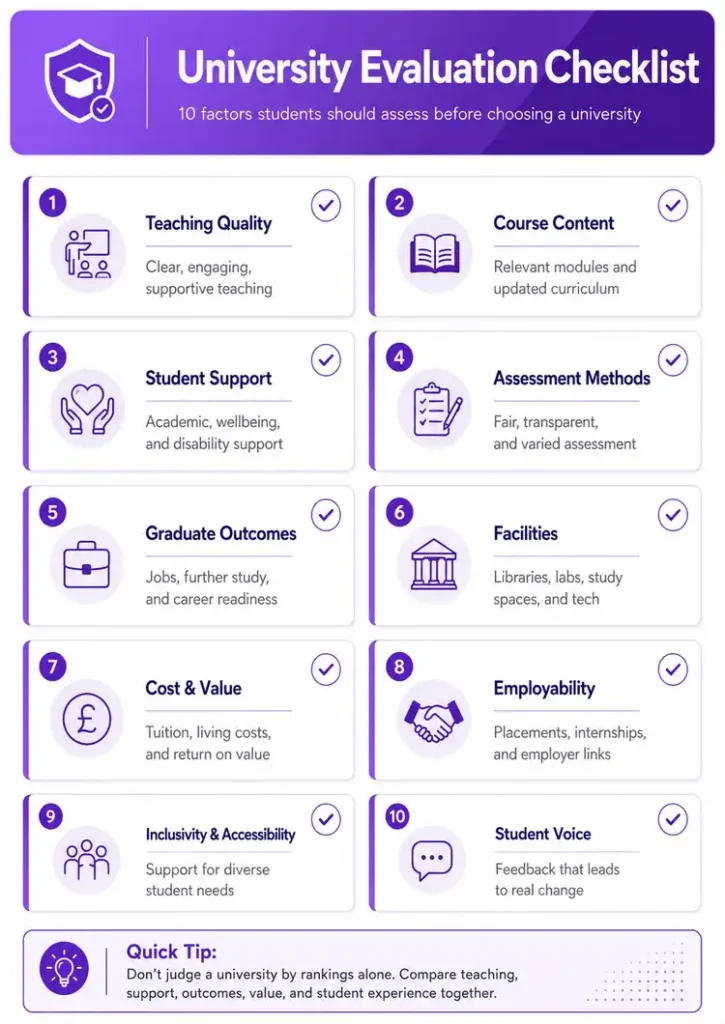
If you are choosing a university, do not rely only on rankings or glossy marketing pages. Use a balanced checklist.
Before Choosing a University
Ask these questions:
- Teaching quality: Are students satisfied with teaching and feedback?
- Course content: Does the course cover the topics and skills you need?
- Assessment: Are assessment methods fair and varied?
- Support: Is academic, wellbeing, and disability support easy to access?
- Employability: Are there placements, internships, employer links, or career services?
- Graduate outcomes: What do graduates do after the course?
- Facilities: Are the libraries, labs, studios, online systems, and study spaces strong?
- Cost and value: Can you afford tuition, rent, travel, and living costs?
- Location: Is the city or campus suitable for your lifestyle and budget?
- Inclusivity: Does the university support students from different backgrounds?
- Student voice: Does feedback lead to visible changes?
- Accreditation: Is the course recognised by professional bodies if needed?
When comparing universities, you should also think about academic performance and degree results. For example, if you want to understand how UK university grades are calculated, this helpful uni grade calculator can help you estimate or understand degree classifications before comparing course outcomes.
While Studying at University
If you are already a student, evaluation can help you judge whether your course is meeting expectations.
Ask yourself:
- Am I learning what the course promised?
- Are teaching sessions clear and useful?
- Is the workload manageable?
- Do I understand how I am assessed?
- Do I receive feedback that helps me improve?
- Can I access support when I need it?
- Are students treated fairly?
- Does the course feel organised?
- Are concerns taken seriously?
Before Completing a Course Evaluation Survey
Your feedback is more useful when it is specific and fair.
Instead of writing:
“This module was bad.”
Write:
“The module content was interesting, but assignment instructions were unclear. A short example answer or marking guide would help future students.”
Instead of writing:
“The lecturer was great.”
Write:
“The lecturer explained difficult ideas clearly and used weekly examples that helped me prepare for the assessment.”
Specific feedback is easier for universities to act on.
University Evaluation Score Calculator
A university evaluation score calculator can help students compare options more clearly. It should not replace official data, open days, course pages, or personal judgement, but it can make comparison easier.
You can score each category from 1 to 5:
- 1 = Very weak
- 2 = Weak
- 3 = Average
- 4 = Strong
- 5 = Excellent
| Category | Suggested Weight |
|---|---|
| Teaching quality | 15% |
| Course content | 10% |
| Student support | 10% |
| Graduate outcomes | 12% |
| Facilities | 8% |
| Assessment methods | 10% |
| Student feedback system | 8% |
| Cost and value | 10% |
| Employability | 12% |
| Inclusivity and accessibility | 5% |
How to Interpret the Score
| Score | Meaning |
|---|---|
| 85–100 | Excellent choice |
| 70–84 | Strong option |
| 55–69 | Average; compare weak areas carefully |
| 40–54 | Weak in several areas |
| Below 40 | Review carefully before choosing |
Important note: this score is a practical guide, not an official university ranking.
University Evaluation Methods
Different evaluation methods answer different questions. A strong university should not depend on only one method.
| Method | Best For | Strength | Limitation |
|---|---|---|---|
| Student surveys | Collecting broad feedback | Easy to scale | Can suffer from low response rates |
| Focus groups | Understanding reasons behind feedback | Gives deeper insight | Small sample size |
| Interviews | Exploring individual experiences | Detailed and personal | Time-consuming |
| Learning analytics | Tracking engagement and progress | Useful for early support | Can miss personal context |
| Graduate outcome data | Understanding career progression | Helps judge employability | Usually appears after students graduate |
| External review | Quality assurance and standards | Independent perspective | May not show daily student experience |
| Complaints and appeals data | Identifying recurring issues | Highlights serious problems | Only captures reported problems |
| Peer review of teaching | Improving teaching practice | Professional feedback | May not capture student experience fully |
The best evaluation combines numbers and human experience. Data can show what is happening, but student comments often explain why it is happening.
Common Problems With University Evaluation
University evaluation is useful, but it is not perfect. Here are some common problems.
Low Survey Response Rates
If only a small number of students respond, the results may not represent the whole class. This is especially important for small courses or modules.
Universities should encourage participation and explain how feedback will be used.
Biased Feedback
Student feedback can be affected by emotions, grades, personal preferences, or isolated experiences. That does not mean student feedback is useless. It means feedback should be interpreted carefully alongside other evidence.
Over-Reliance on Rankings
University rankings can be helpful, but they are not the same as evaluation. A university may rank highly overall but still have a course that is not the best fit for you.
Always check course-level details, not just institution-level reputation.
Weak Follow-Up
Students may stop giving feedback if they feel nothing changes. Evaluation should include visible action.
A university that says “we value student feedback” should also show what changed because of that feedback.
Confusing Survey Questions
Poorly written questions produce poor results. For example, “Was the module good?” is too vague.
A better question would be:
“How clearly were the assessment requirements explained?”
Clear questions lead to clearer improvements.
How to Read a University Evaluation Report
University evaluation reports can be useful, but only if you know what to look for.
1. Check What Was Evaluated
Was the report about:
- One course?
- One department?
- One module?
- Student support?
- Access and participation?
- Graduate outcomes?
- The whole university?
Do not treat a narrow report as if it proves everything about the university.
2. Check the Evidence
Look for the evidence used in the report.
Strong evaluation usually includes more than one source, such as surveys, interviews, outcome data, and action plans.
3. Check the Sample Size
If a report is based on only a few responses, be careful. It may still be useful, but it should not be treated as complete proof.
4. Check the Date
University quality can change. A report from five years ago may not reflect the current course, staff, facilities, or student support.
5. Check the Actions
The most important part of an evaluation report is not the problem list. It is the action plan.
Ask:
- What changed?
- Who was responsible?
- Was the issue reviewed again?
- Did students see the result?
Example: Evaluating a Business Degree
Let’s say you are comparing a Business Management degree at three universities.
You should not only ask, “Which university is ranked highest?”
Instead, compare the areas that affect your real experience.
| Criteria | University A | University B | University C |
|---|---|---|---|
| Teaching quality | 4/5 | 3/5 | 5/5 |
| Course content | 5/5 | 4/5 | 4/5 |
| Student support | 3/5 | 5/5 | 4/5 |
| Employability | 5/5 | 3/5 | 4/5 |
| Facilities | 4/5 | 4/5 | 3/5 |
| Cost and value | 3/5 | 5/5 | 4/5 |
| Overall fit | Strong career focus | Best support and value | Best teaching experience |
This type of comparison helps you make a more personal and practical decision.
The “best” university is not always the one with the biggest name. It is the one that fits your academic goals, support needs, budget, and future plans.
What Makes a University Good?
A good university is not defined by one factor. It is usually strong across several areas.
A good university should offer:
- Clear and engaging teaching
- Relevant and well-structured courses
- Fair assessment methods
- Helpful academic feedback
- Accessible student support
- Good learning resources
- Strong employability support
- Inclusive policies and culture
- Transparent communication
- Evidence that student feedback leads to change
A university does not need to be perfect. But it should be honest about weaknesses and serious about improvement.
University Evaluation for Parents
Parents often look at university choice from a safety, value, and future career perspective. That is understandable.
If you are helping someone choose a university, focus on questions such as:
- Is the course respected and relevant?
- Can the student afford the location?
- Is accommodation safe and accessible?
- What support is available if the student struggles?
- Are there strong career services?
- Are students satisfied with teaching and support?
- Does the university communicate clearly?
- Are graduates progressing into work or further study?
Parents should avoid choosing only by prestige. A supportive university with strong teaching and good career preparation may be better than a more famous university that does not fit the student’s needs.
University Evaluation for Educators and Course Leaders
For educators, evaluation should not feel like a box-ticking exercise. It should be a tool for improving learning.
A good course leader should ask:
- Are students meeting the learning outcomes?
- Are assessments testing the right skills?
- Are students receiving feedback in time to improve?
- Are certain groups of students struggling more than others?
- Is the workload realistic?
- Are students clear about expectations?
- Are teaching methods inclusive?
- What evidence shows that recent changes worked?
The goal is not to collect perfect scores. The goal is to understand the student experience and improve it.
University Evaluation for Quality Assurance Teams
Quality assurance teams need a wider view. They must look at standards, consistency, risk, data, student voice, and improvement.
Useful evidence may include:
- Course monitoring reports
- External examiner feedback
- Student survey results
- Progression and retention data
- Complaints and appeals
- Professional accreditation outcomes
- Access and participation data
- Graduate outcomes
- Department action plans
- Equality and inclusion evidence
A strong quality system does not only detect problems. It helps departments solve them.
Practical University Evaluation Checklist
Use this checklist when comparing a university, course, or department.
| Question | Yes / No / Not Sure |
|---|---|
| Is the course content clearly explained? | |
| Are modules relevant to your goals? | |
| Are teaching methods clear and engaging? | |
| Are assessment methods fair and transparent? | |
| Is feedback useful and timely? | |
| Is academic support easy to access? | |
| Are wellbeing and disability services available? | |
| Are facilities suitable for the course? | |
| Are graduate outcomes strong? | |
| Are there internships, placements, or employer links? | |
| Is the total cost realistic? | |
| Does the university support diverse student needs? | |
| Does student feedback lead to visible changes? | |
| Is the course accredited if required? | |
| Would you feel confident studying there? |
If you answer “Not sure” too often, you need more information before making a decision.
Final Thoughts
University evaluation is about making better decisions with better evidence.
For students and parents, it helps compare universities beyond rankings and marketing. For educators, it helps improve teaching and course design. For university leaders and quality teams, it supports academic standards, student success, equality of opportunity, and long-term improvement.
The best university evaluation is balanced. It looks at teaching, support, outcomes, cost, inclusion, facilities, assessment, and student voice together.
A university is not strong because it looks impressive on paper. It is strong when students are taught well, supported properly, assessed fairly, listened to honestly, and prepared for the future.
FAQs
What does university evaluation mean?
University evaluation means assessing how well a university, course, department, service, or academic programme is performing. It can include teaching quality, course content, student support, assessment, outcomes, facilities, cost, and overall student experience.
Why is university evaluation important?
University evaluation is important because it helps students make better choices and helps universities improve. It turns feedback, data, and evidence into practical decisions.
How do universities evaluate courses?
Universities evaluate courses using student surveys, module feedback, assessment results, progression data, external examiner reports, focus groups, graduate outcomes, and quality review processes.
Are university rankings the same as university evaluation?
No. Rankings are only one source of information. University evaluation is broader and may include course-level quality, personal fit, support, cost, outcomes, facilities, and student experience.
What happens after a university evaluation?
A good university should analyse the results, identify patterns, create an action plan, make improvements, and tell students what changed.