Last Third of the Night Meaning: Calculate Tahajjud Time Easily
Many people hear the phrase “last third of the night” and assume it means midnight, 3 AM, or any time before Fajr — but the correct time depends on your local Maghrib and Fajr times.
The last third of the night means the final one-third portion of the Islamic night. It is calculated from Maghrib/sunset until Fajr/dawn. To find it, calculate the full length of the night, divide it into three equal parts, and the final part before Fajr is the last third of the night. Islamic calculation sources explain the night for this purpose as the time between Maghrib/sunset and Fajr/dawn.
To avoid manual calculation mistakes, you can use our Last Third of the Night Calculator to enter your Maghrib and Fajr times and find tonight’s exact last-third window.
Quick Answer: What Is the Last Third of the Night?
| Question | Short Answer |
|---|---|
| What does it mean? | The final one-third of the night between Maghrib and Fajr. |
| When does it start? | After two-thirds of the night have passed. |
| When does it end? | At Fajr. |
| Is it always 12:00 AM? | No, it changes based on Maghrib and Fajr. |
| Why is it important? | It is a highly recommended time for Tahajjud, dua, dhikr, and seeking forgiveness. |
| Does it change daily? | Yes, because prayer times change by date and location. |
What Does the Last Third of the Night Mean in Islam?
The last third of the night refers to the final third of the night before Fajr. In Islamic practice, this time is especially valued for Tahajjud, Qiyam al-Layl, dua, istighfar, and private worship.
The night is divided into three equal parts:
- First third of the night
- Second third of the night
- Last third of the night
The last third begins when the first two parts have passed and continues until Fajr begins.
For example, if Maghrib is at 6:00 PM and Fajr is at 5:00 AM, the night is 11 hours long. One third of 11 hours is 3 hours and 40 minutes. The last third would start at 1:20 AM and end at 5:00 AM.
Is the Last Third of the Night the Same as Midnight?
No, the last third of the night is not the same as 12:00 AM.
This is one of the most common mistakes. Midnight on the clock is fixed at 12:00 AM, but the last third of the night is calculated from your local Maghrib and Fajr times.
There is also a difference between:
| Term | Meaning |
|---|---|
| Clock midnight | 12:00 AM |
| Islamic midnight | The halfway point between Maghrib and Fajr |
| Last third of the night | The final one-third before Fajr |
So if the night is long, the last third may begin much earlier. If the night is short, it may begin later. That is why the last third can be different in summer, winter, and different cities.
How to Calculate the Last Third of the Night
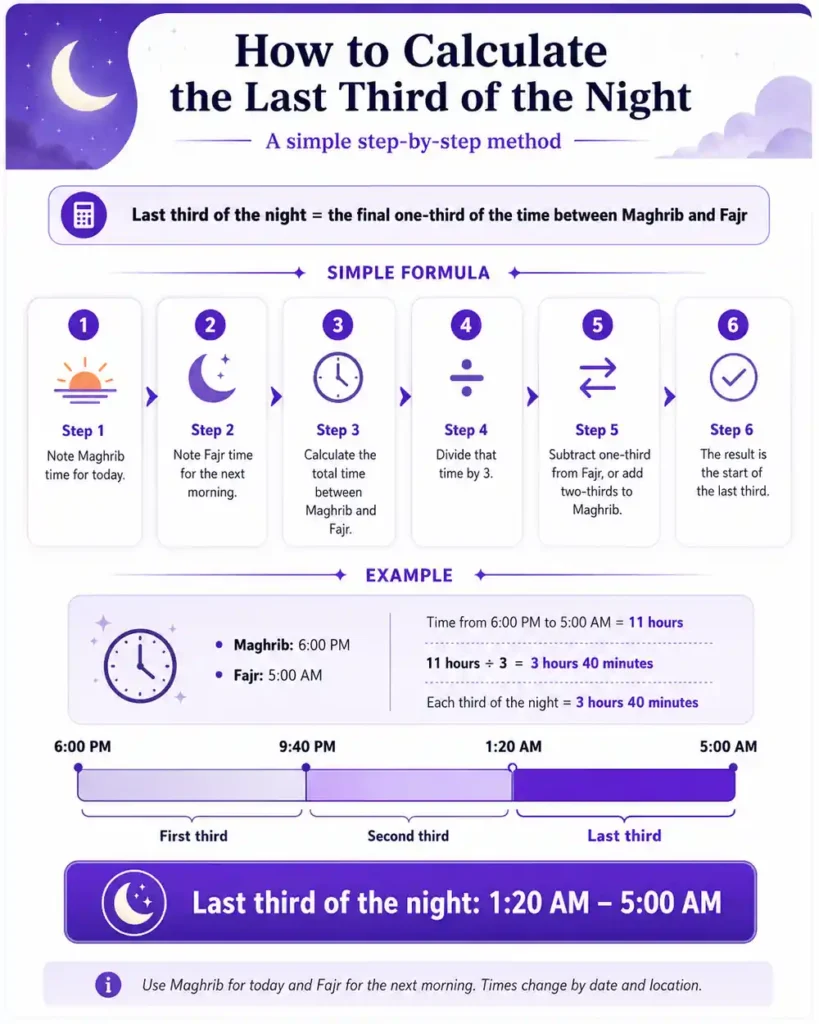
The formula is simple:
Last third of the night = the final one-third of the time between Maghrib and Fajr
Simple Formula
| Step | What to Do |
|---|---|
| Step 1 | Note Maghrib time for today. |
| Step 2 | Note Fajr time for the next morning. |
| Step 3 | Calculate the total time between Maghrib and Fajr. |
| Step 4 | Divide that time by 3. |
| Step 5 | Subtract one-third from Fajr, or add two-thirds to Maghrib. |
| Step 6 | The result is the start of the last third. |
Islamic Q&A sources explain this same calculation method: calculate the time from Maghrib/sunset to Fajr/dawn, divide it into three parts, and identify the final third.
Manual Calculation Example
Let’s say:
- Maghrib: 6:00 PM
- Fajr: 5:00 AM
The time from 6:00 PM to 5:00 AM is 11 hours.
Now divide 11 hours by 3:
11 hours ÷ 3 = 3 hours 40 minutes
So each third of the night is 3 hours and 40 minutes.
| Night Section | Time |
|---|---|
| First third | 6:00 PM – 9:40 PM |
| Second third | 9:40 PM – 1:20 AM |
| Last third | 1:20 AM – 5:00 AM |
So in this example, the last third of the night starts at 1:20 AM and ends at Fajr, 5:00 AM.
Another Example Calculation
| Maghrib | Fajr | Total Night Length | One Third | Last Third Starts | Last Third Ends |
|---|---|---|---|---|---|
| 7:00 PM | 4:00 AM | 9 hours | 3 hours | 1:00 AM | 4:00 AM |
| 6:30 PM | 5:30 AM | 11 hours | 3h 40m | 1:50 AM | 5:30 AM |
| 5:00 PM | 6:00 AM | 13 hours | 4h 20m | 1:40 AM | 6:00 AM |
| 8:30 PM | 3:45 AM | 7h 15m | 2h 25m | 1:20 AM | 3:45 AM |
These examples show why there is no single fixed answer like “the last third starts at 2 AM.” It depends on the length of the night.
Use the Last Third of the Night Calculator
Manual calculation is useful, but it can become confusing when prayer times change daily. The easiest way is to use a calculator.
Use our Last Third of the Night Calculator to calculate the exact time for your location.
Which Prayer Times Should You Use?
For calculating the last third of the night, use:
- Start: Maghrib or sunset
- End: Fajr or true dawn
Do not use sunrise as the end point. Do not start from Isha for this calculation. The standard method used in Islamic Q&A explanations is to calculate from sunset/Maghrib to Fajr/dawn.
Use Fajr Tomorrow, Not Fajr Today
This is very important.
If you are calculating the last third for tonight, you need:
- Maghrib time for today
- Fajr time for tomorrow morning
For example, if today is Monday, use Monday Maghrib and Tuesday Fajr.
Why Does the Last Third of the Night Change Every Day?
The last third changes because Maghrib and Fajr times change.
Prayer times are affected by:
- Your location
- The date
- The season
- The prayer calculation method
- Local timetable adjustments
In winter, the night is usually longer, so the last third may begin earlier. In summer, the night may be shorter, so the last third may begin later or feel shorter.
This is why a person in London, Karachi, New York, Dubai, or Toronto may have a different last-third time on the same date.
Why Is the Last Third of the Night Important?
The last third of the night is important because authentic hadith mention it as a special time for calling upon Allah, asking, and seeking forgiveness. Sahih al-Bukhari 1145 and Sahih Muslim 758a both mention the last third of the night in connection with supplication and forgiveness.
This is why many Muslims try to wake up during this time for:
- Tahajjud prayer
- Dua
- Istighfar
- Dhikr
- Quran recitation
- Quiet reflection
- Asking Allah for forgiveness and help
A respectful note: deeper theological discussions about the wording of the hadith should be learned from qualified scholars. This article focuses on the practical meaning, timing, and worship planning.
Can You Make Dua Before the Last Third of the Night?
Yes. You can make dua at any time.
The last third of the night is a special and blessed time, but it is not the only time when dua can be made. IslamQA.info explains that dua during the last third may be made even outside prayer, while combining dua with night prayer is more virtuous.
So if you wake up during the last third, you can:
- Pray two rak‘ahs
- Make dua
- Ask for forgiveness
- Recite Quran
- Sit quietly and remember Allah
If you are tired or short on time, even a few sincere minutes before Fajr are valuable.
Tahajjud vs Qiyam al-Layl vs Witr vs Dua
Many beginners confuse these terms. Here is a simple comparison.
| Term | Simple Meaning | Timing |
|---|---|---|
| Tahajjud | Voluntary night prayer, commonly after sleep | After Isha until Fajr |
| Qiyam al-Layl | General night worship or night prayer | Any part of the night after Isha |
| Witr | Odd-numbered night prayer | After Isha before Fajr |
| Dua | Supplication, asking Allah | Any time, especially recommended in blessed times |
Is Tahajjud the Same as Qiyam al-Layl?
They are closely related, but Qiyam al-Layl is broader. Qiyam al-Layl can include prayer, Quran, dhikr, and other acts of worship at night. Tahajjud is commonly used for voluntary night prayer, especially after waking from sleep.
Quran 17:79 refers to rising during the night for Tahajjud, and tafsir sources explain Tahajjud as night prayer, commonly performed after waking in the later part of the night.
Where Does Witr Fit?
Witr is prayed after Isha and before Fajr. Many people pray it as their final prayer of the night. If you plan to wake up for Tahajjud, you can plan your Witr accordingly according to the fiqh guidance you follow. For detailed personal rulings, ask a qualified scholar or your local imam.
Common Mistakes When Calculating the Last Third of the Night
| Mistake | Correct Approach |
|---|---|
| Thinking it always starts at 12:00 AM | Calculate from Maghrib to Fajr. |
| Using sunrise as the end time | Use Fajr, not sunrise. |
| Using Isha as the start time | Use Maghrib/sunset for the night division. |
| Using Fajr from the same morning | Use the next Fajr after Maghrib. |
| Assuming the time is the same every day | Recalculate because prayer times change. |
| Ignoring local timetable differences | Check your mosque or trusted prayer app. |
| Waiting for the exact start and missing the whole window | Wake a little before Fajr if that is easier. |
Practical Tips for Waking Up in the Last Third of the Night
Waking up for Tahajjud can feel difficult at first, especially if you are not used to sleeping early. Start gently.
1. Start with 10 Minutes Before Fajr
You do not have to begin with a long routine. Start by waking up 10 minutes before Fajr. Pray two rak‘ahs or simply make dua and istighfar.
2. Sleep with Intention
Before sleeping, make the intention that you want to wake up for worship. A clear intention makes the habit easier.
3. Set Two Alarms
Set one alarm for the start of the last third and another alarm closer to Fajr. If you miss the first one, the second gives you another chance.
4. Keep a Dua List Ready
Many people wake up and then spend time thinking about what to ask for. Keep a short dua list beside your bed or on your phone.
You can include:
- Forgiveness
- Guidance
- Family
- Health
- Rizq
- Protection
- Marriage
- Children
- Exams or work
- Relief from stress
- The Hereafter
5. Do Not Give Up If You Miss It
If you miss the last third one night, try the next night again. Building a habit is better than becoming discouraged.
Does the Last Third of the Night Change in Ramadan?
The calculation does not change in Ramadan. It is still based on Maghrib to Fajr.
However, many people pay more attention to this time in Ramadan because it overlaps with:
- Tahajjud
- Qiyam
- Dua
- Suhoor preparation
- Istighfar before Fajr
If you are already waking for suhoor, it can be easier to wake a little earlier and spend a few minutes in dua or prayer.
Final Summary
The last third of the night means the final third of the Islamic night, calculated from Maghrib to Fajr. It is not always midnight, and it is not a fixed clock time.
To calculate it manually:
- Find the time between Maghrib and Fajr.
- Divide that time by three.
- The final third before Fajr is the last third of the night.
This time is especially valued for Tahajjud, dua, dhikr, Quran recitation, and seeking forgiveness. Because Maghrib and Fajr times change by date, season, city, and calculation method, it is best to check your local prayer timetable or use a calculator.
For an easier answer, use the Last Third of the Night Calculator to find tonight’s exact time.
FAQs
What does the last third of the night mean?
The last third of the night means the final one-third of the night between Maghrib and Fajr. It begins after two-thirds of the night have passed and ends when Fajr starts.
How do you calculate the last third of the night?
Calculate the time between Maghrib and Fajr, divide it by three, then find the final third before Fajr. For example, if the night is 9 hours long, each third is 3 hours, so the last third starts 3 hours before Fajr.
Is the last third of the night the same as midnight?
No. Midnight is not the same as the last third of the night. The last third depends on Maghrib and Fajr times, so it can start before or after 12:00 AM depending on the season and location.
When does the last third of the night start?
It starts after two-thirds of the night have passed. For example, if Maghrib is 6:00 PM and Fajr is 5:00 AM, the last third starts at 1:20 AM.
Does the last third of the night end at Fajr?
Yes. The last third of the night ends when Fajr begins.