MARS Scheme NHS: Payment Rules & Checklist
Important: This guide gives general information for NHS employees. It is not legal, pension, tax or financial advice. Your own outcome will depend on your employer’s local scheme, your contract, your service record, your pension position, your tax circumstances and any settlement agreement you are asked to sign.
An NHS MARS payment can look attractive, but before you apply or accept an offer, you need to know what you may receive, what rights you may be giving up and whether another exit route could leave you in a better position.
NHS MARS in 60 Seconds
MARS means Mutually Agreed Resignation Scheme. It is a form of voluntary severance where you and your NHS employer agree that you will leave your employment in return for a severance payment. NHS England and NHS Employers both describe MARS as voluntary severance, not redundancy or voluntary redundancy.
That distinction matters. A MARS payment is not the same as an NHS redundancy payment. A local scheme may help an employer reduce costs, manage workforce change or create vacancies for redeployment, but your application is not automatically accepted, and your local scheme terms are important.
Before you decide, you should check:
- whether you are eligible under your employer’s local scheme;
- how your payment has been calculated;
- whether the salary and service used are correct;
- how tax, notice pay and annual leave will be treated;
- what happens to your NHS pension;
- whether you can return to NHS employment;
- what you are being asked to agree in any settlement agreement.
Key Facts About NHS MARS
| Question | Plain-English answer |
|---|---|
| What does MARS mean? | Mutually Agreed Resignation Scheme. |
| Is it redundancy? | No. NHS England states that mutually agreed resignation is not redundancy or voluntary redundancy. |
| Is it automatic if I apply? | No. Your employer can reject an application based on local criteria, service need, affordability and business case. |
| Is there a national payment model? | Yes, current official guidance uses a salary-months table based on completed reckonable NHS service. |
| Is the calculator result an entitlement? | No. A calculator can only estimate the gross payment. Your employer’s written calculation and local scheme control the final offer. |
| Does MARS affect my NHS pension? | NHSBSA says MARS is not linked to the NHS Pension Scheme and is treated as voluntary resignation for pension purposes. |
| Is the payment tax free? | It depends on what each part of the payment is for. Wages, holiday pay, bonuses and notice-related payments can be taxable. |
Is NHS MARS the Same as Redundancy?
No. NHS MARS is not redundancy and it is not voluntary redundancy.
Under MARS, you voluntarily resign by agreement with your employer in return for a severance payment. In redundancy, employment ends because the employer’s need for the work, role or workplace has reduced or disappeared. NHS England states that MARS should not be used where the circumstances entitle the employee to contractual redundancy payment or redundancy benefits under NHS Pension Scheme Regulations.
This is one of the most important points to understand before applying. If your role is genuinely at risk of redundancy, or if a restructure, transfer or formal redundancy consultation is likely, you should compare MARS carefully with redundancy and get advice before signing anything.
What Is Decided Nationally and What Is Decided Locally?
MARS has national principles, but each employer’s local scheme matters.
| Area | National position | What may be local |
|---|---|---|
| Basic definition | MARS is voluntary resignation in return for severance. | Local documents may describe how applications are opened, assessed and approved. |
| Redundancy status | MARS is not redundancy or voluntary redundancy. | Local communications should not imply that applying guarantees protection from future redundancy. |
| Payment model | Current official guidance uses completed reckonable service and basic salary. | The employer must confirm your salary, service and final calculation. |
| Caps | NHS England’s current criteria include an £80,000 individual payment cap and an £80,000 salary cap, pro rata for part-time workers. | Local payroll must apply the cap correctly to your case. |
| Minimum service | NHS England states that only staff with at least 12 months’ continuous service can be considered. | Local schemes may add further eligibility rules. |
| Scheme length | NHS England says each scheme must not operate for more than three months. | The exact opening and closing dates are local. |
| Approval | NHS England guidance covers approval or review routes for Trusts, Foundation Trusts and ICBs. | Your employer decides whether your individual application is supported. |
| Settlement terms | A settlement agreement may be used. | The agreement wording can affect your rights, restrictions, payment timing and repayment risk. |
NHS MARS Payment Calculator
Use the calculator section on this page to estimate your gross MARS payment from your annual basic salary and completed years of reckonable service.
For a dedicated tool, you can also use the NHS MARS payment calculator to apply the current payment schedule to your salary and service. The result should be treated as an estimate only. It does not replace your employer’s written calculation.
What the Calculator Needs
The basic MARS estimate normally needs two figures:
- Your annual basic salary
- Your complete years of reckonable service
Do not enter total earnings if they include overtime, on-call payments, special duty payments or other additions that are not basic pay. NHS Employers defines basic pay as the pay based on your pay scale or band as stated on your payslip and lists several additional payments that are not included.
How Is an NHS MARS Payment Calculated?
The current official payment model uses completed years of reckonable service and a scale of salary months. NHS Employers states that MARS payments follow the previous nationally agreed terms and are calculated based on reckonable service at the date of leaving.
The basic calculation is:
Annual basic salary ÷ 12 × number of salary months = estimated gross MARS payment
The current NHS England criteria also include an £80,000 cap on each individual payment and an £80,000 salary cap, pro rata for part-time workers.
NHS MARS Payment Table
| Complete years of reckonable service | Salary months used |
|---|---|
| 1 | 3 months |
| 2 | 3 months |
| 3 | 3 months |
| 4 | 3 months |
| 5 | 3 months |
| 6 | 3 months |
| 7 | 3.5 months |
| 8 | 4 months |
| 9 | 4.5 months |
| 10 | 5 months |
| 11 | 5.5 months |
| 12 | 6 months |
| 13 | 6.5 months |
| 14 | 7 months |
| 15 | 7.5 months |
| 16 | 8 months |
| 17 | 8.5 months |
| 18 | 9 months |
| 19 | 9.5 months |
| 20 | 10 months |
| 21 | 10.5 months |
| 22 | 11 months |
| 23 | 11.5 months |
| 24 | 12 months |
NHS Employers’ published table shows 24 completed years as 12 months’ basic salary. If you have more than 24 years, your employer should confirm how the maximum is applied in your local calculation.
Worked Example
This is a hypothetical example.
Amira works for an NHS Trust and has:
- annual basic salary: £42,000
- completed reckonable service: 10 years
- payment months from the table: 5 months
Calculation:
£42,000 ÷ 12 = £3,500 per month
£3,500 × 5 = £17,500
Amira’s estimated gross MARS payment would be £17,500, before considering tax treatment, notice pay, annual leave, pension decisions or any local scheme conditions.
Common Calculation Mistakes
Mistake 1: Using total earnings instead of basic pay
Your MARS calculation should normally use basic pay, not every payment on your payslip. Additions such as overtime, on-call, acting-up payments, special duty or enhancement payments and recruitment and retention premia are listed by NHS Employers as excluded from basic pay for this purpose.
Mistake 2: Counting incomplete years
The official table is based on complete years of reckonable service. A calculator should not invent a partial-year payment.
Mistake 3: Double-adjusting part-time pay
If you enter your actual annual basic salary for your part-time hours, the calculator should not reduce it again. The part-time salary-cap treatment still needs to follow your employer’s local payroll calculation and the current national cap wording.
Mistake 4: Treating the estimate as an offer
Your employer must verify your salary, service, eligibility and local scheme terms. A calculator estimate is not an entitlement.
Mistake 5: Assuming the amount received will equal the gross estimate
Tax, notice pay, holiday pay, deductions, pension choices and settlement terms can change what arrives in your bank account.
What Counts as Basic Pay?
For MARS, NHS Employers describes basic pay as the pay you receive based on your pay scale or band as stated on your payslip. Protected basic pay due to organisational change is treated as part of basic pay.
Payments That May Not Normally Count as Basic Pay
According to NHS Employers’ MARS guidance, basic pay does not include additional payments such as:
- overtime or emergency work;
- waiting list payments;
- additional programmed activities;
- on-call payments;
- emergency commitment payments;
- acting-up payments;
- special duty or enhancement payments;
- recruitment and retention premia;
- discretionary points;
- distinction awards;
- band supplements;
- intensity supplements;
- clinical director responsibility payments;
- clinical excellence awards.
Ask HR or payroll for the exact salary figure used in your calculation and ask them to show where it appears on your payslip or contract.
What Counts as Reckonable NHS Service?
For MARS, NHS Employers describes reckonable service as continuous full-time or part-time employment with your present or a previous NHS employer where there has been a break in service of 12 months or less at the time of leaving. Employment that has already been used for a previous redundancy or loss-of-office payment by an NHS employer will not count again.
This means you should not rely only on memory. Ask your employer to confirm your service record and check it against:
- your start date with your current NHS employer;
- earlier NHS employment;
- breaks between NHS jobs;
- any previous redundancy payment;
- any previous loss-of-office payment;
- any previous MARS payment;
- any service that your employer has discretion to recognise.
If you have moved between Trusts, Foundation Trusts, ICBs or other NHS employers, ask HR to show exactly which periods have been counted and which have been excluded.
Who Can Apply for NHS MARS?
NHS England’s current criteria state that only staff with a minimum of 12 months’ continuous service can be considered, but that does not mean every employee with 12 months’ service will be accepted.
Your employer’s local scheme may also consider:
- whether your post can be released safely;
- whether your role is essential to retain;
- whether the scheme creates a genuine saving;
- whether your departure creates an unacceptable risk;
- whether you are already under notice;
- whether your post is affected by redundancy consultation;
- whether performance, capability or disciplinary procedures are relevant;
- whether the scheme has a sound business case and is affordable.
NHS England’s criteria state that nobody should be allowed to leave under MARS where this potentially puts the NHS Trust, Foundation Trust or ICB at risk, or where they should otherwise be managed under performance, capability or disciplinary procedures.
Can Staff on Maternity Leave, Sick Leave, Secondment or Unpaid Leave Apply?
NHS Employers says employees currently absent from the organisation should be able to apply if they satisfy the eligibility criteria, including staff on maternity leave, long-term sick leave, secondment or unpaid leave. Employers should draw the scheme to their attention, although communication may need sensitivity.
That does not guarantee acceptance. It means absence alone should not stop the employee from being informed or considered if they meet the scheme criteria.
Can Doctors Apply for MARS?
Doctors should be especially careful. The BMA says MARS provisions are included in Agenda for Change terms, but not in doctors’ national contracts, although some employers have developed local schemes for medical staff that replicate Agenda for Change principles.
If you are a consultant, SAS doctor, resident doctor, salaried GP or other medical staff member, check:
- your own contract;
- your employer’s local scheme;
- whether local medical staff committee or BMA representatives have been consulted;
- whether redundancy, TUPE or another contractual route may be relevant;
- whether the proposed terms are less favourable than redundancy or another option.
What Happens After You Apply?
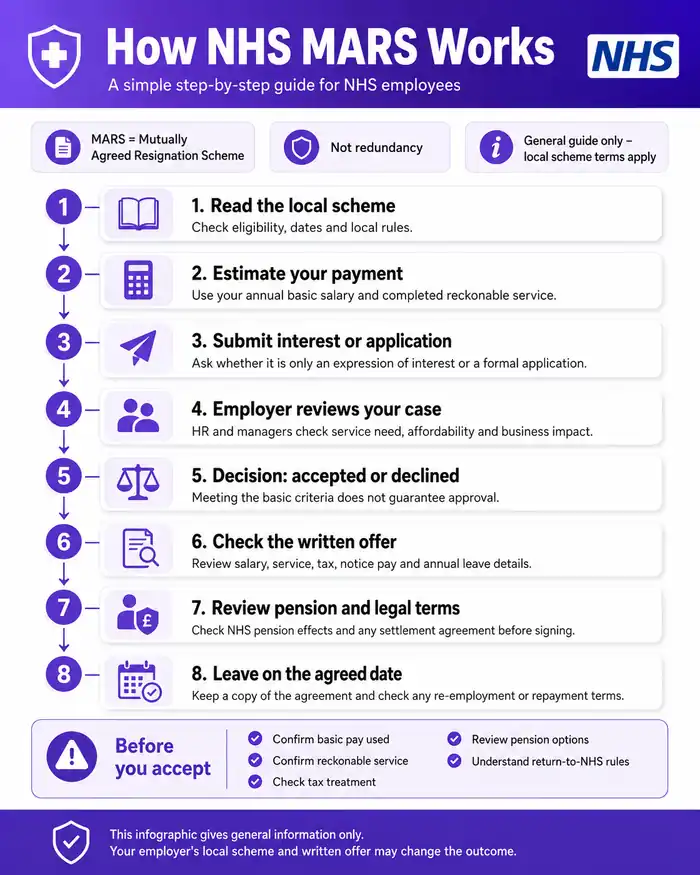
The exact process depends on your employer’s local scheme, but a typical employee journey looks like this:
- Your employer announces a time-limited local MARS scheme.
- You read the policy, eligibility rules and application deadline.
- You calculate an estimated gross payment.
- You submit an expression of interest or application.
- HR verifies your service and salary.
- Managers consider whether your role can be released.
- The organisation checks affordability, service impact and business case.
- Your application is accepted, rejected or queried.
- If accepted, you receive a written offer and calculation.
- You review tax, pension, notice, annual leave and legal terms.
- You may be asked to sign a settlement or compromise agreement.
- Your leaving date and final payroll are confirmed.
NHS England states that local schemes must be time-limited and should not overlap with redundancy consultation. It also requires a business case, affordability and board-level consideration.
Does Registering Interest Commit You?
NHS Employers says registering an interest does not commit employees to proceeding with voluntary severance, and employees can withdraw their application at any time up to the point they sign a compromise agreement.
Still, you should check your local scheme wording. Do not assume that every stage is informal. Ask HR to confirm in writing:
- whether you are submitting an expression of interest or a formal application;
- whether submitting the form creates any obligation;
- the latest point at which you can withdraw;
- whether a signed settlement agreement is required;
- what happens if you change your mind.
Why Might a MARS Application Be Rejected?
Your employer may reject your application even if you meet the basic service requirement. Common reasons may include:
- your role is essential to service delivery;
- your departure would create unacceptable operational risk;
- the saving is not strong enough;
- the post cannot be left vacant or filled by redeployment;
- your department does not meet local scheme criteria;
- the scheme budget is limited;
- the application period has closed;
- you have already resigned or indicated a clear intention to leave;
- formal redundancy consultation or another workforce process affects your position.
NHS Employers says an employee who has already submitted a resignation or clearly indicated they intend to leave is not eligible for a voluntary severance payment under the scheme.
MARS Versus Voluntary Redundancy, Ordinary Resignation and Settlement Agreement
| Point | MARS | Voluntary redundancy | Ordinary resignation | Settlement agreement or negotiated exit |
|---|---|---|---|---|
| Legal nature | Voluntary resignation in return for severance | Redundancy dismissal, where the employer accepts a voluntary leaver | Employee chooses to resign | Legal agreement settling specified claims or exit terms |
| Reason employment ends | Agreement under a local scheme | Redundancy situation | Personal decision to leave | Negotiated resolution |
| Redundancy rights | MARS itself is not redundancy | Redundancy rights may apply | Usually no redundancy rights | Depends on the underlying situation |
| Payment basis | MARS payment table and local terms | NHS redundancy terms may apply where eligible | Usually no severance | Negotiated and itemised |
| Employer can reject request | Yes | Yes, a voluntary redundancy request can be rejected | Usually no, although notice rules apply | Either party can refuse |
| Pension treatment | Treated as voluntary resignation for NHS Pension purposes | Redundancy pension provisions may be relevant if eligible | Normal leaving rules | Depends on the agreement and reason for leaving |
| Settlement agreement | Often used or recommended | May be used | Usually not needed | The main legal document |
| Tax | Depends on payment components | Depends on payment components | Salary and holiday taxed normally | Depends on payment components |
| Return to NHS | Restrictions or clawback may apply | Separate re-employment rules may apply | Usually no MARS clawback | Depends on wording |
| Advice needed | Strongly recommended before signing | Recommended if redundancy or agreement terms are complex | Usually less complex | Independent advice required for a valid statutory settlement waiver |
NHS redundancy is governed separately by Section 16 of the NHS Terms and Conditions of Service Handbook. Current NHS Employers guidance says staff who are made redundant should receive one month’s pay per year of reckonable service, up to 24 months, with only full years counted.
Is MARS Better Than Voluntary Redundancy?
There is no single answer.
MARS may be attractive if you were already planning to leave, retire, change career or reduce work. It may be less attractive if your role is likely to become redundant and you could be entitled to a higher redundancy payment or pension-related redundancy options.
The BMA warns doctors that MARS may be less favourable than voluntary or compulsory redundancy and recommends caution where redundancies or TUPE transfers may be likely.
For any employee, the safest approach is to compare the actual written MARS offer against realistic alternatives, not just against a rough calculator estimate.
Tax on NHS MARS Payments
Do not assume the whole payment is tax-free.
GOV.UK explains that tax and National Insurance treatment depends on what is included in the termination payment. Unpaid wages, holiday pay, bonuses, restrictive-covenant payments and payments instead of working notice can be taxable as earnings.
GOV.UK also explains that the first combined £30,000 of certain qualifying termination payments, such as additional severance or enhanced redundancy payments, may usually be tax-free, with tax due on amounts above that combined total.
Ask Payroll for an Itemised Breakdown
Ask for the offer to separate:
- MARS severance payment;
- salary up to leaving date;
- payment in lieu of notice, if any;
- holiday pay;
- arrears or deductions;
- pension contributions;
- tax and National Insurance deductions;
- any legal-fee contribution paid directly to an adviser.
This matters because a gross MARS estimate does not tell you what you will receive after payroll deductions.
Notice Pay, PILON and Annual Leave
MARS does not automatically answer every final-pay question. You need to check your contract, local scheme and any settlement agreement.
ACAS says employees must be paid as normal for any time they work during their notice period, and that employees should check whether the notice period is statutory or contractual.
If you do not work your full notice, GOV.UK says payments equivalent to what you would have earned during notice can be taxable as Post-Employment Notice Pay or PILON.
ACAS also says employers must pay workers in lieu for untaken statutory holiday entitlement accrued when they leave.
Before accepting MARS, ask:
- Will I work my notice?
- Will I be paid instead of notice?
- Is PILON included in or separate from the MARS payment?
- How much annual leave will I have accrued by the leaving date?
- What happens if I have taken more leave than accrued?
- Which elements will be taxed as earnings?
NHS Pension and MARS
NHSBSA says MARS is not redundancy, is not linked to the NHS Pension Scheme, and is treated as voluntary resignation for NHS Pension purposes.
That does not mean MARS has no pension consequences. Leaving NHS employment can affect contributions, pensionable service, retirement timing and the options available to you. NHSBSA says someone who accepts MARS may be able to apply for actuarially reduced early retirement, age retirement or early payment of preserved benefits on ill-health grounds, depending on eligibility.
Pension Questions to Ask Before You Decide
Ask NHS Pensions, your employer or an appropriate pension adviser:
- Which NHS Pension Scheme section or sections do I have membership in?
- What will my pension estimate be if I leave on the proposed date?
- What happens if I leave my benefits deferred?
- Am I eligible for age retirement or actuarially reduced early retirement?
- Would taking pension now reduce my annual pension?
- Can I transfer benefits to another pension scheme?
- What happens if I return to NHS employment later?
- Will a break affect linked membership?
- Are there annual allowance or tax issues if pension contributions or employer payments are involved?
Do not rely on a colleague’s pension outcome. NHS pension results are individual.
Settlement Agreements and Legal Checks
Your employer may ask you to sign a settlement agreement or compromise agreement before the MARS payment is made.
ACAS explains that, when a worker signs a settlement agreement, they give up the right to bring specified claims in an employment tribunal or court. For the agreement to be legal, the worker must receive advice from a relevant independent adviser on how the agreement affects their rights.
ACAS also says the Code of Practice recommends allowing at least 10 days to consider a settlement agreement.
What to Check Before Signing
Before signing, check:
- the final leaving date;
- the exact gross MARS payment;
- whether the payment is conditional on signing;
- whether notice pay is included or separate;
- whether holiday pay is included or separate;
- whether the agreement says sums are taxable or tax-free;
- who is responsible if HMRC later disagrees with the tax treatment;
- any legal-fee contribution;
- confidentiality wording;
- non-disparagement wording;
- agreed reference wording;
- restrictions on returning to NHS work;
- repayment or clawback wording;
- what claims you are waiving;
- whether whistleblowing or protected disclosures are preserved;
- whether pension issues are expressly excluded from the agreement.
Do not sign only because the headline payment looks right. The surrounding terms can be just as important.
Can You Return to the NHS After Taking MARS?
You may be able to return to NHS employment after MARS, but you must check the restrictions in your local scheme and settlement agreement.
NHS England says the ESR leaving reason should be recorded as “local MARS” so a new employer can identify the need for clawback steps and avoid double-counting reckonable service if the individual takes MARS or is made redundant in future.
Your agreement may include a repayment condition if you return to NHS employment within a certain period. It may also affect how previous service is counted for a later redundancy calculation.
Before Accepting Another NHS Job
Before returning to the NHS, check:
- whether the role is with an NHS employer covered by the agreement;
- whether bank, agency, subsidiary or hosted-body roles are included;
- whether repayment applies to gross or net sums;
- whether repayment is full or proportional;
- whether the salary or band of the new role matters;
- whether the new employer has checked your ESR leaving reason;
- whether future redundancy calculations will offset the earlier MARS payment.
Ask for written confirmation before accepting a new NHS post.
Pros and Cons of NHS MARS
| Possible advantages | Possible disadvantages |
|---|---|
| You may receive a severance payment when ordinary resignation would not provide one. | MARS is not redundancy and may be less valuable than redundancy in some cases. |
| It may suit you if you were already planning to leave, retire or change direction. | Your employer can reject the application. |
| It may give a planned leaving date and agreed terms. | You may be asked to waive claims in a settlement agreement. |
| It may avoid a longer restructure process for some employees. | Tax, pension and final-pay treatment can be more complex than expected. |
| It may help you leave with a defined payment rather than resigning with no severance. | Returning to NHS employment may trigger restrictions or repayment. |
| It may be useful where redundancy is not available or likely. | If redundancy or TUPE rights may be relevant, MARS could be a worse route. |
Before You Apply: Document Checklist
Gather these before making a decision:
- your employer’s local MARS policy;
- the application form or expression-of-interest form;
- the scheme opening and closing dates;
- eligibility and exclusion rules;
- your current contract;
- your most recent payslip;
- confirmation of annual basic salary;
- your NHS service history;
- details of any breaks in NHS service;
- details of any previous redundancy, loss-of-office or MARS payment;
- your annual leave balance;
- your notice period;
- your latest Total Reward Statement or pension estimate;
- any written offer;
- the itemised payment calculation;
- the draft settlement agreement, if provided.
Questions to Ask HR, Payroll, NHS Pensions, Your Union and a Solicitor
Questions for HR
- Am I submitting an expression of interest or a formal application?
- Does this commit me to leaving?
- What is the latest point at which I can withdraw?
- Which local eligibility rules apply to me?
- Could my application be refused because my role is essential?
- Is there any redundancy consultation planned or open?
- Will I need to sign a settlement agreement?
- What re-employment restrictions apply?
Questions for Payroll
- What annual basic salary did you use?
- Did you exclude overtime, on-call and enhancements?
- Did any salary cap apply?
- Is the payment capped?
- How will notice pay be handled?
- How will holiday pay be handled?
- Which parts will be taxed as earnings?
- When will the payment be made?
Questions for NHS Pensions
- What happens if I leave on the proposed date?
- Can I defer my pension benefits?
- Am I eligible to take pension benefits now?
- Would early retirement reduce my pension?
- What happens if I return to NHS employment?
- Do I need an updated pension estimate before signing?
Questions for Your Union
- Has the local scheme been discussed with staff side?
- Are there concerns about redundancy, TUPE or workforce change?
- Is the scheme less favourable than another route?
- Has the employer provided enough information?
- Should I challenge the calculation or process?
Questions for a Solicitor or Independent Adviser
- What claims am I waiving?
- Are the payment and tax clauses clear?
- Is the repayment clause fair and understandable?
- Does the agreement restrict future NHS work?
- Is the reference wording agreed?
- Are confidentiality and non-disparagement clauses reasonable?
- Does the agreement preserve statutory protected disclosures?
- Is the legal-fee contribution enough for proper advice?
Decision Pathway: What Should You Do Next?
If you have only heard the term MARS
Start by reading your employer’s local announcement and calculating a rough gross estimate. Do not assume the scheme applies to you.
If you are considering applying
Check your salary, service, pension position and likely alternatives. Ask whether the scheme overlaps with any restructure, redundancy consultation or TUPE situation.
If you have submitted an application
Wait for the written outcome. Do not resign separately unless you have taken advice and understand the consequences.
If you have received an offer
Ask for an itemised calculation and compare it with your own estimate. Check service, basic pay, caps, tax, notice, annual leave, pension and repayment wording.
If you have received a settlement agreement
Do not sign until you have had independent advice and understand what claims, restrictions and repayment terms you are accepting.
Final Checklist Before You Accept NHS MARS
Before you accept a MARS offer, make sure you can answer these questions:
- Do I know whether this is definitely MARS and not redundancy?
- Have I read the current local scheme document?
- Have I checked my complete reckonable service?
- Have I checked the basic salary figure used?
- Have I checked whether caps apply?
- Have I received an itemised gross payment calculation?
- Do I understand what will be taxed?
- Do I know how notice pay will be handled?
- Do I know how annual leave will be handled?
- Have I checked my NHS pension options?
- Have I checked benefits or insurance consequences?
- Do I understand the settlement agreement?
- Do I understand the claims I am waiving?
- Do I understand re-employment restrictions?
- Do I understand repayment or clawback wording?
- Have I spoken to HR, payroll, NHS Pensions, my union or an independent adviser where appropriate?
FAQs
What does MARS mean in the NHS?
MARS means Mutually Agreed Resignation Scheme. It is a voluntary severance arrangement where an employee agrees with their NHS employer to resign in return for a severance payment.
Is NHS MARS the same as redundancy?
No. NHS England states that mutually agreed resignation is not redundancy or voluntary redundancy. Redundancy is covered separately under Section 16 of the NHS Terms and Conditions of Service Handbook.
How is an NHS MARS payment calculated?
The current official MARS payment table uses complete years of reckonable service and several months of basic salary. The table starts at three months’ basic salary for one to six completed years and reaches 12 months at 24 completed years.
What counts as reckonable service?
NHS Employers describes reckonable service for MARS as continuous full-time or part-time employment with your present or previous NHS employer where there has been a break in service of 12 months or less at the time of leaving. Service already used for a previous redundancy or loss-of-office payment does not count again.
What counts as basic salary?
Basic pay is the pay based on your pay scale or band as stated on your payslip. NHS Employers says it does not include several additional payments, including overtime, on-call, acting-up, enhancements and recruitment and retention premia.
Is an NHS MARS payment tax-free?
Some qualifying severance may fall within the £30,000 termination-payment threshold, but you should not assume the whole payment is tax-free. GOV.UK says wages, holiday pay, bonuses and notice-related payments can be taxable as earnings.
Sources and Review Note
This article was last reviewed against current official and reputable sources, including NHS England MARS guidance, NHS Employers Section 20 guidance, the NHS Terms and Conditions of Service Handbook, NHSBSA pension guidance, GOV.UK termination-payment tax guidance and ACAS settlement/final-pay guidance.
Because MARS involves employment rights, pension choices, tax treatment and local scheme discretion, this page should be reviewed at least every six months and sooner if NHS England, NHS Employers, NHSBSA, HMRC, GOV.UK or ACAS update relevant guidance.