NHS Voluntary Redundancy: Pay, Pension and Eligibility
A voluntary redundancy offer can look attractive when you first see the estimated payment. However, the headline figure is only one part of the decision.
Your NHS service history, current working hours, pension position, redeployment options, tax treatment and plans to return to NHS employment can all affect the final outcome. A settlement agreement or local clawback condition may also place restrictions on what you can do after leaving.
This guide explains how NHS voluntary redundancy generally works in England, particularly for employees covered by Agenda for Change. It also covers issues affecting NHS England, Integrated Care Board, Commissioning Support Unit and NHS Trust employees.
Important: National NHS redundancy terms provide the starting point, but your employer may operate a local voluntary redundancy scheme with additional conditions. Always obtain the complete written scheme, calculation and proposed agreement before making a final decision.
NHS voluntary redundancy: the quick answer
NHS voluntary redundancy allows an employee to ask to leave where their employer is reducing roles or reorganising services. Although you volunteer, your employer does not have to approve your application.
Under the standard Section 16 Agenda for Change terms in England, contractual NHS redundancy pay is normally based on:
One month’s pay × each complete year of reckonable service
You generally need at least two years of continuous full-time or part-time NHS service. A maximum of 24 complete years of reckonable service can normally be included. Part-years are disregarded. Current Section 16 rules also apply an annual full-time-equivalent pay floor of £23,000 and a cap of £80,000, with pro-rating for part-time employees.
That formula does not confirm what you will receive. Your employer must first check:
- whether you qualify under the scheme
- whether your application can be released without harming services
- which NHS employment counts
- whether any service has already been used for redundancy, severance or pension benefits
- whether suitable alternative employment is available
- whether local settlement or clawback conditions apply
Is voluntary redundancy guaranteed?
No.
Submitting an expression of interest or formal application does not give you an automatic right to leave with redundancy pay. Your employer may reject the application because:
- your post still needs to exist
- your knowledge or skills are difficult to replace
- releasing you would create a clinical, operational or financial risk
- the proposed workforce saving would not be achieved
- another employee’s departure would produce a better organisational outcome
- there is suitable alternative employment available
- the local scheme’s eligibility conditions are not met
The RCN confirms that seeking volunteers is a legitimate way to reduce compulsory redundancies, but an employee is not guaranteed approval simply because they volunteer.
The five questions that matter most
Before concentrating on the estimated lump sum, answer these questions:
- Do I appear to meet the eligibility and service rules?
- Which salary and complete service years has my employer used?
- What happens to my NHS pension if I leave?
- Could redeployment, re-employment or a clawback clause affect the payment?
- Is voluntary redundancy better for me than waiting, redeployment, retirement or MARS?
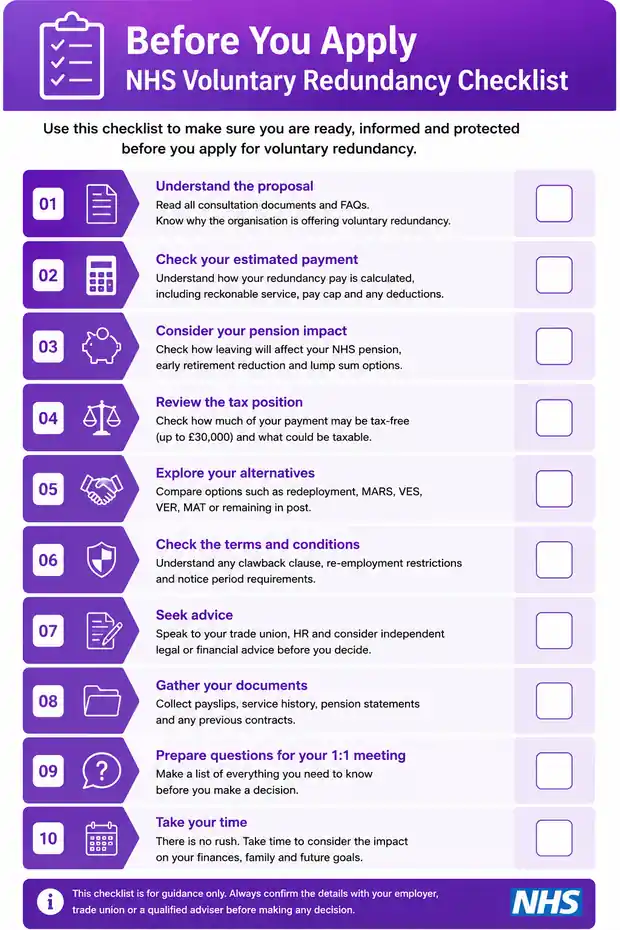
Before you apply: NHS voluntary redundancy checklist
Ask for the following information before submitting an irreversible application or accepting an offer.
| Check | Why it matters |
|---|---|
| Complete voluntary redundancy policy | Local rules may differ from the basic Section 16 position |
| Written payment estimate | You need to see the salary, service and formula used |
| Continuous-service date | This helps establish initial eligibility |
| Reckonable-service breakdown | Not all previous service will necessarily count |
| List of excluded service | Previous redundancy, MARS or pension benefits may affect the calculation |
| Current WTE or FTE | Part-time pay limits and payment calculations must be pro-rated correctly |
| Pension estimate | The long-term pension impact may outweigh the immediate cash payment |
| Capitalisation-cost estimate | Taking an unreduced early pension may use some or all of the redundancy payment |
| Redeployment position | Suitable alternative employment can affect entitlement |
| Clawback wording | Returning to covered employment could trigger repayment |
| Settlement agreement | The agreement may waive employment claims and add restrictions |
| Tax breakdown | Redundancy pay, notice pay and holiday pay are not necessarily taxed in the same way |
| Notice arrangements | Confirm whether you will work notice or receive PILON |
| Annual leave calculation | Check whether leave must be taken or will be paid |
| Application withdrawal rules | Some applications become binding at a specified point |
| Appeal or review process | You may need to challenge an incorrect calculation or refusal quickly |
Do not rely only on a verbal discussion. Ask for the important points in writing.
What does NHS voluntary redundancy mean?
Redundancy occurs where an employer’s need for employees to perform work of a particular kind has ceased or reduced, or is expected to cease or reduce. It can also arise where the employer closes a business or workplace. Section 16 states that a contractual redundancy payment is available only where the employee is dismissed by reason of redundancy.
Voluntary redundancy means the employer asks for volunteers before, or as part of, a process that may otherwise lead to compulsory redundancies.
Although you agree to be considered, the legal reason for ending the employment should still be redundancy if the arrangement is genuinely voluntary redundancy.
Voluntary redundancy versus compulsory redundancy
The standard contractual payment formula may be the same, depending on the scheme. The main difference is how you are selected.
With voluntary redundancy:
- you put yourself forward
- the employer decides whether to approve the application
- the departure date may be agreed
- the employer may require a settlement agreement under a local scheme
With compulsory redundancy:
- the employer selects employees through a redundancy process
- consultation and selection rules become especially important
- you may have appeal rights under the local procedure
- a settlement agreement is not automatically required for an ordinary redundancy dismissal
Do not assume that volunteering will always produce a higher payment. Compare the written voluntary offer with the contractual terms that could apply if you were later made compulsorily redundant.
Voluntary redundancy versus voluntary severance
The distinction matters.
Voluntary redundancy is connected to a genuine redundancy situation. Voluntary severance involves an agreed resignation in return for a payment and may not provide the same contractual or pension rights.
MARS, for example, is a form of voluntary severance. NHSBSA and NHS England state that MARS is not redundancy; for pension purposes, the employee is treated as voluntarily resigning.
Who may be eligible for NHS voluntary redundancy?
Your eligibility depends on your employment status, contractual terms, service history and the rules of the scheme being offered.
Agenda for Change employees
Section 16 applies to eligible employees covered by the NHS Terms and Conditions of Service Handbook in England.
Under the standard provisions, you must generally:
- be an employee working under a contract of employment for an NHS employer
- be dismissed because of redundancy
- have at least two years of continuous full-time or part-time service by the termination date
- not fall within one of the exclusions relating to suitable alternative employment or early departure
Contracts can be permanent or fixed-term. The handbook states that a fixed-term contract can potentially qualify where its termination is because of redundancy and the employee meets the continuous-service requirement.
NHS England, ICB and CSU employees
Employees of NHS England, Integrated Care Boards and Commissioning Support Units may be offered voluntary redundancy through organisation-specific programmes.
These programmes can contain additional provisions covering:
- application windows
- organisational approval
- required departure dates
- settlement agreements
- re-employment and re-engagement
- public-sector work
- clawback periods
- repayment calculations
- professional registration
- references and equipment
- lease-car arrangements
The RCN has warned that voluntary redundancy model schemes used during NHS system changes may contain wider or longer clawback arrangements than standard NHS terms. It has also raised concerns about using settlement agreements as part of the process.
Treat the local scheme as essential reading. Do not assume that the policy used by a neighbouring ICB or another NHS organisation applies to you.
NHS Trust and Foundation Trust employees
A Trust can invite voluntary redundancy applications as part of workforce restructuring, but approval will normally depend on whether the post can genuinely be removed.
The Trust may consider:
- patient and service safety
- workforce establishment
- skill mix
- vacancy levels
- recruitment difficulties
- cost of the exit
- the time needed to recover the payment through savings
- whether another at-risk employee could be redeployed into the vacancy
Part-time employees
Part-time work does not prevent you from qualifying. Section 16 expressly recognises continuous full-time and part-time service.
Your years of service do not normally shrink because you worked fewer hours. However, your pay figure and the salary floor or cap are pro-rated according to your part-time status.
Fixed-term employees
A fixed-term employee should generally be treated in the same way as a permanent employee where:
- the reason the contract ends is redundancy
- the employee has the required continuous service
- the contractual scheme applies
A fixed-term contract ending naturally is not automatically a redundancy in every case. Ask the employer to confirm the reason for termination.
Bank, agency and casual workers
The NHS Terms and Conditions of Service Handbook does not provide standard contractual redundancy arrangements for bank staff. Entitlement will therefore depend on employment status, the local contract and the employer’s policies. Agency workers, casual workers and people on zero-hours arrangements may not have employee status for statutory redundancy purposes.
Obtain individual advice rather than assuming that regular bank shifts automatically create Section 16 entitlement.
How NHS redundancy pay is usually calculated
The standard Section 16 formula is:
One month’s pay × complete years of reckonable service
The following limits normally apply:
- at least two years of continuous service are required
- no more than 24 complete years of reckonable service are counted
- fractions of a year are ignored
- a full-time-equivalent salary floor of £23,000 applies
- a full-time-equivalent salary cap of £80,000 applies
- the figures are pro-rated for part-time employees
- no standard payment can exceed £160,000 before part-time pro-rating
These are the current England handbook provisions at the time of review.
What counts as one month’s pay?
Under Section 16, a month’s pay is whichever of the following is more beneficial:
- One-twelfth of annual salary at the termination date, or
- 4.35 times a week’s pay, calculated under the relevant Employment Rights Act provisions.
Normal contractual working hours and contractual payments may be included. NHS Employers says this can include unsocial-hours pay where it forms part of normal working hours. Overtime would not normally count unless the employer is contractually required to offer it and the employee is contractually required to work it.
Ask payroll for both calculations if regular enhancements make a material difference.
Simple NHS redundancy calculation example
An employee has:
- annual pay of £36,000
- 11 complete years of reckonable service
- full-time status
- no excluded service
One month’s pay:
£36,000 ÷ 12 = £3,000
Estimated contractual redundancy payment:
£3,000 × 11 = £33,000
This is a gross estimate. It does not account for tax on other termination-payment components, pension capitalisation, clawback or a local scheme variation.
The full-year service rule
Only complete years count.
For example:
- 8 years and 11 months becomes 8 complete years
- 12 years and 2 months becomes 12 complete years
- 24 years and 9 months remains capped at 24 years
The termination date can therefore affect whether another complete year is reached. However, do not assume that an employer must change the leaving date to increase the payment.
NHS redundancy pay floor
Where full-time-equivalent annual earnings are below £23,000, the standard payment is calculated using a notional full-time salary of £23,000.
For a full-time employee with six complete years:
£23,000 ÷ 12 = £1,916.67
£1,916.67 × 6 = approximately £11,500
For part-time staff, the £23,000 figure is pro-rated.
NHS redundancy pay cap
Where full-time-equivalent annual earnings exceed £80,000, the standard calculation uses £80,000.
For an eligible full-time employee with 15 complete years:
£80,000 ÷ 12 = £6,666.67
£6,666.67 × 15 = approximately £100,000
The standard maximum of 24 years at the £80,000 cap produces £160,000. A part-time maximum is pro-rated according to WTE.
Continuous service versus reckonable service
These terms sound similar, but they answer different questions.
| Term | What it normally decides | Basic rule |
|---|---|---|
| Continuous service | Whether you meet the initial qualifying period | You normally need at least two years; previous NHS employment can remain continuous where there has not been a break of a week or more |
| Reckonable service | How many complete years are used to calculate the payment | Previous NHS employment may count where a break was 12 months or less, subject to exclusions |
Section 16 states that working part time does not, by itself, break continuity. Previous continuous employment with different NHS employers may count where there has not been a break of a week or more, measured Sunday to Saturday.
What is continuous NHS service?
Continuous service is mainly used to check whether you have met the minimum qualifying period.
Suppose you worked:
- three years at NHS Trust A
- moved directly to NHS Trust B
- worked one further year at Trust B
If there was no relevant break, the four years may form one continuous period.
If there was a break of a week or more between the jobs, the earlier employment may not count towards the two-year continuous-service test, although it could potentially remain reckonable for the payment calculation.
What is reckonable NHS service?
Reckonable service is the eligible service used to calculate the redundancy payment.
It can normally include:
- continuous full-time NHS employment
- continuous part-time NHS employment
- employment with current and previous NHS employers
- earlier NHS employment where the break was 12 months or less
- certain relevant non-NHS employment, but only where the employer exercises its discretion
The break itself does not count as service.
Service that may be excluded
Service may not count where it has already been used for:
- a previous NHS redundancy payment
- a previous loss-of-office payment
- NHS pension benefits already taken
NHS Employers also explains that a previous MARS payment may need to be offset against a later redundancy calculation under the relevant handbook provisions.
Example: a break in NHS service
An employee has:
- four years with an NHS Trust
- a six-month break
- three years with an ICB before redundancy
The three recent years may satisfy the continuous-service requirement.
Because the earlier break was no more than 12 months, the previous four years may also count as reckonable service, producing seven complete reckonable years, provided none of that earlier service is excluded.
The employer should confirm the exact dates and exclusions in writing.
How voluntary redundancy works for part-time NHS staff
Part-time service can count in complete calendar years in the same way as full-time service. Your payment is then based on the applicable part-time pay.
Part-time example
An employee has:
- £30,000 full-time-equivalent salary
- 0.6 WTE
- actual annual salary of £18,000
- eight complete years of reckonable service
Estimated month’s pay:
£18,000 ÷ 12 = £1,500
Estimated redundancy payment:
£1,500 × 8 = £12,000
The employee should still ask whether the alternative 4.35-times-weekly-pay calculation would be more beneficial.
What if your hours changed?
Where you worked full time for many years but reduced your hours before redundancy, do not assume that the payment will be calculated separately for each historic working pattern.
The standard formula generally focuses on the applicable pay at termination. That means a recent reduction in hours can materially affect the payment.
Ask HR or payroll to confirm:
- the termination-date WTE
- the annual salary used
- whether any contractual pay protection applies
- whether a flexible-retirement or family-leave arrangement changes the calculation
- whether the alternative weekly-pay method is more beneficial
More than one NHS role
Concurrent employment can create complicated pension and redundancy questions.
You may be made redundant from one role while continuing in another. NHS pension options can differ depending on whether you end all pensionable employment or only the post being removed.
Ask for separate calculations for each contract rather than combining the jobs yourself.
Is NHS redundancy pay taxable?
The tax treatment depends on what each part of your leaving package represents.
Up to £30,000 of qualifying redundancy or termination payments can generally be paid free of Income Tax. However, this does not mean that the first £30,000 of everything shown on your final payslip will automatically be tax-free.
Payments such as the following are normally treated separately:
- salary up to the leaving date
- payment instead of notice
- holiday pay
- unpaid wages
- bonuses
- taxable benefits
- other contractual earnings
GOV.UK confirms that termination packages can contain several components and that tax and National Insurance depend on what is included. The employer is responsible for applying the correct payroll treatment.
Example tax breakdown
Suppose your package contains:
- £28,000 qualifying redundancy payment
- £6,000 payment instead of notice
- £2,000 holiday pay
The redundancy element may fall within the £30,000 exemption, but the PILON and holiday pay will generally be treated as taxable earnings.
Ask for an itemised schedule showing:
- contractual redundancy pay
- statutory redundancy element
- PILON
- annual leave
- salary or arrears
- pension contribution or capitalisation
- taxable and non-taxable totals
Do not make a financial commitment based on the gross headline figure.
What happens to your NHS pension?
Your pension decision could be more important than the redundancy payment itself, particularly if you are close to retirement.
NHSBSA says an eligible NHS Pension Scheme member may have up to three broad options:
- defer the pension
- take an early pension with a reduction
- retire on redundancy terms where the contractual and pension conditions allow it
Option 1: Keep the redundancy payment and defer your pension
You may be able to:
- receive the redundancy payment
- leave the pension benefits preserved
- claim them later under the applicable scheme rules
This can protect more of the future annual pension, but you will need another source of income until the pension begins.
Option 2: Take an actuarially reduced early pension
You may be able to take pension benefits before normal pension age, subject to scheme eligibility.
The pension is usually reduced because it is expected to be paid for longer. The reduction can apply for life, so compare the immediate income with the long-term cost.
Option 3: Use the redundancy payment towards an unreduced pension
Where Section 16’s conditions are met, the redundancy payment can be used to buy out some or all of the actuarial reduction.
The cost of paying the pension early is known as a capitalisation cost.
If the redundancy payment is greater than the cost, you may receive the remaining balance. If it is insufficient, the pension may remain partly reduced unless you are allowed and choose to pay the difference from personal funds before the pension is paid.
NHSBSA states that the employer’s responsibility for capitalisation costs is limited so it cannot exceed the employee’s redundancy payment under the relevant England arrangements.
Pension questions to answer before applying
Obtain written confirmation of:
- which NHS Pension Scheme sections hold your benefits
- your minimum pension age
- your estimated pension if deferred
- your estimated pension if taken immediately with a reduction
- the capitalisation cost
- how much of the redundancy payment would remain
- whether you can pay any shortfall
- the deadline for choosing an option
- how future NHS employment might affect the pension
- whether the McCloud remedy affects the estimate
Partial retirement warning
Partial retirement allows eligible members to take some or all of their pension benefits while continuing to work and build further benefits.
However, service already used to provide NHS pension benefits may not be available again as reckonable service for a later contractual redundancy payment. NHS Employers specifically identifies this issue when discussing partial retirement and retired-and-returned staff.
Do not calculate your own entitlement by counting every year since you first joined the NHS. Ask the employer to identify exactly which service remains available.
Clawback and returning to NHS work
A clawback clause requires you to repay some or all of a redundancy or severance payment if a specified event happens after you leave.
The standard Section 16 terms and local model-scheme clawback rules should not be treated as identical.
Standard Section 16 position
Under Section 16, an employee is not entitled to redundancy pay where suitable alternative NHS employment:
- has been obtained without a break, or
- starts after a break of no more than four weeks
Entitlement can also be lost where the employee unreasonably refuses to accept or apply for suitable alternative NHS employment brought to their attention. Before payment, the employee may be required to certify that the relevant alternative-employment condition has not been breached and undertake to refund the payment if the statement proves incorrect.
Local model-scheme clawback
A local voluntary redundancy scheme may go further.
It might cover:
- a longer restricted period
- a wider range of NHS bodies
- DHSC or other public-sector employers
- direct employment
- agency work
- consultancy
- office-holder appointments
- re-engagement through another organisation
- full or proportionate repayment
The RCN has reported concerns that model schemes affecting NHSE, CSU and ICB staff may have wider employer coverage and longer restrictions than existing NHS contractual terms.
Questions to ask about clawback
Ask HR to confirm in writing:
- How long does the restriction last?
- Which employers are covered?
- Does the restriction include another NHS Trust or ICB?
- Does it include DHSC or other public-sector organisations?
- Does bank, agency, consultancy or contractor work count?
- Does unpaid or voluntary work count?
- Is repayment full or proportionate?
- When does the period begin?
- Does it apply when an offer is accepted or when employment begins?
- Who decides whether repayment is due?
- Is there an appeal or waiver process?
- Does the restriction also affect pension arrangements?
Do not accept a verbal statement that returning “should be fine”. Obtain the exact contractual wording.
Settlement agreements and voluntary redundancy
A settlement agreement is a legally binding agreement between an employer and employee. It often records:
- the employment termination date
- the payment
- tax treatment
- notice and holiday arrangements
- confidentiality obligations
- an agreed reference
- restrictions after employment
- the legal claims the employee agrees not to pursue
For a settlement agreement to validly waive employment claims, it must be in writing, relate to specific claims and meet statutory conditions. The employee must receive advice from a relevant insured independent adviser, and the agreement must identify that adviser.
Settlement agreement checklist
Before signing, check the following.
| Clause | What to confirm |
|---|---|
| Termination date | Exact last day of employment and continuity implications |
| Redundancy payment | Gross figure, service and salary used |
| Notice | Worked notice or payment in lieu |
| Annual leave | Days owed, taken or paid |
| Tax | Which amounts are taxable and who bears additional liabilities |
| Pension | Any retirement election, capitalisation or pension application |
| Clawback | Period, employers, work types and repayment formula |
| Claims waived | Each legal claim covered by the agreement |
| Confidentiality | What you may discuss and with whom |
| Protected disclosures | Wording must not unlawfully prevent protected whistleblowing |
| Reference | Final wording and who may provide it |
| Announcement | What colleagues or external contacts will be told |
| Future employment | Re-employment, re-engagement and application restrictions |
| Legal costs | Employer contribution and whether it covers negotiation |
| Property | Laptop, phone, ID cards, records and equipment |
| Lease car | Return date, fees and early-termination costs |
| Professional matters | Registration, investigations and reporting duties |
Independent advice should involve more than confirming that you understand the document. Tell your adviser about anything that may affect your decision, including:
- discrimination concerns
- whistleblowing
- disability or reasonable adjustments
- maternity or family-leave protection
- an existing grievance
- incorrect service calculations
- selection concerns
- redeployment disputes
- unpaid contractual sums
Redeployment and suitable alternative employment
NHS employers are expected to look for suitable alternative employment before making an employee redundant.
Suitability can depend on:
- pay and benefits
- band or status
- duties and responsibilities
- hours and flexibility
- workplace location
- travel time and cost
- your skills and qualifications
- training requirements
- health, disability or caring circumstances
- contractual terms
- career impact
Section 16 says personal circumstances should be considered, although employees are expected to show some flexibility.
Can you refuse redeployment?
You can explain why you believe an alternative role is unsuitable. However, an unreasonable refusal may result in loss of redundancy pay.
Do not simply reject the role verbally. Set out your reasons in writing and support them with evidence where possible.
For example:
- the salary is materially lower
- contractual benefits are lost
- the location creates an unreasonable journey
- the hours conflict with established caring responsibilities
- you lack required qualifications
- health restrictions cannot be accommodated
- the responsibilities are substantially different
- the proposed training would not make the role suitable
Do you have to apply?
General ACAS guidance says suitable alternative employment should normally be offered rather than requiring an ordinary competitive application. However, Section 16 contains wording under which failure to make a necessary application for suitable alternative NHS employment brought to your attention can be treated as refusal.
Ask your employer to explain the process and how it complies with the contractual scheme.
Four-week trial period
You normally have the right to a four-week trial period in an alternative role.
If additional training is needed, an extended trial can be agreed in writing with a clear end date. Remaining in the role beyond the applicable trial period can cause you to lose the right to redundancy.
Before beginning the trial, obtain written confirmation of:
- start and end dates
- objectives
- training
- reporting arrangements
- pay and expenses
- how concerns will be reviewed
- what happens if the trial is unsuccessful
- whether redundancy entitlement remains protected
NHS voluntary redundancy versus MARS and other exit routes
The name attached to an exit scheme can change your employment, payment and pension rights.
| Exit route | How employment ends | Main payment basis | Key issue |
|---|---|---|---|
| Voluntary redundancy | Dismissal because of redundancy after volunteering | Usually Section 16 or local redundancy scheme | Approval is not guaranteed |
| Compulsory redundancy | Employer dismisses because the role is redundant | Contractual and statutory redundancy rules | Fair consultation and selection are important |
| MARS | Voluntary resignation by agreement | Local severance formula | It is not redundancy and is not linked to redundancy pension rights |
| VES | Voluntary exit under scheme terms | Scheme-specific | Check whether it is redundancy or severance |
| VER | Early retirement by agreement | Pension and local employer rules | Pension reduction or employer cost may apply |
| MAT | Mutually agreed termination | Individually negotiated or scheme-based | Usually involves a settlement agreement |
| Redeployment | Employment continues in another role | No redundancy payment if suitable role accepted | Check suitability, pay protection and trial period |
| Interest of efficiency | Employer-discretionary early retirement | Pension may be paid without reduction; no redundancy payment under Section 16 | Not an employee entitlement |
Is voluntary redundancy better than MARS?
Neither route is automatically better.
Voluntary redundancy may be more appropriate where:
- your role is genuinely redundant
- you qualify for Section 16
- you have substantial reckonable service
- redundancy pension provisions could assist you
- the contractual payment is more favourable
MARS may be worth considering where:
- no redundancy entitlement currently exists
- the organisation is offering an approved MARS
- you want to resign voluntarily
- the severance figure is acceptable
- the pension and re-employment consequences have been checked
NHS England’s current MARS guidance says MARS is voluntary severance, not voluntary redundancy. It also states that severance payments should not be made where the circumstances entitle the employee to contractual redundancy payment or NHS redundancy pension benefits.
Where your employer is discussing more than one exit route, use the NHS MARS calculator to estimate a possible MARS payment. Compare the result with your employer’s written voluntary redundancy calculation rather than assuming the two schemes use the same rules.
ICB, NHS England and CSU voluntary redundancy
ICB, NHS England and CSU employees should pay particular attention to local model-scheme documentation.
Your scheme may specify:
- which roles or teams are in scope
- whether you can submit only an expression of interest or a binding application
- who approves departures
- how affordability is assessed
- whether applications are ranked
- the latest leaving date
- notice arrangements
- whether a settlement agreement is mandatory
- whether applications can be withdrawn
- a wider clawback provision
- restrictions on work across the NHS or public sector
Why an application may be rejected
An organisation may approve the removal of particular posts rather than simply approving everyone who wants to leave.
For example, two employees might apply, but only one post can safely be removed. The employer may consider which departure:
- delivers a genuine recurring saving
- avoids compulsory redundancy elsewhere
- supports the future structure
- does not create an unacceptable capability gap
- can be implemented within the required timetable
Request the decision criteria at the start of the consultation rather than waiting until after an unsuccessful application.
Local terms versus Section 16
Ask the employer to identify clearly:
- which terms come directly from Section 16
- which terms form part of the local voluntary redundancy scheme
- which terms are contained only in the settlement agreement
- which terms have been agreed with recognised trade unions
- which terms remain under consultation
Where the local scheme appears less favourable than your contractual rights, seek union or legal advice before agreeing to it.
NHS voluntary redundancy process: step by step
Step 1: The employer announces organisational change
The organisation explains the proposed structure, reasons for change, affected roles and expected timetable.
At this stage, proposals may still change.
Step 2: Consultation begins
Consultation should be genuine and meaningful. It is an opportunity to:
- understand why your role is affected
- challenge errors
- suggest alternatives
- ask about redeployment
- understand selection criteria
- request a redundancy estimate
- discuss voluntary options
ACAS says consultation should take place before final redundancy decisions are made.
Step 3: The voluntary scheme opens
You may be invited to:
- express a non-binding interest
- request an estimate
- submit a formal application
- choose a preferred leaving date
- provide reasons for applying
Confirm when the application becomes binding.
Step 4: The employer assesses applications
The employer reviews service needs, affordability, workforce structure and scheme conditions.
Step 5: You receive the decision
If approved, ask for:
- formal written approval
- proposed termination date
- full payment calculation
- service breakdown
- pension forms or estimate
- notice and annual-leave arrangements
- settlement agreement
- clawback conditions
If refused, ask for the reason and whether there is a review or appeal process.
Step 6: Complete pension and legal checks
Do not sign until you understand:
- the long-term pension effect
- the net payment
- the effect of future employment
- the claims being waived
- any repayment risk
Step 7: Notice and leaving arrangements are agreed
Confirm whether you will:
- work your notice
- receive PILON
- take annual leave
- receive payment for unused leave
- leave on a mutually agreed earlier date
Leaving before your notice expires without formal agreement can affect Section 16 entitlement.
Step 8: Payment and pension are processed
Check your final payslip and compare it with the settlement schedule.
Raise discrepancies promptly. Section 16 allows an employee who disputes the calculation or rejection of a redundancy claim to use the local grievance procedure. It also provides for recalculation where a retrospective pay award is announced after termination.
Questions to ask at your one-to-one meeting
Eligibility and approval
- Is this a genuine redundancy situation?
- Is my role formally at risk?
- Am I eligible to apply?
- Is this an expression of interest or a binding application?
- Can the employer reject my application?
- What criteria will be used?
- Who makes the final decision?
- Can I appeal or request a review?
Service and payment
- What is my recognised continuous-service date?
- How many complete reckonable years will be counted?
- Which service has been excluded and why?
- Has any previous MARS, redundancy or pension event affected the figure?
- Which salary and WTE have been used?
- Has the £23,000 floor or £80,000 cap been applied?
- Has payroll compared both definitions of a month’s pay?
- Do regular unsocial-hours payments count?
Pension
- Which pension options are available?
- Can I obtain estimates for each option?
- What is the capitalisation cost?
- How much redundancy cash would remain?
- Has partial retirement reduced my reckonable service?
- What are the deadlines for submitting pension forms?
Redeployment
- Which vacancies have been considered?
- How will suitable alternative employment be assessed?
- Is pay protection available?
- Will I receive a four-week trial?
- What happens if the role proves unsuitable?
- Could refusing or not applying affect my payment?
Settlement and clawback
- Is a settlement agreement mandatory?
- Which claims am I being asked to waive?
- How much will the employer contribute to legal advice?
- What is the clawback period?
- Which employers and work arrangements are covered?
- Is repayment full or proportionate?
- Can the employer waive clawback in exceptional circumstances?
The RCN recommends taking notes, asking for agreed actions in writing and making clear when you are only exploring an option rather than making a binding decision.
Documents to collect before applying
Create one folder containing:
Employment records
- current employment contract
- variation letters
- latest job description
- organisational change policy
- redundancy policy
- redeployment policy
- pay-protection policy
- consultation documents
Service evidence
- ESR employment history
- start and end dates for previous NHS roles
- contracts from earlier NHS employers
- P45s or payslips where dates are disputed
- evidence relating to employment breaks
- previous redundancy or MARS documents
Pay records
- recent payslips
- annual salary statement
- WTE confirmation
- regular enhancement history
- salary-sacrifice arrangements
- written redundancy calculation
Pension records
- Total Reward Statement
- Annual Benefit Statement
- formal pension estimate
- partial-retirement documents
- retirement-and-return records
- capitalisation estimate
Exit documents
- formal application
- approval letter
- settlement agreement
- tax schedule
- reference
- clawback undertaking
- notice letter
- annual-leave calculation
Example NHS voluntary redundancy scenarios
The examples below illustrate calculation issues only. They do not confirm entitlement.
Example 1: Full-time employee with 11 years’ service
- annual salary: £36,000
- complete reckonable service: 11 years
- estimated month’s pay: £3,000
- estimated payment: £33,000
Main check: Ask for the tax breakdown because the estimate exceeds £30,000.
Example 2: Part-time employee
- FTE salary: £30,000
- WTE: 0.6
- Actual salary: £18,000
- Complete reckonable service: 8 years
- Estimated month’s pay: £1,500
- Estimated payment: £12,000
Main check: Confirm current WTE and whether the weekly-pay calculation produces a better result.
Example 3: Six-month service break
- first NHS role: 5 complete years
- break: 6 months
- latest NHS role: 4 complete years
The latest four years may satisfy continuous-service eligibility. Because the break was no more than 12 months, the earlier five years may also be reckonable.
Possible total: 9 complete reckonable years.
Main check: Confirm that the earlier service was not used for a previous payment or pension benefit.
Example 4: Previous MARS payment
An employee received MARS after ten years, returned to NHS work and later faces redundancy.
The employee should not assume that all service before MARS can be used again. The previous MARS payment may affect a later redundancy calculation.
Main check: Ask for a written explanation of the service excluded and any offset.
Example 5: Partial retirement
An employee has worked for 25 years but used part of that service to take partial-retirement benefits.
Service already used to calculate pension benefits may be excluded from the redundancy calculation.
Main check: Ask HR and NHS Pensions to identify the post-retirement service available.
Example 6: Lower-paid alternative role
An employee at Band 7 is offered a Band 6 role at another site.
Suitability will depend on more than the band. Relevant issues include:
- actual pay and pay protection
- responsibilities
- location
- travelling costs
- hours
- employee circumstances
- training
Main check: Obtain the offer and pay-protection terms in writing before refusing it.
Example 7: Planning to return to NHS work
An employee accepts voluntary redundancy and intends to take an NHS role two months later.
That may fall outside the standard four-week Section 16 condition, but a local model-scheme clawback may last longer and cover more organisations.
Main check: Review the local clawback clause rather than relying only on Section 16.
Common NHS voluntary redundancy mistakes
Looking only at the lump sum
A large payment may be less attractive after considering pension loss, tax, lost salary and the time needed to find another role.
Assuming your application must be accepted
The employer can reject voluntary applications based on service and workforce requirements.
Counting part-years
Only complete reckonable years normally count.
Confusing continuous and reckonable service
Continuous service establishes initial eligibility. Reckonable service determines the number of years used in the calculation.
Using the FTE salary as actual part-time pay
Part-time calculations must be pro-rated correctly.
Counting service twice
Service used for previous redundancy, loss-of-office payments or pension benefits may be excluded.
Rejecting redeployment too quickly
An unreasonable refusal or failure to follow the required process can affect redundancy entitlement.
Assuming the entire package is tax-free
PILON, annual leave and other employment earnings can be taxable even where the redundancy element is within £30,000.
Ignoring the settlement agreement
The agreement may waive claims and contain restrictions beyond the redundancy policy.
Missing the clawback clause
Plans to return to NHS, public-sector, agency or consultancy work could create repayment risk.
Treating MARS as redundancy
MARS is voluntary resignation with severance, not voluntary redundancy.
Relying on verbal assurances
Important decisions about service, pension, tax and future employment should be confirmed in writing.
FAQs
Is NHS voluntary redundancy guaranteed?
No. Your employer can reject your application because of workforce requirements, affordability, service safety, your skills or the inability to remove your post. Volunteering does not create an automatic entitlement.
How is NHS voluntary redundancy pay calculated?
Under standard Section 16 terms, it is generally one month’s pay for every complete year of reckonable service, up to 24 years. A full-time-equivalent salary floor of £23,000 and cap of £80,000 normally apply, with part-time pro-rating.
How many years of NHS service count?
A maximum of 24 complete reckonable years normally count under Section 16. Part-years are disregarded.
Does part-time NHS service count?
Yes. Part-time service can count towards continuous and reckonable service. The payment itself is normally based on your applicable part-time pay and WTE.
What is reckonable service?
Reckonable service is the eligible NHS employment used to calculate the number of years in your redundancy payment. Earlier NHS service may count where the break was 12 months or less, subject to exclusions.
What is continuous service?
Continuous service is used to determine whether you meet the initial qualifying period. Standard Section 16 terms normally require at least two years of continuous full-time or part-time service.
What happens if I had a break in NHS service?
A break of a week or more can affect continuous service. Earlier employment may still count as reckonable service where the break was 12 months or less. Exact dates and the reason for the break should be checked.
Can I return to the NHS after voluntary redundancy?
Possibly, but accepting suitable alternative NHS employment within the standard four-week period can remove entitlement. A local scheme may impose a longer or wider clawback restriction, so check the written terms.
What is a clawback clause?
It is a condition requiring you to repay all or part of your redundancy payment if a specified event happens, such as returning to covered NHS or public-sector work during a restricted period.
Important disclaimer
This guide provides general information about NHS voluntary redundancy in England. Individual entitlement depends on your contract, employer, local scheme, service record, pension position and the terms offered to you.
It is not legal, pension, tax or financial advice. Confirm your position with your employer and consider advice from your trade union, NHS Pensions, a regulated financial adviser, tax adviser or employment lawyer before making an irreversible decision.