SUVAT Calculator with Working | Solve s, u, v, a & t
Not sure which SUVAT equation to use, or worried that one wrong sign will spoil your answer? Enter any three known values below, and our calculator will accurately solve for the missing variables with step-by-step working.
What the SUVAT Letters Mean
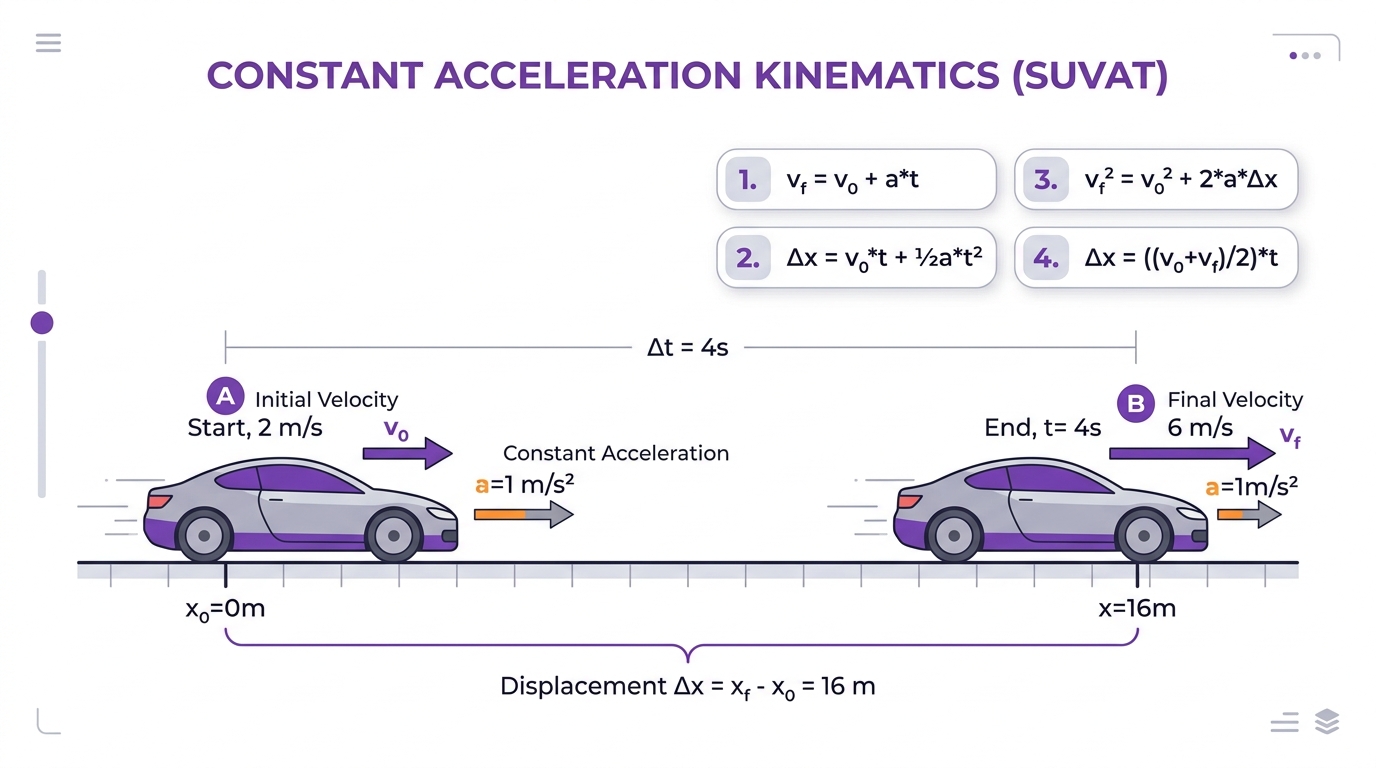
Which SUVAT Equation Should You Use?
If you prefer to calculate manually, choose the equation that avoids your unknown variable.
| Equation | Variable omitted | When it is useful |
|---|---|---|
| v = u + at | s | Use when displacement is not needed |
| s = ut + ½at² | v | Use when final velocity is unknown |
| s = vt − ½at² | u | Use when initial velocity is unknown |
| v² = u² + 2as | t | Use when time is unknown |
| s = ½(u + v)t | a | Use when acceleration is unknown |
How to Use the Calculator
1. Choose a positive direction: Decide whether forward (or up) is positive. Keep this sign convention consistent for all your inputs. For example, if up is positive, Earth's gravity acts downwards, so acceleration is approximately -9.81 m/s².
2. Enter at least 3 values: Check your question and identify at least three values you know. Type them into the calculator and adjust the units if needed. If you enter four or five values, the calculator will also check whether they are consistent.
3. Review the working: The calculator instantly solves the missing variables. Expand the working section to see the step-by-step physics substitutions used to get the answer.
When SUVAT Equations Work
The SUVAT equations (equations of motion) can only be used when an object is undergoing constant acceleration in a straight line. This includes free fall near the Earth's surface (where gravity is uniform) and vehicles braking with a steady force.
When SUVAT Should Not Be Used
- Changing acceleration: If the force driving the object changes over time, acceleration is not constant.
- Significant air resistance: As speed increases, air resistance increases, which changes the object's acceleration.
- Circular motion: An object moving in a circle is constantly changing direction, which means its velocity (and acceleration) are not constant in a 1D straight-line sense.
- Unsplit 2D motion: For projectiles, you must split the motion into horizontal and vertical components and apply SUVAT to each dimension separately.
Worked SUVAT Example
Question: A car travelling at 20 m/s brakes to a complete stop in 4 seconds. Calculate its acceleration and the distance travelled while braking.
1. Identify knowns:
Initial velocity, u = 20 m/s
Final velocity, v = 0 m/s (because it stops)
Time, t = 4 s
2. Calculate Acceleration (a):
Using v = u + at
Rearrange: a = (v - u) / t
Substitute: a = (0 - 20) / 4
a = -5 m/s²
3. Calculate Displacement (s):
Using s = ½(u + v)t
Substitute: s = ½(20 + 0) × 4
s = 40 m
Frequently Asked Questions
What does SUVAT stand for?
SUVAT is an acronym representing the five variables in kinematic equations: s (displacement), u (initial velocity), v (final velocity), a (acceleration), and t (time).
How many values do I need to enter?
You must enter at least three known values. With exactly three values, the equations of motion solve the remaining two. If you enter four or five values, the calculator checks whether the full set is mathematically consistent.
Can time have two solutions?
Yes. Because the equation s = ut + ½at² is a quadratic equation, it can produce two valid time solutions. Physically, this usually happens when an object passes a certain displacement once while moving away, and a second time when returning.
Can acceleration be negative?
Yes. A negative acceleration means the acceleration is acting in the negative direction based on your chosen sign convention. It does not always mean slowing down. An object slows down when its velocity and acceleration have opposite signs.
What is the difference between distance and displacement?
Distance is a scalar quantity measuring the total path travelled. Displacement is a vector quantity measuring the straight-line distance and direction from the starting point to the finishing point. The SUVAT equations always calculate displacement.
What value should I use for gravity?
For UK GCSE and A-Level Physics, the acceleration due to Earth's gravity is usually taken as 9.81 m/s² (or sometimes 9.8 m/s² depending on the exam board). Remember to make it negative if you have chosen "upwards" as the positive direction.