University Degree Levels Explained: UK Levels 4–8
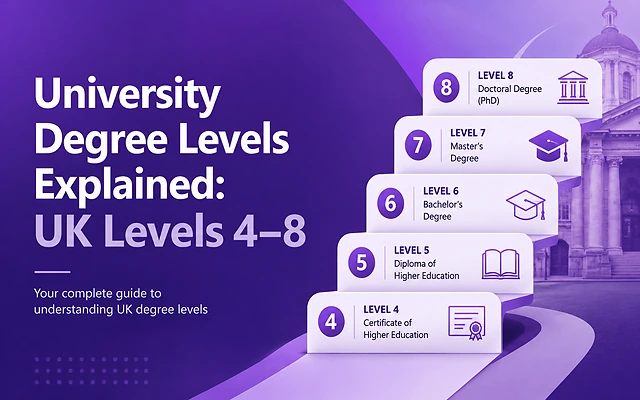
University degree levels can feel confusing at first, especially when you see terms like HNC, HND, Foundation Degree, Bachelor’s, Honours Degree, PGCert, Master’s, MBA, MPhil and PhD. The simple answer is that UK university-level qualifications usually sit between Level 4 and Level 8, with each level showing the difficulty and depth of study.
In general, Level 4 is the first stage of higher education, Level 5 is the second stage, Level 6 is bachelor’s degree level, Level 7 is master’s level, and Level 8 is doctoral level. Before university, many students study Level 3 qualifications such as A levels, T Levels, BTECs or Access to HE courses to meet entry requirements.
This guide explains university degree levels in plain English, so you can understand what each qualification means, how they compare, and which route may be right for your studies or career.
Quick Answer: What Are University Degree Levels?
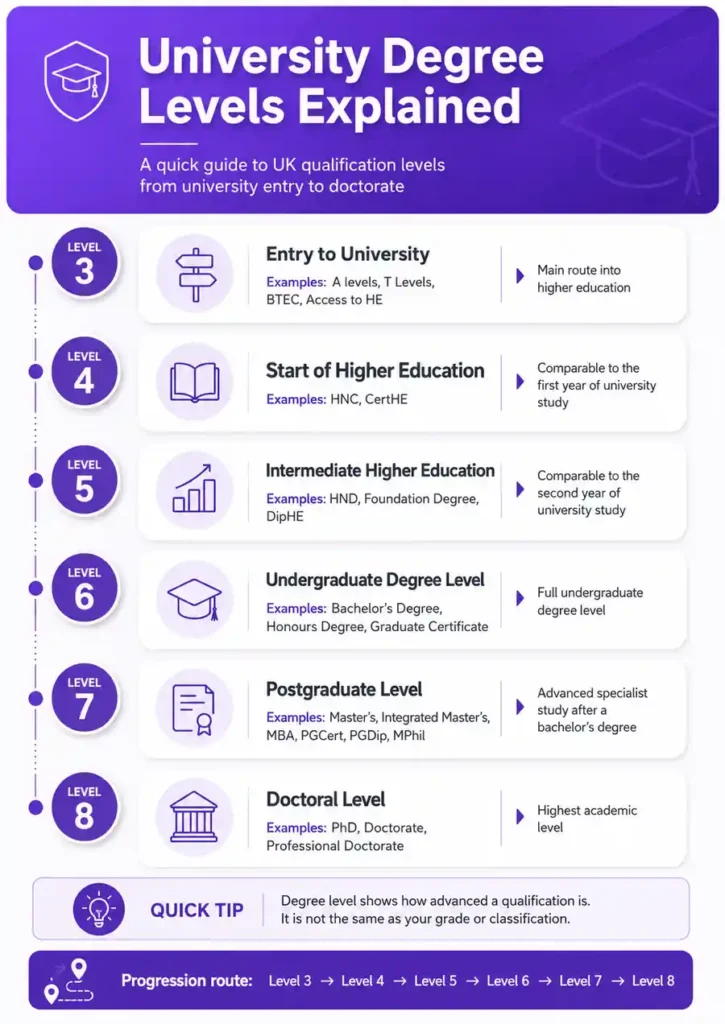
University degree levels are used to show how advanced a qualification is. In the UK, higher education qualifications usually start at Level 4 and go up to Level 8.
| Level | Common Qualifications | Simple Meaning |
|---|---|---|
| Level 3 | A levels, T Levels, BTEC Nationals, Access to HE | Main entry route into university |
| Level 4 | HNC, CertHE | First year of university-level study |
| Level 5 | HND, Foundation Degree, DipHE | Second year or intermediate higher education |
| Level 6 | Bachelor’s Degree, Honours Degree, Graduate Certificate | Full undergraduate degree level |
| Level 7 | Master’s Degree, MBA, PGCert, PGDip, MPhil | Postgraduate level |
| Level 8 | PhD, Doctorate, Professional Doctorate | Highest academic level |
The higher the level, the more advanced the study usually becomes. But level is not the only thing that matters. You should also look at the qualification type, credits, duration, subject, entry requirements and where it can take you next.
The Simple Order of University Degrees
A common UK university pathway looks like this:
Level 3 → Level 4 → Level 5 → Level 6 → Level 7 → Level 8
In real life, your route may look different. For example, you may go straight from Level 3 to a bachelor’s degree, or you may study an HNC first, then an HND, then a top-up degree. Some people study a bachelor’s degree, work for a few years, and then return for an MBA or professional doctorate.
Here is the simple version:
| Study Stage | Level | Examples |
|---|---|---|
| Pre-university entry | Level 3 | A levels, T Levels, BTEC, Access to HE |
| Early undergraduate | Level 4 | HNC, CertHE, first year of a degree |
| Intermediate undergraduate | Level 5 | HND, Foundation Degree, DipHE |
| Full undergraduate degree | Level 6 | Bachelor’s Degree, Honours Degree |
| Postgraduate study | Level 7 | Master’s, MBA, PGCert, PGDip, MPhil |
| Doctoral study | Level 8 | PhD, DPhil, DBA, EdD, Professional Doctorate |
What Do UK Qualification Levels Mean?
Qualification levels show the difficulty of a course. A higher level usually means you will study more complex ideas, use more independent research, solve harder problems, and show deeper understanding.
However, a higher level does not always mean a longer course. For example, a Postgraduate Certificate and a Master’s Degree may both be Level 7, but a full master’s degree is usually larger and more detailed.
That is why you should understand three things:
- Level — how advanced the qualification is.
- Credit size — how much study is involved.
- Qualification type — what the award is used for.
For example, a PGCert, PGDip and Master’s Degree can all sit at postgraduate Level 7, but they are not the same award.
Level 3: The Main Entry Route Into University
Level 3 is not usually classed as university-level study, but it matters because it is the standard entry route into many undergraduate courses.
Common Level 3 qualifications include:
- A levels
- T Levels
- BTEC Nationals
- Access to Higher Education Diploma
- International Baccalaureate
- Some advanced apprenticeships or vocational qualifications
If you are applying for a bachelor’s degree, universities usually check your Level 3 qualifications or equivalent experience. For adult learners, an Access to HE Diploma can be a useful route into university if you do not have traditional school qualifications.
Why Level 3 matters
Level 3 affects:
- Which university courses you can apply for
- Whether you meet entry requirements
- Whether you need a foundation year
- Whether you can start at Level 4 or need extra preparation
A common mistake is thinking that Level 3 is a degree level. It is not. It is normally the level before higher education.
Level 4 University Qualifications
Level 4 is the first stage of higher education. It is usually similar to the first year of a bachelor’s degree.
Common Level 4 qualifications include:
- Higher National Certificate, HNC
- Certificate of Higher Education, CertHE
- First year of a bachelor’s degree
- Some higher apprenticeships
HNC: Higher National Certificate
An HNC is a Level 4 qualification. It is often practical and career-focused. Many students choose an HNC if they want a shorter higher education qualification or a route into work-based study.
An HNC may be useful if you want to:
- Build job-related skills
- Study part-time while working
- Start higher education without committing to a full degree
- Progress later to an HND or degree
CertHE: Certificate of Higher Education
A CertHE is also Level 4. It usually shows that you have completed the first stage of higher education. Some students receive a CertHE as a standalone award, while others may receive it if they leave a degree after completing the first year.
Is Level 4 the same as the first year of university?
In many cases, yes. Level 4 is commonly equal to the first year of undergraduate study. But the qualification you receive depends on the course. A first-year bachelor’s student does not always receive a separate Level 4 award unless the course structure allows it.
Level 5 University Qualifications
Level 5 is the next stage after Level 4. It is often compared with the second year of a bachelor’s degree.
Common Level 5 qualifications include:
- Higher National Diploma, HND
- Foundation Degree
- Diploma of Higher Education, DipHE
- Second year of a bachelor’s degree
- Some higher apprenticeships
HND: Higher National Diploma
An HND is a Level 5 qualification. It is usually more advanced than an HNC and often has a strong practical or vocational focus.
Students often choose an HND because it can lead to:
- Employment in technical or professional roles
- A top-up degree
- Further undergraduate study
- Career progression in a specific sector
Foundation Degree
A Foundation Degree is also a Level 5 qualification. It is not the same as a foundation year.
A Foundation Degree is a higher education qualification that usually combines academic study with practical, work-related learning. It can be useful if you want a degree-level qualification with a career focus.
Common Foundation Degree abbreviations include:
- FdA — Foundation Degree in Arts
- FdSc — Foundation Degree in Science
Foundation Degree vs Foundation Year
This is one of the most common misunderstandings.
| Term | What It Means | Level |
|---|---|---|
| Foundation Year | A preparatory year before starting a full degree | Usually Level 3 or early Level 4 depending on course |
| Foundation Degree | A standalone higher education qualification | Level 5 |
A foundation year helps you get ready for a degree. A Foundation Degree is already a university-level qualification.
DipHE: Diploma of Higher Education
A DipHE is a Level 5 qualification. It often represents successful completion of the first two years of higher education. Like a CertHE, it may be awarded as a standalone qualification or as an exit award.
Can you top up a Level 5 qualification to a full degree?
Yes, in many cases you can. Students with an HND or Foundation Degree may be able to study a top-up degree to gain a full bachelor’s degree. A top-up degree is often one year full-time, but this depends on the course, university and subject.
HNC vs HND vs Foundation Degree
These qualifications are often confused because they are all below a full bachelor’s degree but still count as higher education.
| Qualification | Level | Usually Similar To | Best For | Common Next Step |
|---|---|---|---|---|
| HNC | Level 4 | First year of university | Practical skills and career entry | HND or degree |
| HND | Level 5 | First two years of university | Technical or vocational progression | Top-up degree or work |
| Foundation Degree | Level 5 | First two years of university | Work-related higher education | Top-up degree |
| DipHE | Level 5 | First two years of higher education | Academic progression or exit award | Degree continuation |
If your goal is a full bachelor’s degree, check whether your HND or Foundation Degree has a clear top-up route before you apply.
Level 6 University Qualifications
Level 6 is full undergraduate degree level. This is the level most people mean when they say they have “a degree”.
Common Level 6 qualifications include:
- Bachelor’s Degree
- Bachelor’s Degree with Honours
- Ordinary Degree
- Graduate Certificate
- Graduate Diploma
- Level 6 Degree Apprenticeship
Bachelor’s Degree
A Bachelor’s Degree is the most common undergraduate degree. Examples include:
- BA — Bachelor of Arts
- BSc — Bachelor of Science
- BEng — Bachelor of Engineering
- LLB — Bachelor of Laws
- BEd — Bachelor of Education
- BBA — Bachelor of Business Administration
In England, Wales and Northern Ireland, a bachelor’s degree is commonly three years full-time. Some courses are four years if they include a placement year, foundation year, year abroad or integrated master’s route. In Scotland, undergraduate degrees often follow a different structure and may take four years.
Honours Degree
An Honours Degree is a bachelor’s degree with a higher level of academic depth than an ordinary degree. You may see it written as:
- BA Hons
- BSc Hons
- BEng Hons
- LLB Hons
Honours degrees are usually classified using grades such as First, 2:1, 2:2 and Third.
Ordinary Degree vs Honours Degree
An ordinary degree is a bachelor’s degree without honours. It may involve fewer credits or less advanced study than an honours degree, depending on the university and country.
| Type | Level | Usually Classified? | Common Use |
|---|---|---|---|
| Ordinary Degree | Level 6 | Sometimes pass/fail or classified differently | Shows undergraduate completion |
| Honours Degree | Level 6 | Usually First, 2:1, 2:2 or Third | Common route for graduate jobs and postgraduate study |
Many UK graduate jobs and postgraduate courses prefer or require an honours degree, especially when they mention a 2:1 or 2:2 requirement.
Graduate Certificate and Graduate Diploma
A Graduate Certificate or Graduate Diploma is usually aimed at people who already have some higher education background. These are often Level 6 qualifications.
Do not confuse them with postgraduate certificates or postgraduate diplomas. A Graduate Certificate is usually Level 6, while a Postgraduate Certificate is usually Level 7.
Level 7 University Qualifications
Level 7 is postgraduate level. It comes after bachelor’s degree level and usually involves more advanced, independent and specialist study.
Common Level 7 qualifications include:
- Master’s Degree
- Integrated Master’s Degree
- MBA
- MPhil
- Postgraduate Certificate, PGCert
- Postgraduate Diploma, PGDip
- Some professional qualifications
Master’s Degree
A Master’s Degree is a Level 7 postgraduate qualification. Common examples include:
- MA — Master of Arts
- MSc — Master of Science
- LLM — Master of Laws
- MRes — Master of Research
- MPH — Master of Public Health
A taught master’s usually includes modules, assessments and often a dissertation or major project. A research master’s focuses more heavily on independent research.
Integrated Master’s Degree
An Integrated Master’s combines undergraduate and master’s-level study in one longer course. Examples include:
- MEng — Master of Engineering
- MPhys — Master of Physics
- MChem — Master of Chemistry
- MPharm — Master of Pharmacy
This route is common in science, engineering and professional subjects. Instead of finishing a bachelor’s degree and applying separately for a master’s, students study one extended programme.
MBA: Master of Business Administration
An MBA is a Level 7 postgraduate business and management degree. It is often designed for people with professional experience who want to move into leadership, management, entrepreneurship or senior business roles.
An MBA is different from a general MSc in Business because it usually focuses more on practical leadership, strategy, finance, operations and real-world management decision-making.
MPhil: Master of Philosophy
An MPhil is usually a research-based Level 7 qualification. It is more advanced than many taught master’s courses in terms of research focus, but it is below a PhD.
Some students complete an MPhil as a standalone research degree. Others may begin a research programme and later upgrade to a PhD if they meet the university’s requirements.
PGCert: Postgraduate Certificate
A Postgraduate Certificate is a Level 7 qualification but is shorter than a full master’s degree. It may be useful if you want postgraduate-level knowledge without committing to a full master’s.
PGDip: Postgraduate Diploma
A Postgraduate Diploma is also Level 7. It is usually larger than a PGCert but smaller than a full master’s degree. Some students complete a PGDip and then later continue to a full master’s if the university allows progression.
PGCert vs PGDip vs Master’s
| Qualification | Level | Size | Best For |
|---|---|---|---|
| PGCert | Level 7 | Shorter postgraduate award | Focused professional development |
| PGDip | Level 7 | Larger than PGCert | Advanced study without full dissertation |
| Master’s Degree | Level 7 | Full postgraduate degree | Specialist knowledge, career progression or PhD route |
The key point is this: same level does not always mean same size.
Level 8 University Qualifications
Level 8 is the highest level in the UK qualification framework. It is doctoral level.
Common Level 8 qualifications include:
- PhD
- DPhil
- Doctorate
- Professional Doctorate
- DBA
- EdD
- EngD
- DClinPsy
PhD and DPhil
A PhD, or Doctor of Philosophy, is a research doctorate. A DPhil is another name used by some universities for the same type of qualification.
A PhD usually involves original research, a thesis, and an examination process such as a viva. It is often required for academic research careers and can also support advanced roles in industry, policy, science, education and specialist professions.
Professional Doctorate
A Professional Doctorate is also a Level 8 qualification, but it usually focuses on applying research to professional practice.
Examples include:
- DBA — Doctor of Business Administration
- EdD — Doctor of Education
- EngD — Engineering Doctorate
- DClinPsy — Doctorate in Clinical Psychology
PhD vs Professional Doctorate
| Qualification | Level | Main Focus | Best For |
|---|---|---|---|
| PhD / DPhil | Level 8 | Original academic research | Academic, research and specialist careers |
| Professional Doctorate | Level 8 | Research applied to professional practice | Senior professionals and practice-based experts |
A PhD is not the only doctorate. If your goal is professional leadership rather than an academic research career, a professional doctorate may be more suitable.
Undergraduate vs Postgraduate Degrees
The difference between undergraduate and postgraduate study is simple.
An undergraduate degree is usually your first university degree. A postgraduate degree is usually studied after you already have an undergraduate degree or equivalent experience.
| Type | Levels | Examples |
|---|---|---|
| Undergraduate | Level 4, Level 5, Level 6 | HNC, HND, Foundation Degree, Bachelor’s Degree |
| Postgraduate | Level 7, Level 8 | PGCert, PGDip, Master’s, MBA, MPhil, PhD |
Undergraduate study
Undergraduate study helps you build foundation knowledge in a subject. You usually get more support and structure, especially in the first year.
Examples:
- BA English
- BSc Computer Science
- LLB Law
- HND Business
- Foundation Degree in Health and Social Care
Postgraduate study
Postgraduate study is more advanced and independent. You are expected to analyse, research, critique and apply knowledge at a higher level.
Examples:
- MSc Data Science
- MA Education
- MBA
- MPhil
- PhD
Degree Classifications Explained
Degree level and degree classification are not the same thing.
Your degree level tells you how advanced the qualification is. Your degree classification tells you the result or grade you achieved.
For example, a BA Honours degree is usually Level 6. Your classification might be First-Class Honours, 2:1, 2:2 or Third.
Undergraduate Honours Classifications
| Classification | Common Name | Typical Meaning |
|---|---|---|
| First-Class Honours | First or 1st | Highest common undergraduate classification |
| Upper Second-Class Honours | 2:1 | Strong degree result |
| Lower Second-Class Honours | 2:2 | Standard honours degree result |
| Third-Class Honours | Third or 3rd | Lowest common honours classification |
| Ordinary Degree / Pass | Pass | Degree without honours or without classification |
Many employers and postgraduate courses ask for a 2:1 or 2:2, but this depends on the subject, university, employer and course. Some universities also consider work experience, professional qualifications, portfolios or interviews.
Pass, Merit and Distinction
At postgraduate level, many taught courses use:
- Pass
- Merit
- Distinction
A Distinction is usually the highest result, followed by Merit, then Pass. Exact rules can vary by university, so always check the course handbook.
If you are trying to estimate your final result, you can use this uni grade calculator to check whether your marks may be pointing towards a First, 2:1, 2:2, Merit or Distinction.
How Degree Levels Affect Entry Requirements
Degree levels affect what you need before you apply.
For example:
- Level 4 courses usually require Level 3 qualifications or equivalent experience.
- Level 5 courses may require Level 4 study or relevant qualifications.
- Level 6 top-up degrees often require an HND, Foundation Degree or equivalent Level 5 study.
- Level 7 master’s courses usually require a bachelor’s degree or relevant professional experience.
- Level 8 doctorates usually require a strong academic background, research proposal or relevant master’s-level study.
Entry requirements are not identical everywhere. One university may accept professional experience, while another may ask for a specific degree classification.
How Degree Levels Affect Career Options
A higher degree level can open different career routes, but higher is not always better for every person.
Level 4 and Level 5
These can be useful for technical, vocational and work-based roles. They may help you enter an industry faster or progress while studying part-time.
Examples:
- Engineering technician roles
- Business administration roles
- Healthcare support progression
- Computing and IT support roles
- Construction and built environment roles
Level 6
A Level 6 bachelor’s degree is commonly used for graduate jobs, professional training and postgraduate entry.
Examples:
- Graduate schemes
- Teacher training routes
- Law conversion or legal training routes
- Professional healthcare pathways
- Business, finance, marketing and technology roles
Level 7
Level 7 qualifications can help with specialist, senior or professional roles.
Examples:
- Data scientist
- Senior manager
- Specialist teacher
- Policy analyst
- Clinical or professional development roles
- Research assistant or PhD preparation
Level 8
Level 8 qualifications are useful for advanced research, academic careers and high-level specialist practice.
Examples:
- University lecturer
- Research scientist
- Senior policy expert
- Clinical specialist
- Professional practice leader
The best level depends on your goal. A Level 5 HND may be more practical for one career than a master’s degree in an unrelated subject.
UK Degree Levels and International Comparison
International students often search for UK degree levels because qualification names can differ from country to country.
A UK bachelor’s degree, for example, may not match another country’s bachelor’s degree exactly in length, credits or grading style. A UK honours classification such as 2:1 may also be compared differently depending on the university, employer or country.
If you are applying from outside the UK, check:
- The university’s international entry requirements
- UK ENIC guidance if formal comparison is needed
- Course-specific requirements
- English language requirements
- Whether your qualification is accepted for direct entry
- Whether you need a foundation year, pre-master’s or conversion course
Do not assume that a qualification is automatically equivalent just because the name sounds similar.
Common Mistakes Students Make When Comparing Degree Levels
Mistake 1: Confusing Foundation Degree with foundation year
A Foundation Degree is usually Level 5. A foundation year is normally a preparation year before a degree.
Mistake 2: Thinking Level 7 always means a full master’s
PGCert, PGDip and Master’s qualifications can all be Level 7, but they are different in size and depth.
Mistake 3: Thinking HND and bachelor’s degree are the same
An HND is Level 5. A bachelor’s degree is usually Level 6. An HND may lead to a top-up degree, but it is not normally the same as a full bachelor’s degree.
Mistake 4: Confusing degree level with degree grade
Level 6 tells you the qualification level. First, 2:1, 2:2 and Third tell you the result.
Mistake 5: Ignoring progression routes
Before choosing an HNC, HND or Foundation Degree, check whether it leads to the next qualification you want.
Mistake 6: Assuming all universities use the same rules
Universities can set different entry requirements, grading rules and progression policies. Always check the course page and admissions guidance.
Which Degree Level Should You Choose?
The right level depends on your current qualifications and your future goal.
| Choose This Level | If You Want To |
|---|---|
| Level 4 | Start higher education, build practical skills, or complete the first stage of university study |
| Level 5 | Gain a work-focused higher qualification or prepare for a top-up degree |
| Level 6 | Complete a full undergraduate degree and apply for graduate jobs or postgraduate study |
| Level 7 | Specialise further, change career direction, or prepare for senior roles or research |
| Level 8 | Produce original research or become an expert in an academic or professional field |
If you are unsure, start with your end goal. Ask yourself:
- Do I need a full degree for my career?
- Do I want a practical or academic route?
- Do I want to work while studying?
- Do I need a specific classification for postgraduate study?
- Can this qualification lead to the next level?
Final Thoughts
University degree levels are easier to understand when you think of them as a ladder. Level 4 is the start of higher education, Level 5 is the next stage, Level 6 is bachelor’s degree level, Level 7 is postgraduate master’s level, and Level 8 is doctoral level.
The most important thing is not just choosing the highest level. It is choosing the right qualification for your current situation and future goal. An HND, Foundation Degree, Bachelor’s, MBA, MPhil or PhD can all be valuable when they match your career plan.
Before you apply, check the course level, entry requirements, credits, progression route and career outcomes. That way, you can choose a degree level that actually helps you move forward.
FAQs
What level is a bachelor’s degree?
A bachelor’s degree is usually Level 6 in England, Wales and Northern Ireland. Examples include BA, BSc, BEng, LLB and BEd degrees.
What level is an honours degree?
An honours degree is usually Level 6. It is a bachelor’s degree with honours and is commonly classified as First, 2:1, 2:2 or Third.
Is an HND the same as a degree?
No. An HND is usually Level 5, while a full bachelor’s degree is usually Level 6. However, an HND may allow you to progress to a top-up degree.
Can I turn an HND into a bachelor’s degree?
Yes, many students use an HND to apply for a top-up degree. A top-up degree can help you complete a full bachelor’s degree, but availability depends on the subject and university.
What level is a master’s degree?
A master’s degree is usually Level 7. Examples include MA, MSc, LLM, MRes and MBA qualifications.
What level is an MPhil?
An MPhil is usually Level 7. It is a research-based master’s qualification and can sometimes be used as a route towards doctoral study.
What level is a PhD?
A PhD is Level 8, which is doctoral level. It is one of the highest academic qualifications and usually involves original research.
What is the difference between undergraduate and postgraduate study?
Undergraduate study usually includes Level 4, Level 5 and Level 6 qualifications, such as HNCs, HNDs, Foundation Degrees and Bachelor’s Degrees. Postgraduate study usually includes Level 7 and Level 8 qualifications, such as Master’s Degrees, MBAs, MPhils and PhDs.
What is the difference between an ordinary degree and an honours degree?
An ordinary degree is a bachelor’s degree without honours. An honours degree usually involves more advanced study and is commonly classified as First, 2:1, 2:2 or Third.
What does 2:1 mean in a degree?
A 2:1 means Upper Second-Class Honours. It is a strong undergraduate degree classification and is often accepted for many postgraduate courses and graduate jobs.
Is a 2:2 degree bad?
A 2:2 is still an honours degree. Some competitive courses or employers may prefer a 2:1, but many opportunities still accept a 2:2, especially if you have relevant experience, skills or a strong portfolio.