
Uni Grades Explained: UK Degree Marks & Classifications
If you have just received a university mark and thought, “Is 58% good?” or “What does a 2:1 actually mean?”, you are not alone. UK university grades can feel confusing at first because they work differently from school marks, A-levels, GCSEs, GPA systems and many international grading systems.
In the UK, most undergraduate degrees are classified using percentage bands. As a quick guide, 70% and above is usually a First, 60–69% is usually a 2:1, 50–59% is usually a 2:2, 40–49% is usually a Third, and below 40% is usually a fail. These are common UK degree classification boundaries, although exact rules can vary slightly between universities and courses.
This guide explains uni grades in plain English, including undergraduate grades, postgraduate grades, module marks, credits, weighted averages, resits, borderline grades, GPA comparisons and what your results may mean for jobs or further study.
Quick Answer: What Do UK Uni Grades Mean?
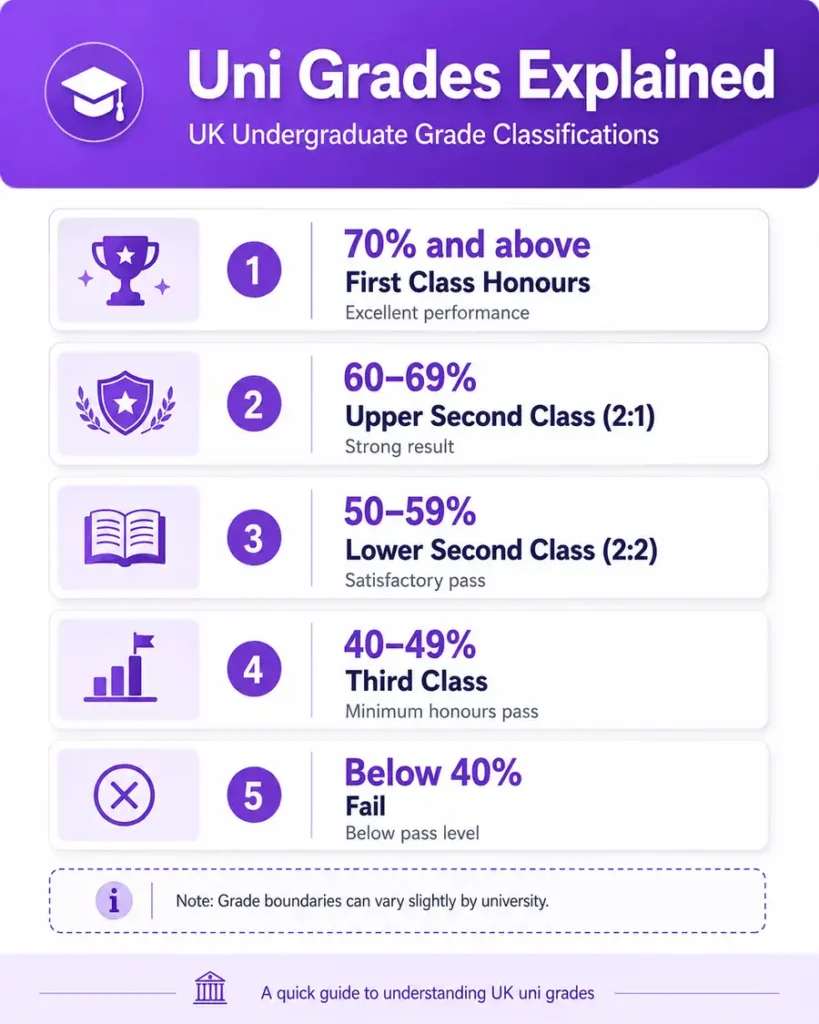
UK university grades are usually given as percentages, but your final degree is normally awarded as a classification. The classification gives a simple label to your overall academic performance.
| Percentage mark | Undergraduate classification | Common short name | Simple meaning |
|---|---|---|---|
| 70% and above | First Class Honours | First / 1st | Excellent performance |
| 60–69% | Upper Second Class Honours | 2:1 | Strong performance |
| 50–59% | Lower Second Class Honours | 2:2 | Satisfactory pass |
| 40–49% | Third Class Honours | Third / 3rd | Minimum honours pass |
| Below 40% | Fail | Fail | Usually below pass level |
The most important thing to understand is that university percentages do not feel the same as school percentages. At university, a mark in the 60s can be very good, and a mark of 70% or above is often considered excellent.
Imperial College London explains that marks between 50% and 70% are normal at university level, while marks of 90% or more are rare. So if you were used to getting 85–95% at school, do not panic when your university marks look lower.
Why University Grades Feel Different From School Grades
Many students arrive at university expecting marks to work like school grades. At school, 70% may feel average or just “okay”. At university, 70% is usually a First, which is the highest common undergraduate classification.
That difference can be a shock.
University work is marked against higher academic expectations. You are expected to show independent thinking, critical analysis, wider reading, clear argument, evidence, originality and subject understanding. You are not just repeating information. You are being assessed on how well you understand, apply, question and communicate it.
That is why:
- 50% can still be a respectable mark, especially in first year.
- 60% or above usually shows strong understanding.
- 70% or above is normally excellent.
- 80% or above is outstanding.
- 90% or above is unusual in many subjects.
If you get 55% in your first semester, it does not mean you are failing. It may mean you are adjusting to university-level work. The key is to read your feedback, understand the marking criteria and improve before higher-weighted years or modules.
Undergraduate Uni Grades Explained
Most UK bachelor’s degrees use the honours classification system. This applies to many BA, BSc, BEng, LLB and similar undergraduate degrees.
First Class Honours
A First Class Honours degree, often called a First or 1st, is usually awarded for an overall mark of 70% or above.
A First shows excellent academic performance. It normally means your work demonstrates strong knowledge, independent thinking, good structure, critical analysis and a high level of understanding.
A First can be helpful for competitive graduate jobs, postgraduate study, scholarships and academic pathways. However, it is not the only route to success. Experience, skills, work placements, portfolios and references also matter.
Upper Second Class Honours / 2:1
An Upper Second Class Honours degree, usually called a 2:1, is normally awarded for an overall mark of 60–69%.
A 2:1 is a strong result and one of the most commonly requested degree classifications for graduate schemes and master’s courses. Many employers and universities use a 2:1 as a standard entry requirement, although this depends on the role, subject and institution.
If you are aiming for jobs or postgraduate study, a 2:1 is usually a very solid outcome.
Lower Second Class Honours / 2:2
A Lower Second Class Honours degree, usually called a 2:2, is normally awarded for an overall mark of 50–59%.
A 2:2 is still a pass and still an honours degree. Some graduate schemes may ask for a 2:1, but a 2:2 does not end your career options. Many students with a 2:2 move into good jobs, further study, internships, professional training or portfolio-based careers.
If you have a 2:2, you should focus on strengthening the rest of your profile: work experience, skills, projects, references, internships, volunteering, certifications and a strong CV.
Third Class Honours
A Third Class Honours degree, often called a Third or 3rd, is usually awarded for an overall mark of 40–49%.
This is normally the lowest honours classification. It means you have passed the degree, but your overall performance was close to the minimum honours level.
A Third may make some competitive graduate schemes or postgraduate courses harder to access, but it is still a completed degree. Your next step should be to build practical experience, explain your strengths clearly and consider alternative routes into your chosen career.
Ordinary Degree or Pass Degree
An ordinary degree or pass degree may be awarded in some cases where a student completes enough credits for a degree but does not meet the full honours requirements.
This can happen for different reasons, such as not completing enough honours-level credits or narrowly missing the requirements for an honours classification. Rules vary by university, so always check your course handbook or academic regulations.
Fail
A fail usually means the mark is below the pass threshold. For many undergraduate modules, the pass mark is commonly 40%, although some professional courses or specific modules may have different rules.
Failing one assessment or module does not always mean you have failed your whole degree. You may be offered a resit, referral, compensation, condonement or another route depending on your university’s regulations.
Postgraduate Uni Grades Explained
Postgraduate taught degrees, such as many master’s degrees, usually use a different classification system from undergraduate degrees.
Instead of First, 2:1, 2:2 and Third, taught master’s degrees are commonly awarded as:
| Percentage mark | Postgraduate classification | Simple meaning |
|---|---|---|
| 70% and above | Distinction | Excellent postgraduate performance |
| 60–69% | Merit | Strong postgraduate performance |
| 50–59% | Pass | Meets master’s-level requirements |
| 40–49% | Borderline/possible fail area | Depends on university rules |
| Below 40% | Fail | Usually below postgraduate pass level |
Prospects explains that taught master’s degrees in the UK usually use Distinction, Merit, Pass and Fail rather than undergraduate classifications, although exact boundaries can differ between institutions.
Distinction
A Distinction is usually the highest taught postgraduate classification. It is commonly awarded for marks of 70% or above.
A Distinction can be valuable if you want to apply for PhD study, academic roles, competitive scholarships or specialist professional positions.
Merit
A Merit usually reflects strong postgraduate performance, commonly around the 60–69% range.
A Merit is a good result and shows that you have performed above the basic pass level.
Pass
A Pass usually means you have met the required standard for the master’s degree. At postgraduate level, the pass mark is often higher than undergraduate level, commonly around 50%, but this can vary.
Research Master’s and PhD Grades
Research degrees often work differently. Some research master’s programmes, MPhil programmes and PhD programmes may not use Distinction, Merit and Pass in the same way as taught master’s degrees. A PhD is usually examined through a thesis and viva process rather than ordinary module marks.
Module Marks vs Final Degree Classification
One of the biggest mistakes students make is confusing a module mark with a final degree classification.
A module mark is the percentage you receive for one module. For example:
- Introduction to Psychology: 62%
- Business Law: 58%
- Dissertation: 68%
Your final degree classification is your overall result after your university combines your relevant module marks according to its rules.
This means one low mark does not always ruin your final grade. A 45% in a small 15-credit module will usually affect your degree less than a 45% in a 40-credit dissertation or major project.
How UK University Grades Are Calculated
Most university grades are calculated using a credit-weighted average. This means modules with more credits have more impact on your final result.
Prospects explains that undergraduate degrees are commonly worth 360 credits, often 120 credits per academic year, while taught master’s degrees are commonly worth 180 credits. It also notes that final classifications are usually calculated using a credit-weighted average of module marks, although each university has its own algorithm.
Simple Weighted Average Formula
The basic formula is:
Weighted average = total of mark × credits ÷ total credits
Here is a simple example:
| Module | Mark | Credits | Mark × credits |
|---|---|---|---|
| Module A | 65% | 20 | 1,300 |
| Module B | 58% | 20 | 1,160 |
| Module C | 72% | 40 | 2,880 |
| Module D | 60% | 20 | 1,200 |
| Module E | 55% | 20 | 1,100 |
| Total | 120 | 7,640 |
Now divide the total weighted marks by total credits:
7,640 ÷ 120 = 63.67%
That student’s weighted average is 63.67%, which would usually sit in the 2:1 range.
Why Credits Matter
Credits show the size or workload of a module. A 40-credit dissertation usually counts more than a 15-credit optional module. This is why you should not simply add all your marks together and divide by the number of modules.
For example, imagine you got:
- 70% in a 15-credit module
- 55% in a 40-credit dissertation
The dissertation will affect your final average more because it carries more credits.
Why Final Year Often Matters More
Some universities count every year equally, but many give more weight to later years. First year may count less, or sometimes not count directly toward the final classification, although you still need to pass it to progress.
For example, a university might use:
| Year | Average mark | Weighting | Contribution |
|---|---|---|---|
| Year 1 | 55% | 0% | 0 |
| Year 2 | 62% | 30% | 18.6 |
| Year 3 | 68% | 70% | 47.6 |
| Final average | 66.2% |
In this example, the student’s final average is 66.2%, which is usually a 2:1.
This is why final-year modules, dissertations and high-credit projects are so important.
Calculate Your Uni Grade
Once you understand credits and weightings, the easiest way to estimate your own result is to enter your marks into a tool.
You can use this uni grade calculator to calculate your weighted average, estimate your final degree classification, test year weightings and work out what marks you may need in your remaining modules.
A useful calculator section should let you enter:
- your module names
- your percentage marks
- each module’s credit value
- your year averages
- your year weightings
- your target classification
The tool can then estimate your likely final classification. It can also help you plan questions like:
- What average do I need to get a 2:1?
- Can I still get a First?
- How much will my dissertation affect my final grade?
- What happens if one module mark is lower than expected?
- What GPA might my UK percentage roughly convert to?
Remember, a calculator gives an estimate. Your official result depends on your university’s academic regulations, rounding rules, resit rules, compensation rules and exam board decisions.
Worked Examples: Uni Grade Calculations
Example 1: Calculating a Module Average
Imagine a module has two assessments:
| Assessment | Mark | Weight |
|---|---|---|
| Essay | 64% | 40% |
| Exam | 58% | 60% |
Calculation:
- Essay: 64 × 0.40 = 25.6
- Exam: 58 × 0.60 = 34.8
- Final module mark: 25.6 + 34.8 = 60.4%
The module mark is 60.4%, which is usually in the 2:1 range.
Example 2: Calculating a Year Average
| Module | Mark | Credits | Weighted score |
|---|---|---|---|
| Module 1 | 62% | 20 | 1,240 |
| Module 2 | 70% | 20 | 1,400 |
| Module 3 | 58% | 20 | 1,160 |
| Module 4 | 65% | 20 | 1,300 |
| Module 5 | 60% | 20 | 1,200 |
| Dissertation | 68% | 20 | 1,360 |
| Total | 120 | 7,660 |
7,660 ÷ 120 = 63.83%
The year average is 63.83%, usually a 2:1-level year average.
Example 3: Can You Move From a 2:2 to a 2:1?
Let’s say your current average is 58%, and you still have 60 credits left. You want to finish with at least 60% overall.
If your completed credits and remaining credits are equal, you would need a higher average in your remaining work to pull your overall mark up.
A simplified example:
| Completed average | Completed credits | Remaining target | Remaining credits | Final average |
|---|---|---|---|---|
| 58% | 60 | 62% | 60 | 60% |
In this case, averaging 62% in the remaining credits would bring the final average to 60%.
This is why it is useful to track your grades before the end of the year. A small improvement across several remaining assessments can change your final classification.
Example 4: What If You Finish on 69%?
A final average of 69% is usually borderline between a 2:1 and a First. Some universities have borderline rules that may consider your profile, such as:
- how close you are to the next classification
- how many credits are already in the higher band
- your final-year performance
- your dissertation or project mark
- your university’s rounding policy
- exam board discretion
However, you should never assume that 69% will automatically become a First. Always check your university’s academic regulations.
Common Student Scenarios
“I got 55% in first year. Is that bad?”
Not necessarily. A 55% mark is usually in the 2:2 range, but first year is often a transition period. You are learning how university marking works, how to write academically and how to use feedback.
If your first-year marks are around 50–60%, focus on improving your essay structure, exam technique, referencing, critical analysis and time management.
“I got 62%. Is that good?”
Yes, 62% is usually a good university mark. It normally sits in the 2:1 range. If you consistently achieve marks in the low to mid-60s, you are performing strongly.
“I failed one module. Have I failed my degree?”
Not always. Failing one module does not automatically mean you have failed your degree. You may be offered a resit, referral, compensation, condonement or the chance to retake the module.
The result depends on:
- how badly you failed
- whether the module is compulsory
- how many credits the module is worth
- whether you passed the rest of the year
- whether your course has professional requirements
- your university’s progression rules
“Can I still get a 2:1 if I failed one module?”
Possibly, yes. If the failed module is low-credit, successfully resat, compensated or not heavily weighted, you may still be able to achieve a 2:1 overall.
However, resit marks may be capped, often at the pass mark. This can limit how much the resit improves your average.
“Can I get a First if my second year was weak?”
It depends on your university’s weighting system and how much your final year counts. If final year carries a high weighting, strong final-year marks may improve your classification significantly.
You need to calculate:
- your current weighted average
- your remaining credits
- your final-year weighting
- your target average
- any university borderline rules
“Is 70% the same as an A?”
Roughly, 70% and above is often considered excellent in the UK system and may be compared with a high grade internationally. But UK percentages do not convert perfectly into US letter grades or GPA. Each university, employer or admissions office may use its own conversion method.
What Happens If You Fail a Module?
Failing a module can feel stressful, but universities usually have clear procedures. The exact outcome depends on your course and institution.
Resits
A resit allows you to take an assessment again. This might be another exam, revised coursework, or a new assignment.
Resits are often used when a student fails a module or assessment but is allowed another attempt.
Capped Marks
A capped mark means your resit mark may be limited to the minimum pass mark, even if you score higher.
For example, if the undergraduate pass mark is 40%, and your resit is capped, you might receive 40% for classification purposes even if you score 58% in the resit.
This is why failing a module can affect your average even after you pass the resit.
Compensation
Compensation means the university may allow you to pass a module or progress even if you failed narrowly, usually because your performance in other modules was strong.
For example, if you scored 38% in one small module but passed everything else well, your university may allow compensation. Not all modules are eligible, especially core or professional modules.
Condonement
Condonement is similar to compensation. It means a failed module may be tolerated under specific rules, usually if the failure is small and your overall performance is acceptable.
Retaking a Module or Year
If you fail too many credits, fail a core module or do not meet progression requirements, you may need to retake a module or repeat part of the year.
This can affect your timeline, funding and progression, so speak to your academic adviser or student support team quickly.
Mitigating Circumstances
If illness, bereavement, mental health difficulties or serious personal issues affected your performance, you may be able to submit a mitigating circumstances claim.
You normally need evidence, and deadlines can be strict. Do not wait until the end of the year if something serious has affected your work.
Academic Appeals
An academic appeal is not usually for simply disagreeing with a mark. It is normally used when there may have been a procedural error, accepted mitigating circumstances were not considered properly, or assessment rules were not followed.
Prospects notes that universities have academic appeal procedures, but students normally need valid grounds and evidence.
Borderline Grades Explained
A borderline grade is a result close to the next classification.
Common examples include:
| Final average | Borderline issue |
|---|---|
| 39% | Close to undergraduate pass / Third boundary |
| 49% | Close to 2:2 boundary |
| 59% | Close to 2:1 boundary |
| 69% | Close to First boundary |
Universities may have borderline rules, but they are not all the same. Some may round marks. Some may look at your best credits. Some may consider final-year performance. Some may require a certain number of credits in the higher band.
For example, a student with 68.8% overall and many final-year credits above 70% may be considered differently from a student with 68.1% and fewer credits in the First range. But this depends entirely on the university’s regulations.
The safest advice is simple: do not rely on borderline discretion. Aim to move clearly into the classification band you want.
UK Grades vs GPA and US Letter Grades
International students often ask how UK university grades compare with GPA or US letter grades. The answer is: only approximately.
There is no single universal conversion because universities, employers and admissions teams may use different systems.
Still, a rough comparison may look like this:
| UK percentage | UK classification | Approximate US letter grade | Approximate GPA idea |
|---|---|---|---|
| 70%+ | First / Distinction | A / A- range | Around 3.7–4.0 |
| 60–69% | 2:1 / Merit | B+ / A- range | Around 3.3–3.7 |
| 50–59% | 2:2 / Pass | B / C+ range | Around 2.7–3.2 |
| 40–49% | Third/low pass | C range | Around 2.0–2.6 |
| Below 40% | Fail | F | Below pass level |
Use this only as a general guide. If you are applying for a master’s degree, job, scholarship or visa-related process, check the exact conversion required by that institution.
Undergraduate vs Postgraduate Grading
| Area | Undergraduate degree | Taught postgraduate degree |
|---|---|---|
| Common awards | First, 2:1, 2:2, Third | Distinction, Merit, Pass |
| Common pass mark | Around 40% | Often around 50% |
| Common highest band | 70%+ First | 70%+ Distinction |
| Credits | Often 360 credits for a three-year bachelor’s | Often 180 credits for a taught master’s |
| Major project | Dissertation or final project | Dissertation, thesis or major project |
| Main concern | Final degree classification | Distinction, Merit or Pass |
The main difference is that undergraduate degrees use honours classifications, while taught postgraduate degrees usually use Distinction, Merit and Pass.
What Grades Do Employers Usually Look For?
Many graduate schemes ask for a 2:1 or above, especially in competitive fields such as finance, consulting, law, engineering, technology, and public-sector fast-track schemes.
However, not every employer uses strict degree classification filters. Many employers also care about:
- work experience
- internships
- placement years
- technical skills
- communication skills
- portfolio work
- volunteering
- leadership
- commercial awareness
- interview performance
- references
If you have a 2:2 or Third, you may need to be more strategic. Apply to employers that use skills-based hiring, build experience through internships or entry-level roles, and make your CV stronger with practical achievements.
What Grades Do You Need for a Master’s Degree?
Many UK master’s courses ask for a 2:1, but this is not universal. Some courses accept a 2:2, especially if you have relevant work experience, a strong personal statement, professional qualifications or strong marks in relevant modules.
Competitive courses, scholarships and research degrees may ask for higher grades.
If your overall grade is lower than the requirement, you can sometimes strengthen your application by showing:
- high marks in relevant modules
- a strong dissertation or project
- work experience
- research experience
- a clear study plan
- strong references
- professional achievements
- evidence of improvement over time
Always check the entry requirements for the specific course and university.
Common Mistakes Students Make When Reading Uni Grades
Mistake 1: Thinking 70% Is Average
At university, 70% is usually excellent. Do not compare it directly with school marks.
Mistake 2: Ignoring Credits
A 40-credit module matters more than a 15-credit module. Always check credit values before estimating your average.
Mistake 3: Treating Every Year Equally
Some universities weight final year more heavily. Your first-year marks may not count the same way as your final-year marks.
Mistake 4: Assuming a 69% Automatically Becomes a First
A 69% may be borderline, but it does not guarantee an upgrade. University rules decide what happens.
Mistake 5: Forgetting Resit Marks May Be Capped
Passing a resit is good, but a capped mark may still affect your final average.
Mistake 6: Not Reading Feedback
Your feedback tells you why you received the mark. If you ignore it, you may repeat the same mistakes.
Mistake 7: Comparing UK Percentages Directly With GPA
UK marks and GPA systems are different. A 65% in the UK can be a strong mark, even if it looks low to someone used to a US-style percentage system.
How to Improve Your Uni Grades
Understand the Marking Criteria
Before starting an essay, report, project or exam revision, read the marking criteria. Look for words such as:
- analyse
- evaluate
- compare
- justify
- critique
- apply
- discuss
These words tell you what the marker expects.
Use Feedback Properly
Do not just look at the number. Read the comments.
Ask yourself:
- Did I answer the question directly?
- Was my argument clear?
- Did I use enough evidence?
- Was my referencing accurate?
- Did I analyse instead of describe?
- Was my structure easy to follow?
Imperial advises students to review feedback after their work is returned because it offers the best chance of improving future grades.
Focus on High-Credit Modules
If a dissertation is worth 40 credits, it needs serious attention. A strong mark in a high-credit module can move your overall average more than a small improvement in a low-credit module.
Ask for Help Early
Speak to your tutor, academic adviser, module leader or study skills team before the deadline, not after the result.
Ask specific questions:
- “Am I answering the question clearly?”
- “Is my argument critical enough?”
- “How can I improve from a 2:2 to a 2:1?”
- “What does a First-class answer look like in this module?”
Track Your Grades
Keep a simple spreadsheet or use a calculator to track your marks, credits and year weightings. This helps you understand whether you are on track for your target classification.
What To Do If Your Grade Is Lower Than Expected
If your grade is lower than expected, do not panic. Take these steps:
- Read the feedback carefully.
Identify the exact reasons for the mark. - Check the marking criteria.
Compare your work with the higher-grade requirements. - Speak to your tutor.
Ask what one or two changes would make the biggest improvement. - Check the module weighting.
A low mark in a small module may not damage your final grade as much as you fear. - Check resit or appeal rules if needed.
If you failed or believe something went wrong, look at your university’s regulations quickly. - Make a recovery plan.
Focus on remaining assessments, especially high-credit modules.
What To Do If Your Grade Is…
| Your mark | What it usually means | What to do next |
|---|---|---|
| 70%+ | First-level work | Keep using the same methods and refine your critical analysis |
| 60–69% | Strong 2:1-level work | Improve depth, structure and originality to push toward a First |
| 50–59% | 2:2-level work | Read feedback carefully and target clearer argument and evidence |
| 40–49% | Minimum pass / Third-level work | Speak to your tutor and improve urgently before higher-weighted work |
| Below 40% | Usually a fail | Check resit, compensation and support options immediately |
Final Thoughts
Understanding uni grades is not just about knowing what First, 2:1, 2:2 and Third mean. It is about knowing how your marks are calculated, which modules matter most, how credits affect your average and what to do if your results are not where you want them to be.
If you are new to university, remember this: lower percentages are normal compared with school, and improvement is possible. Read your feedback, understand your marking criteria, track your credits and ask for help early.
A single mark does not define your whole degree. What matters most is how you respond, improve and plan your next steps.
FAQs
What is a good grade at university in the UK?
A good university grade depends on your year, subject and goals, but generally 60% or above is strong because it is usually in the 2:1 range. A mark of 70% or above is excellent because it is usually a First.
Is 70% a First at university?
Yes, in most UK undergraduate degrees, 70% and above is usually a First Class Honours mark. Some universities may have additional rules for final classification, so check your academic regulations.
Is 60% a good uni grade?
Yes. A mark of 60% is usually the start of the 2:1 range, which is considered a strong undergraduate result in the UK.
Is 40% a pass at university?
For many undergraduate modules, 40% is the standard pass mark. However, some courses, professional programmes or postgraduate modules may require a higher mark.
What is a 2:1 degree?
A 2:1, or Upper Second Class Honours degree, is usually awarded for an overall undergraduate mark of 60–69%. It is a strong result and is commonly requested for graduate jobs and master’s courses.
What is a 2:2 degree?
A 2:2, or Lower Second Class Honours degree, is usually awarded for an overall mark of 50–59%. It is still an honours degree and a valid pass.
What is a Third Class degree?
A Third Class Honours degree is usually awarded for an overall mark of 40–49%. It is normally the lowest honours classification.
What is the difference between a module mark and a final degree classification?
A module mark is the percentage you receive for one module. Your final degree classification is calculated from multiple module marks, usually using credits, weightings and your university’s classification rules.
How are final uni grades calculated?
Final uni grades are usually calculated using a credit-weighted average. This means each module mark is multiplied by its credit value, then divided by the total number of credits. Some universities also apply year weightings.
Does first year count towards your final degree?
It depends on the university and course. In many UK degrees, first year may count less or may not count directly toward the final classification, but you usually still need to pass it to progress.
What happens if I fail a module?
You may be offered a resit, referral, compensation, condonement or module retake depending on your university’s rules. Check your course handbook and speak to your academic adviser quickly.
Are resit marks capped?
Often, yes. Many universities cap resit marks at the pass mark, but rules vary. This means even if you score higher in the resit, the mark used for your classification may be limited.
Can a 69% become a First?
Sometimes, but not always. Some universities have borderline rules, but a 69% does not automatically become a First. Check your university’s classification regulations.
What is a Distinction in a master’s degree?
A Distinction is usually the highest taught postgraduate classification and is commonly awarded for marks of 70% or above, although exact rules may vary.
Do employers care about university grades?
Some employers care, especially graduate schemes that ask for a 2:1. Others focus more on skills, experience, interviews, portfolios and practical ability.
What grade do I need for a master’s degree?
Many master’s courses ask for a 2:1, but some accept a 2:2 with relevant experience or strong supporting evidence. Competitive courses may ask for higher grades.