What Is a Standard Roof Pitch? Complete Guide
What is a standard roof pitch?
Roof pitch refers to the steepness of a roof. It is expressed as the ratio of how many inches the roof rises for every horizontal foot, or as the angle in degrees by which the roof surface deviates from a horizontal line. A flat roof has a pitch of zero, while all other roofs are considered pitched roofs.
Pitch, angle, incline, and slope are all terms used to describe the steepness of a roof. In roofing, “pitch” is usually measured in relation to 12 inches. This means it shows how many inches the roof rises vertically for every 12 inches it runs horizontally. If a roof rises 2 inches vertically for every 12 inches of horizontal run, it is called a “2-in-12 pitch” or simply a “2 pitch.”
In the UK, most traditional houses have roof pitches between 40° and 50°, although some can go as high as 70°. Anything above 70° is generally considered a wall rather than a roof. The choice of pitch depends on the architect, so houses from different periods may have different roof angles. A pitched roof usually has at least a 15° slope, but in most cases, it is much steeper.
Description
The pitch of a roof is expressed as a fraction. The vertical rise from the top of the wall plates to the ridge is the numerator, while the horizontal span between the wall plates is the denominator.
Although the terms pitch and slope are sometimes used interchangeably, they refer to different concepts in roof geometry. Pitch is defined as the ratio of the total vertical rise to the total horizontal span of a roof. Slope, on the other hand, refers to the ratio of rise to run, which is half of the span.
A common misconception is that the pitch of a roof is displayed on a framing square. In reality, the tables and markings on a framing square represent slope, not pitch.
Common Types of Roofs
Roof pitch refers to the ratio of a roof’s slope. In the UK, the typical roof pitch or slope can vary depending on the type of construction and regional preferences. However, for residential buildings, a common roof pitch is between 40° and 50°. If you are wondering what the typical roof slope is, there is no single standard slope that works for every building.
It is important to note that roof pitch preferences may vary based on architectural style, local climate conditions, and individual design choices.
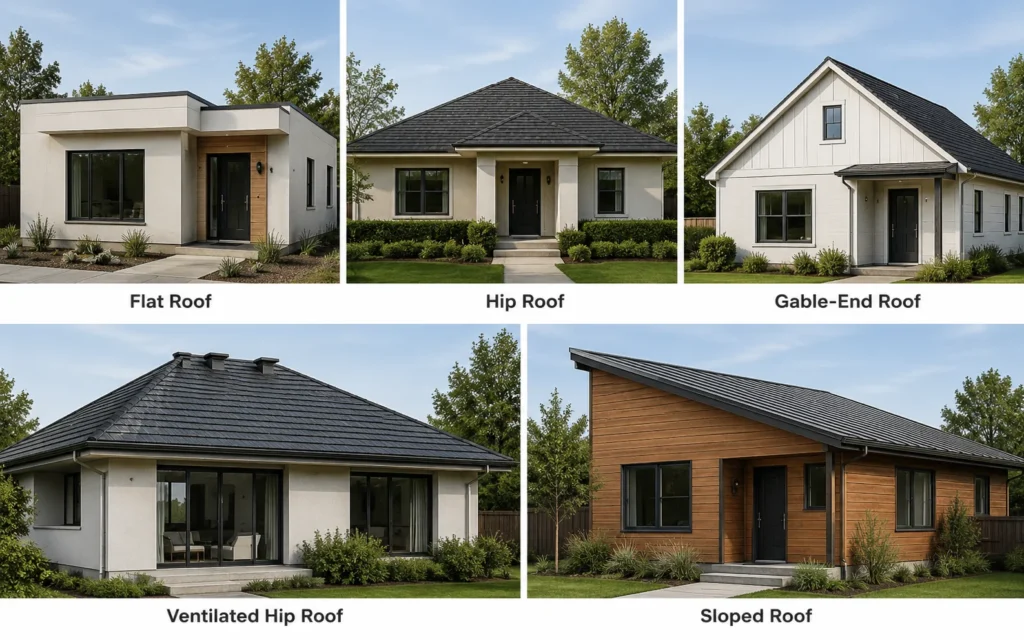
Flat Roofs
A flat roof is commonly used in commercial buildings because it provides good protection against weather conditions such as rain and snow. It also allows easy access for maintenance. However, flat roofs do not provide much insulation value.
Hip Roofs
Hip roofs are another type of gabled roof that has become increasingly popular in recent years. This design offers many benefits compared to other roof styles. For example, it provides excellent ventilation while also maintaining an attractive appearance.
Gable-End Roofs
Gable-end roofs are very popular among homeowners who want an attractive design without dealing with steep slopes. These roofs are often found in Victorian-style homes.
Ventilated Hip Roofs
Ventilated hip roofs are similar to regular hip roofs, but they include vents along the ridgeline. These vents allow air to flow through the roof, which helps reduce heat loss during the winter months.
Sloped Roofs
Sloped roofs are generally considered one of the easiest types of roofs to install. They provide maximum exposure area and help increase solar gain. In addition, they are relatively inexpensive compared to other forms of roofing.
The best way to determine your ideal roof pitch is to consult a professional roofing contractor. If you are planning construction or renovation and have specific requirements, it is advisable to consult local architects, builders, or authorities.
If you travel around the UK, you will most likely find roof pitches between 30° and 50°. Low-pitch roofs are generally defined as roofs with a pitch of less than 30°.
| Roof Type | Best Used For | Main Advantage | Main Limitation |
| Flat Roofs | Commercial buildings and modern properties | Easy access for maintenance and simpler construction | Not suitable for heavy winds or strong storms |
| Hip Roofs | Homes that need strong design and good ventilation | Attractive appearance and excellent ventilation | Requires more complex construction planning |
| Gable-End Roofs | Residential homes with traditional designs | Uses less material and sheds rainwater effectively | May not perform well in extreme temperatures |
| Ventilated Hip Roofs | Homes where airflow and heat control are important | Allows better air circulation through roof vents | More detailed design may be required |
| Sloped Roofs | Homes in areas where water drainage is important | Helps with solar gain and water runoff | Can be more expensive than flat roofs |
Pros and Cons of Different Comment Types of Roof Slopes
Each type of roof has its own advantages and disadvantages. Below, these points are discussed in detail.
Flat Roof Pros and Cons
Pros
A flat roof does not require additional support structures such as walls or columns. Therefore, it is easier to construct than a sloped roof.
Cons
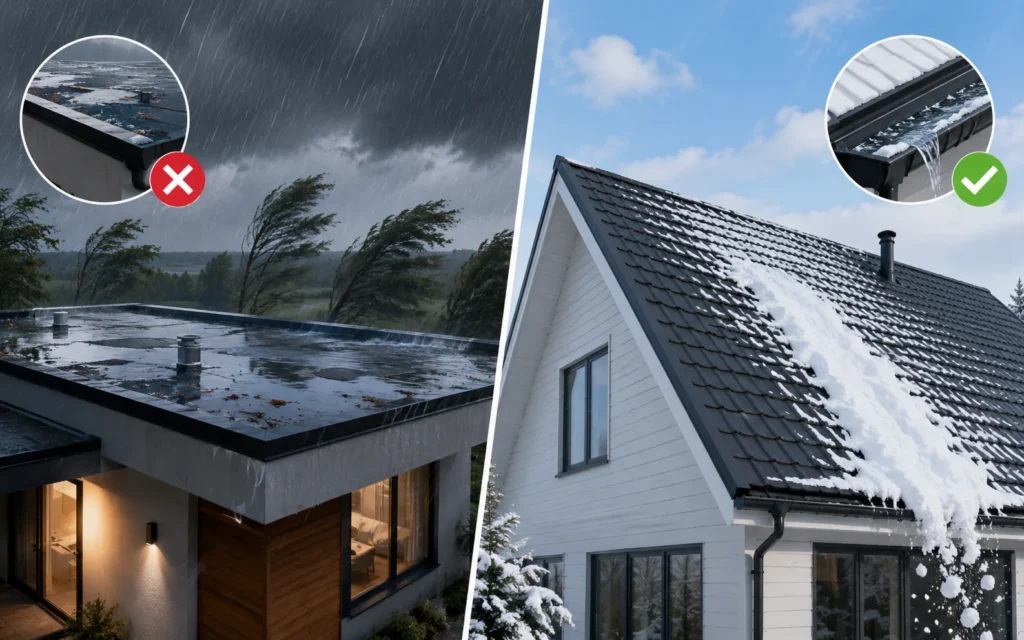
The downside is that flat roofs cannot withstand heavy winds or strong storms very well. In addition, if water enters the attic space, it can damage the structure below.
Gable-End Roof Pros and Cons
Pros
This type of roof requires less material than other roofs because it needs only two sides instead of four. As a result, it costs less to build. Another advantage of a gable-end roof is that it can shed large amounts of rainwater effectively.
Cons
The disadvantage of a gable-end roof is that it does not perform well in extreme temperatures. It may also struggle to control excessive heat.
Hip Roof Pros and Cons
Pros
As mentioned earlier, hip roofs are among the most versatile roof designs available today. They can easily accommodate different shapes and sizes.
Cons
One disadvantage is that construction projects involving hip roofs may take longer to complete because they require more complex engineering calculations.
Vented Hip Roof Pros
Vented hip roofs have become popular in recent years. They combine the advantages of both hip roofs and gable-end roofs. Like gable-end roofs, vented hip roofs do not require extra supports. The main difference between the two types is that vented hip roofs include ventilators.
Sloped Roof Cons
One of the biggest drawbacks of sloped roofs is that they may leak during high wind speeds. If you live in an area with frequent rainfall, you may face leakage problems sooner rather than later. Sloped roofs are also significantly more expensive than flat roofs.
The Best Rule for Roof Pitch Selection
To successfully apply the best rule for roof pitch selection, it is important to understand that the optimal roof angle is not one perfect solution. Instead, it is a balance between different requirements. Your roof pitch depends on the style of home you are building or renovating, as well as the area in which you live.
When selecting a roof pitch, several factors must be considered. These include the availability and cost of materials, appearance, ease or difficulty of construction, climatic factors such as wind and possible snow load, and local building codes. Traditional houses usually have steeper pitches. Victorian houses often have the steepest pitches, while Georgian houses usually have shallower pitches.
This rule emphasizes that long-term performance should be prioritized over short-term cost savings when selecting a roof pitch. Inadequate pitch angles often lead to expensive repair work and ongoing maintenance problems.
Modern building techniques and improved materials have expanded the usable pitch range for many applications. This allows greater flexibility in design while still maintaining the basic principles of the golden rule. However, this flexibility must be balanced with proven performance standards and regulatory requirements to ensure the best long-term results.
Historic Expressions of Roof Pitch
Historically, roof pitch was described in two other ways: as the ratio of ridge height to the width of the building, also known as the span, and as the ratio of rafter length to the width of the building.
Commonly used roof pitches were given names such as:
- Elizabethan: The rafters are longer than the span, with an angle greater than 60°.
- Common: The rafter length is 3⁄4 of the span, with an angle of approximately 48°.
- Greek: The ridge height is 1⁄9 to 1⁄7 of the span, with an angle of 12.5° to 16°.
- Roman: The ridge height is 2⁄9 to 1⁄3 of the span, with an angle of 24° to 34°.
- Gothic: The rafters are equal to the span, with an angle of 60°.
What is a Roof Pitch Calculator?
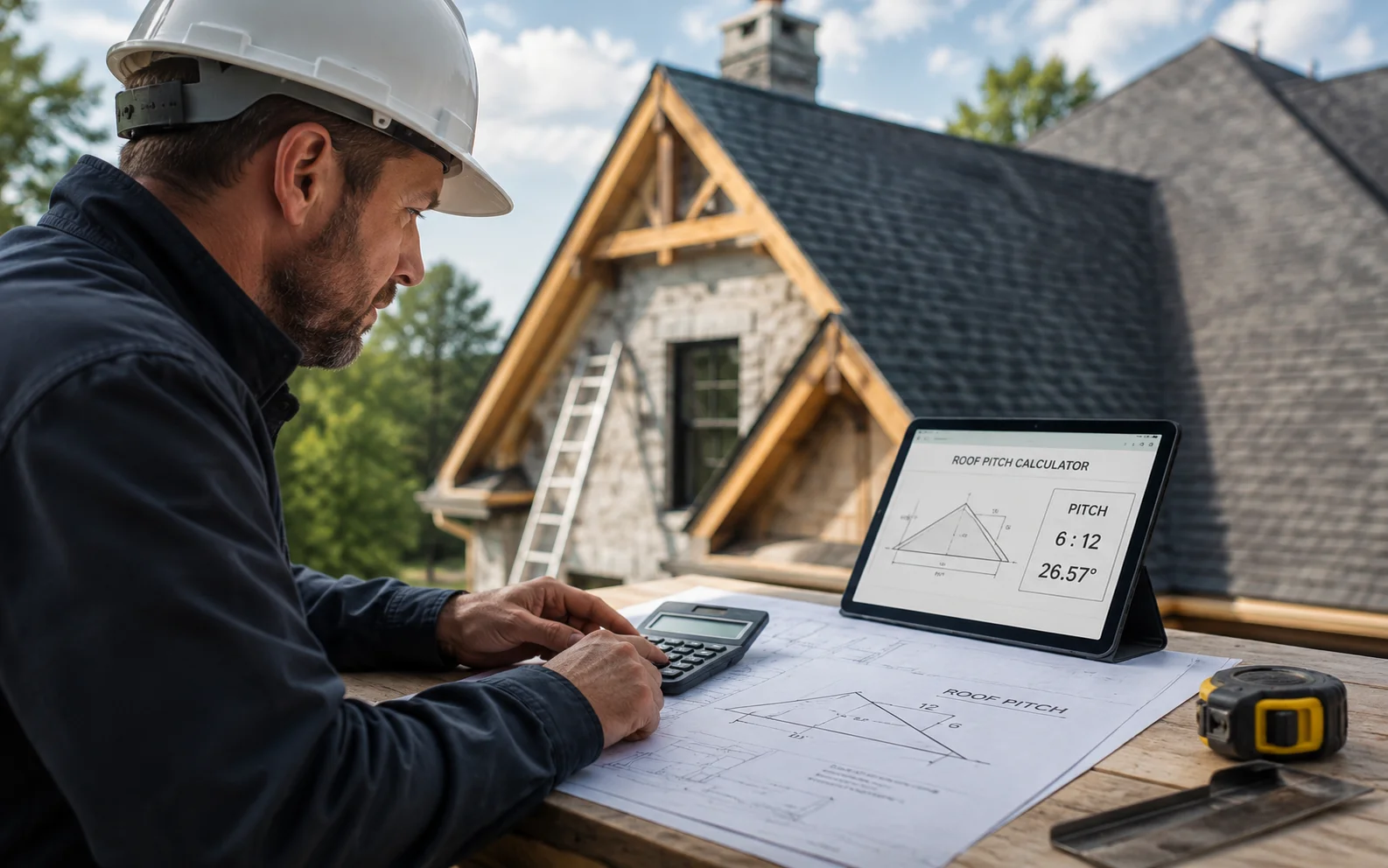
A roof pitch calculator is a simple online tool that allows homeowners to determine their ideal roof pitch without consulting a professional. This tool takes into account both the size of the structure and its location. It helps users decide whether installing a pitched roof instead of a flat roof is a sensible choice.
FAQs
Which Type of Roof Should I Choose?
If you are looking for an affordable solution, a flat roof may be suitable for you. However, if you prefer something more durable and long-lasting, you should consider installing a sloped roof on your home.
Do Certain Materials Work Better for Certain Pitches?
Choosing the pitch of your roof should be your decision, but some factors may limit your options. For example, some roofing materials cannot handle extreme pitches. When asphalt shingles are used on flat or low-sloped roofs, they allow water to penetrate more easily compared to other materials.
How Does the Local Climate Affect a Pitch?
The local climate should influence your choice of roof pitch. In areas that experience snowy winters, flat or low-slope roofs are not recommended because snow can accumulate and may cause the roof to collapse.
Local Regulations and Building Code for Roof Pitch?
The building code in your area will determine how steep your roof must be. In some cases, these regulations apply only to new homes, while in other areas, they may also apply to existing structures. Before making any decision about changing the pitch of your roof, you should check with your local city officials.