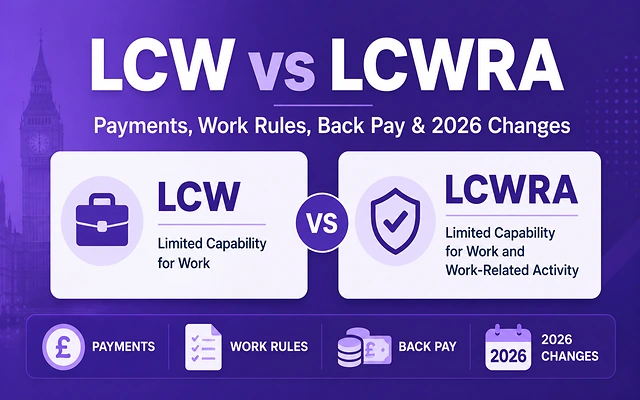
Difference Between LCW and LCWRA: Payments, Work Rules, Back Pay and 2026 Changes
If you have received a Universal Credit health decision and you are confused by the words LCW and LCWRA, you are not alone. These two terms sound similar, but they can affect your money, work-related requirements, Jobcentre appointments and possible back pay in very different ways.
The main difference is simple: LCW means you have limited capability for work now but may still need to prepare for work in the future. LCWRA means you have limited capability for work and work-related activity, so you usually do not have to look for work or prepare for work, and you may get an extra Universal Credit amount. GOV.UK explains that LCWRA can include an extra amount on top of the standard Universal Credit allowance, while LCW only gives an extra amount in limited older cases.
This guide explains the difference between LCW and LCWRA in plain English, including payments, the 2026 LCWRA changes, back pay, work rules, fit notes, Work Capability Assessments and what you can do if you believe the DWP decision is wrong.
Quick Answer: What Is the Difference Between LCW and LCWRA?
LCW stands for Limited Capability for Work. It means the DWP accepts that your health condition or disability limits your ability to work right now, but you may still be expected to take steps to prepare for work in the future.
LCWRA stands for Limited Capability for Work and Work-Related Activity. It means the DWP accepts that you are not expected to look for work or prepare for work because of how your health condition or disability affects you. GOV.UK says people with LCWRA do not need to look for work or prepare for work, although they can work if they feel able to.
The biggest practical difference is this:
| Decision | Simple meaning | Extra Universal Credit money? | Work-related activity? |
|---|---|---|---|
| LCW | You are not fit for work right now, but may prepare for work later | Usually no for newer claims | Usually yes, depending on your claimant commitment |
| LCWRA | You are not expected to work or prepare for work because of your condition | Usually yes | Usually no |
LCW vs LCWRA Comparison Table
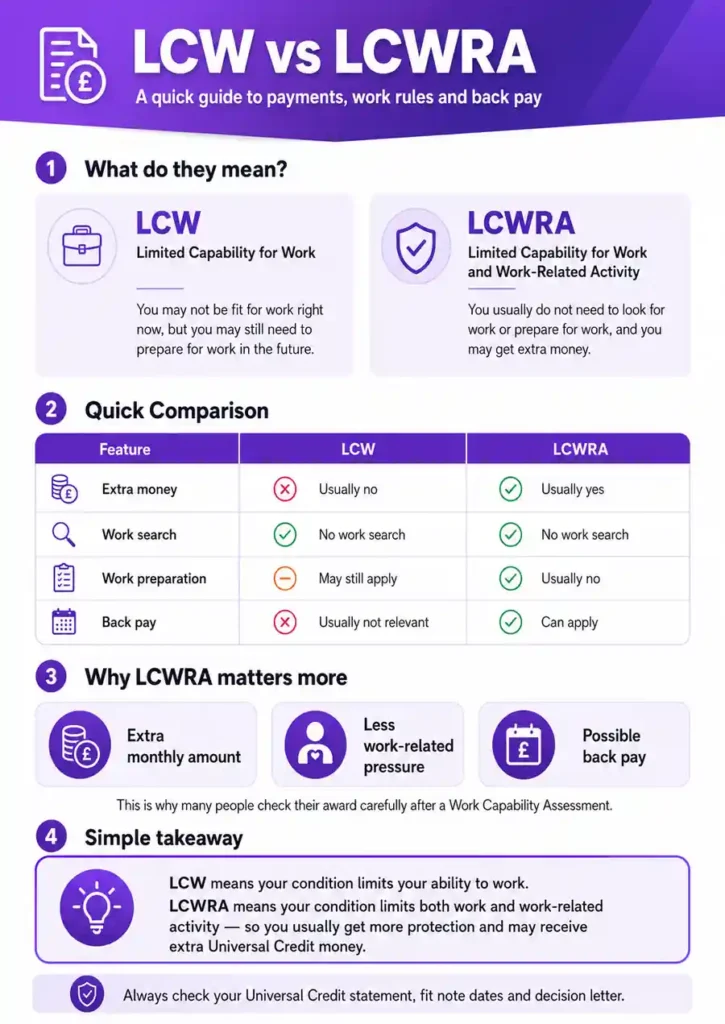
| Feature | LCW | LCWRA |
|---|---|---|
| Full name | Limited Capability for Work | Limited Capability for Work and Work-Related Activity |
| What it means | Your condition limits your ability to work now | Your condition limits both work and work-related activity |
| Work search | Usually you should not be required to look for work while LCW applies | You do not need to look for work |
| Work preparation | You may still need to do work preparation, such as speaking to a work coach or preparing a CV | You do not need to prepare for work |
| Extra UC money | Usually only if you had LCW before 3 April 2017 or moved from certain ESA cases | Yes, if LCWRA is awarded |
| Back pay | Usually not relevant for most newer LCW decisions | Often relevant if the LCWRA element starts after earlier assessment periods |
| Jobcentre contact | Can still happen | Usually reduced, depending on your circumstances |
| Can you work? | Yes, if you feel able to | Yes, if you feel able to |
| Decision comes from | Work Capability Assessment | Work Capability Assessment |
| Best next step after decision | Check your claimant commitment and evidence | Check your payment date, rate and possible back pay |
What Does LCW Mean on Universal Credit?
LCW means Limited Capability for Work. If you are given LCW, the DWP has decided that your health condition or disability limits the work you can do at the moment.
However, LCW does not usually mean you are completely free from all work-related requirements. GOV.UK explains that if you need to prepare to work in the future, your work coach may agree steps with you, such as preparing a CV.
Do You Get Extra Money for LCW?
For most newer Universal Credit claims, LCW does not add extra money.
This is one of the most common misunderstandings. Many people see “limited capability for work” and assume that it automatically means a higher Universal Credit payment. In most cases, the extra health amount is linked to LCWRA, not LCW.
GOV.UK states that an LCW extra amount may apply if you started your health-related Universal Credit or ESA claim before 3 April 2017. The current old LCW amount is listed as £158.76 per month.
What Work-Related Activities Can LCW Include?
If you have LCW, your claimant commitment should reflect your health condition. You should not be treated the same as someone who is fully fit for work. But you may still be asked to do reasonable work-preparation activities.
These could include:
- attending occasional work coach appointments;
- discussing future work options;
- updating or preparing a CV;
- joining training that fits your condition;
- taking small steps toward work if your health allows.
Your exact requirements should depend on your condition, your evidence and what your work coach agrees with you.
Can You Work If You Have LCW?
Yes. Having LCW does not ban you from working.
GOV.UK says you can still work if you feel able to, even if you have limited capability for work. Starting work does not automatically mean you need another assessment unless your health condition changes.
What Does LCWRA Mean on Universal Credit?
LCWRA means Limited Capability for Work and Work-Related Activity.
This is the more serious Universal Credit health decision. It means your health condition or disability affects you so much that you should not be required to look for work or prepare for work.
If you receive LCWRA, you usually get an extra Universal Credit amount on top of your standard allowance. GOV.UK also says some people call this the health element or the LCWRA element.
Do You Get Extra Money for LCWRA?
Yes, LCWRA usually adds extra money to your Universal Credit award.
From 6 April 2026, the LCWRA extra amount has two rates: a higher rate and a lower rate. The rate depends on when you declared your health condition, whether your condition is severe and lifelong, and whether you are nearing the end of life.
LCWRA Higher Rate and Lower Rate in 2026
As of the 2026/27 benefit year, Turn2us lists the LCWRA higher rate as £429.80 per month and the lower LCWRA rate as £217.26 per month.
| LCWRA situation | Likely monthly amount |
|---|---|
| Higher LCWRA rate | £429.80 |
| Lower LCWRA rate | £217.26 |
| Old LCW amount, where protected rules apply | £158.76 |
You should always check your Universal Credit statement because your total payment can also change because of rent, earnings, deductions, advances, sanctions, savings or other benefit income.
What Changed for LCWRA From 6 April 2026?
The Universal Credit Act 2025 changed how the LCWRA extra amount works from 6 April 2026. Before this change, LCWRA had one main extra amount. From 6 April 2026, LCWRA is paid at two rates: higher and lower.
You May Get the Higher LCWRA Amount If
You may get the higher LCWRA amount if any of these apply:
| Situation | Higher rate possible? |
|---|---|
| You were already getting LCWRA before 6 April 2026 | Yes |
| You told Universal Credit about your health condition before 6 April 2026 | Yes |
| You had the ESA support group component before 6 April 2026 and then moved to Universal Credit | Yes |
| You have a severe, lifelong health condition or disability | Yes |
| You are nearing the end of life | Yes |
GOV.UK says severe and lifelong conditions must mean you cannot work, will last your whole life, will not get better, and are officially diagnosed by a health professional.
You May Get the Lower LCWRA Amount If
You may get the lower LCWRA amount if all of these apply:
- you declared your health condition on or after 6 April 2026;
- you do not have a severe, lifelong health condition;
- you are not nearing the end of life;
- your partner is not entitled to the higher LCWRA amount.
This is why the date you first reported your health condition matters. If I were checking a UC statement, I would not only look at the decision date. I would also check the date the health condition was first reported and the date medical evidence started.
How the Work Capability Assessment Decides LCW or LCWRA
The DWP usually decides LCW or LCWRA through a Work Capability Assessment, often called a WCA.
The WCA looks at how your condition affects your ability to work. It can include physical health, mental health, cognitive difficulties, fatigue, pain, mobility, communication, safety, and how reliably you can do tasks.
GOV.UK says you may need a WCA if your condition limits how much work you can do for longer than 28 days. Before the assessment, you usually need to complete the Capability for Work questionnaire, called the WCA50.
Citizens Advice also explains that people usually need to complete the WCA50 form and usually attend a medical assessment, and the process can take a few months.
Possible WCA Outcomes
After the Work Capability Assessment, you may be told that you:
| WCA outcome | What it means |
|---|---|
| Fit for work | You are expected to look for suitable work |
| LCW | You have limited capability for work but may prepare for work |
| LCWRA | You are not expected to look for work or prepare for work |
| LCWRA with severe lifelong condition | You have LCWRA and meet severe lifelong condition rules |
LCWRA Back Pay: When Does the Extra Money Start?
LCWRA back pay is one of the biggest reasons people search for the difference between LCW and LCWRA.
If you are awarded LCWRA, you will usually get the extra money after 3 monthly assessment periods from when you started submitting medical evidence, such as fit notes, showing that your condition limits how much work you can do. GOV.UK says there are exceptions where it can be added straight away, such as end-of-life rules or some moves from ESA to Universal Credit.
Simple LCWRA Back Pay Example
Let’s say your Universal Credit assessment period runs from the 10th of one month to the 9th of the next month.
Example:
| Step | Example date |
|---|---|
| You first provide fit note evidence | 15 January |
| Assessment period containing fit note | 10 January to 9 February |
| Waiting assessment period 1 | 10 February to 9 March |
| Waiting assessment period 2 | 10 March to 9 April |
| Waiting assessment period 3 | 10 April to 9 May |
| First possible LCWRA payable assessment period | 10 May to 9 June |
In this example, the LCWRA element may first appear after the 10 May to 9 June assessment period, depending on the decision date, evidence and your exact Universal Credit record.
If you already have your fit note date, assessment period dates and decision date, you can use our LCWRA back pay calculator to estimate when your extra payment may start and whether any backdated amount may be due.
Why Your Back Pay Can Be Different From Someone Else’s
Two people can receive LCWRA on the same date but get different back pay because their Universal Credit assessment periods are different.
Your back pay may depend on:
- the first date you reported your health condition;
- the first date you submitted fit notes or medical evidence;
- your monthly assessment period dates;
- the date of the LCWRA decision;
- whether you were moving from ESA;
- whether end-of-life rules apply;
- whether DWP accepts an earlier evidence date;
- whether there were gaps in your fit notes.
This is why you should never calculate LCWRA back pay from the decision date alone.
Can You Work While on LCW or LCWRA?
Yes. You can work while on LCW or LCWRA if you feel able to.
This point is important because many people worry that trying work will automatically remove their LCWRA. GOV.UK says starting work does not mean you need another assessment unless your health condition changes.
However, earnings can still affect your Universal Credit payment.
Work Allowance Explained
If you or your partner has limited capability for work, you may qualify for a work allowance. This means you can earn a certain amount before your earnings reduce your Universal Credit.
Turn2us lists the 2026 work allowance as:
| Situation | Monthly work allowance |
|---|---|
| You get help with housing costs through Universal Credit | £427 |
| You do not get help with housing costs through Universal Credit | £710 |
After the work allowance, the Universal Credit taper rate is 55%, meaning your UC is reduced by 55p for every £1 of earnings over the work allowance.
What You Must Report
You should report changes that may affect your claim, including if:
- your condition gets better;
- your condition gets worse;
- you start work;
- you stop work;
- your earnings change;
- you move in with a partner;
- you have a new health condition.
GOV.UK says you must report changes straight away because otherwise you could be paid too much or too little.
LCWRA for Couples
If you live with your partner and both of you have LCWRA, your Universal Credit usually includes only one extra monthly LCWRA amount.
If one partner is entitled to the higher LCWRA amount, the couple receives the higher amount. GOV.UK confirms this rule for couples where both partners have LCWRA.
Example
If Person 1 has lower-rate LCWRA and Person 2 has higher-rate LCWRA, the Universal Credit award should include one LCWRA amount at the higher rate.
If both partners have LCWRA at the lower rate, the award usually includes one lower LCWRA amount, not two separate LCWRA elements.
LCW, LCWRA and Carer Element
If you are entitled to an extra Universal Credit amount because you care for someone and you are also entitled to LCW or LCWRA, you do not receive both extra amounts. GOV.UK says you receive the higher of the two amounts.
This matters if you are both disabled and caring for someone else. You should check your statement carefully to see which element has been included.
LCW and LCWRA When Moving From ESA
If you were previously on Employment and Support Allowance, your ESA group can affect what happens on Universal Credit.
GOV.UK says people moving from ESA to Universal Credit without a break may not need to provide fit notes or have another WCA if they have already completed a WCA and were in the ESA support group or work-related activity group when they claimed Universal Credit.
| ESA group | Universal Credit outcome |
|---|---|
| ESA Support Group | Usually LCWRA |
| ESA Work-Related Activity Group | Usually LCW, depending on rules and dates |
Citizens Advice explains that if you get the ESA support component, you automatically have LCWRA, and if you were in the ESA work-related activity group, you automatically have LCW.
Does LCWRA Affect PIP?
LCWRA and PIP are different benefits with different tests.
LCWRA is about how your condition affects your ability to work and do work-related activity. PIP is about how your condition affects daily living and mobility. Being awarded LCWRA does not automatically mean you will get PIP, and getting PIP does not automatically mean you will get LCWRA.
However, evidence used for one benefit may sometimes help explain your condition for the other. For example, medical letters, care plans, occupational therapy reports or specialist evidence may support both claims if they clearly describe how your condition affects you.
What If You Got LCW but Think You Should Have Got LCWRA?
If you got LCW but believe your condition means you should not have to prepare for work, you may be able to challenge the decision.
This is usually done through mandatory reconsideration first. GOV.UK says you usually need to ask for mandatory reconsideration within one month of the decision date. You can ask later if you have a good reason, such as being in hospital or bereavement.
Step 1: Read the Decision Carefully
Check whether the decision says:
- fit for work;
- LCW;
- LCWRA;
- LCWRA with severe lifelong condition.
Also check the date of the decision and whether the letter explains why the DWP chose that outcome.
Step 2: Compare Your Condition With the WCA Rules
Do not only say, “I am unwell.” Instead, explain exactly why work-related activity is not realistic or safe for you.
Strong evidence may include:
- GP letters;
- consultant letters;
- mental health team notes;
- hospital discharge summaries;
- medication lists;
- care plans;
- therapy reports;
- occupational health reports;
- evidence from a carer or support worker;
- your own daily examples.
Step 3: Ask for Mandatory Reconsideration
In your journal or letter, clearly say:
I want to ask for a mandatory reconsideration of the Work Capability Assessment decision because I believe I should have been placed in the LCWRA group, not the LCW group.
Then explain what the DWP missed, what evidence supports you, and how your condition affects you most days.
Step 4: Appeal If Needed
If the mandatory reconsideration does not change the decision, you may be able to appeal to a tribunal. Many people get advice from Citizens Advice, a welfare rights adviser, a disability charity or a local law centre before appealing.
Common Mistakes People Make With LCW and LCWRA
Mistake 1: Thinking LCW Always Means Extra Money
For most newer claims, LCW does not add extra Universal Credit money. LCWRA usually does.
Mistake 2: Checking the Decision Date but Not the Fit Note Date
LCWRA back pay often depends on when you started submitting medical evidence, not just when the decision arrived.
Mistake 3: Missing the Mandatory Reconsideration Deadline
If you disagree with the decision, act quickly. The usual deadline is one month from the decision date.
Mistake 4: Sending Evidence Without Explaining It
Do not assume the assessor will understand how your evidence connects to work. Explain your symptoms, frequency, risk, recovery time, and what happens if you try to do too much.
Mistake 5: Thinking Work Automatically Ends LCWRA
Working does not automatically end LCWRA. But you should report work and earnings correctly, and you should report any change in your health condition.
LCW vs LCWRA: Which One Applies to You?
You may fit LCW if your condition limits your ability to work right now, but you can still take some reasonable steps to prepare for work in the future.
You may fit LCWRA if work-related activity itself is not realistic, safe, or manageable because of your condition.
Ask yourself:
| Question | If yes, it may support |
|---|---|
| Can I do some preparation for work with support? | LCW |
| Would work preparation put my health at serious risk? | LCWRA |
| Do I need long recovery after basic activities? | Possibly LCWRA |
| Do I struggle to attend appointments reliably? | Possibly LCWRA |
| Is my condition severe, lifelong and unlikely to improve? | LCWRA higher-rate consideration |
| Am I nearing the end of life? | LCWRA higher-rate / special rules |
Final Summary
The difference between LCW and LCWRA matters because it can change your Universal Credit payment, work-related requirements, and possible back pay.
In simple terms:
- LCW means your condition limits your ability to work, but you may still need to prepare for work.
- LCWRA means your condition limits both work and work-related activity, so you usually do not need to look for work or prepare for work.
- LCW usually does not add extra money for newer claims.
- LCWRA usually adds extra money and may create back pay.
- From 6 April 2026, LCWRA has a higher rate and a lower rate.
- If you disagree with an LCW decision, you can usually ask for mandatory reconsideration within one month.
If you have just received your decision, check three things first: your decision letter, your Universal Credit assessment period dates and the date you first submitted medical evidence. Those three details usually tell you what the decision means, when payment may start and whether you should challenge it.
FAQs
What is the main difference between LCW and LCWRA?
LCW means you have limited capability for work but may still need to prepare for work in the future. LCWRA means you have limited capability for work and work-related activity, so you usually do not need to look for work or prepare for work.
Does LCW get extra money?
Usually, no. LCW only gives an extra amount in limited older cases, such as if your health-related Universal Credit or ESA claim started before 3 April 2017.
Does LCWRA get extra money?
Yes. LCWRA usually adds an extra amount to your Universal Credit. From 6 April 2026, LCWRA has a higher rate and a lower rate.
How much is LCWRA in 2026?
The higher LCWRA rate is listed as £429.80 per month, and the lower LCWRA rate is listed as £217.26 per month for claims on or after 6 April 2026.
When does LCWRA payment start?
LCWRA usually starts after 3 monthly assessment periods from when you started submitting medical evidence, such as fit notes. Some cases can start sooner, such as end-of-life rules or certain ESA moves.
Can I get LCWRA back pay?
Yes, you may get LCWRA back pay if your decision is made after the date your LCWRA element should have started. The exact amount depends on your assessment periods, evidence date, decision date and rate.
Can I be moved from LCW to LCWRA?
Yes, it can happen after reassessment, a change in your condition or a successful challenge. If you believe the decision is wrong, you can ask for mandatory reconsideration.