Pregnancy Gender Predictor
You want a quick boy-or-girl prediction, but different ages, conception dates, and calendar rules can make a simple guess surprisingly confusing.
Enter your date of birth and the best conception information you have. This pregnancy gender predictor applies a traditional Chinese calendar method and shows the age and conception month used for your result.
Important: This is a folklore-based prediction for entertainment only. It cannot determine your baby’s sex and should never influence medical treatment or pregnancy decisions.
Pregnancy Gender Predictor
Enter your birth date and the closest pregnancy date you know to get a just-for-fun boy-or-girl prediction.
For fun, this predictor points to a result.
This prediction is for entertainment only. It cannot determine your baby’s sex and should not be used for medical, pregnancy, fertility, or treatment decisions.
Try the Pregnancy Gender Predictor
Enter two details to receive your prediction:
- Your date of birth
- Your exact or estimated conception timing
You can still use the tool when you do not know your conception date. Select your due date or the first day of your last menstrual period, and the calculator can create an estimate.
Recommended calculator fields
Your date of birth
Used to calculate your age at conception and traditional Chinese lunar age.
What conception information do you have?
- Exact or estimated conception date
- Estimated due date
- First day of your last menstrual period
- A hypothetical future conception date
Predict Boy or Girl
Calculator disclaimer: This folklore prediction is for entertainment only and cannot medically determine your baby’s sex.
Your result
The result card should use one of the following messages:
Boy result:
For fun, this traditional Chinese calendar method points to a boy.
Girl result:
For fun, this traditional Chinese calendar method points to a girl.
Uncertain result:
This chart cannot provide a clear result from the details entered. Check your dates or review the input guidance below.
Every result should also display:
- The conception date used
- Whether that date was entered or estimated
- Your age at conception
- Your calculated Chinese lunar age
- The lunar conception month
- The chart result
- A short explanation of the lookup
Remember: This prediction cannot confirm fetal sex. Use it as a fun activity while relying on your maternity-care team for medical information.
What Should You Enter?
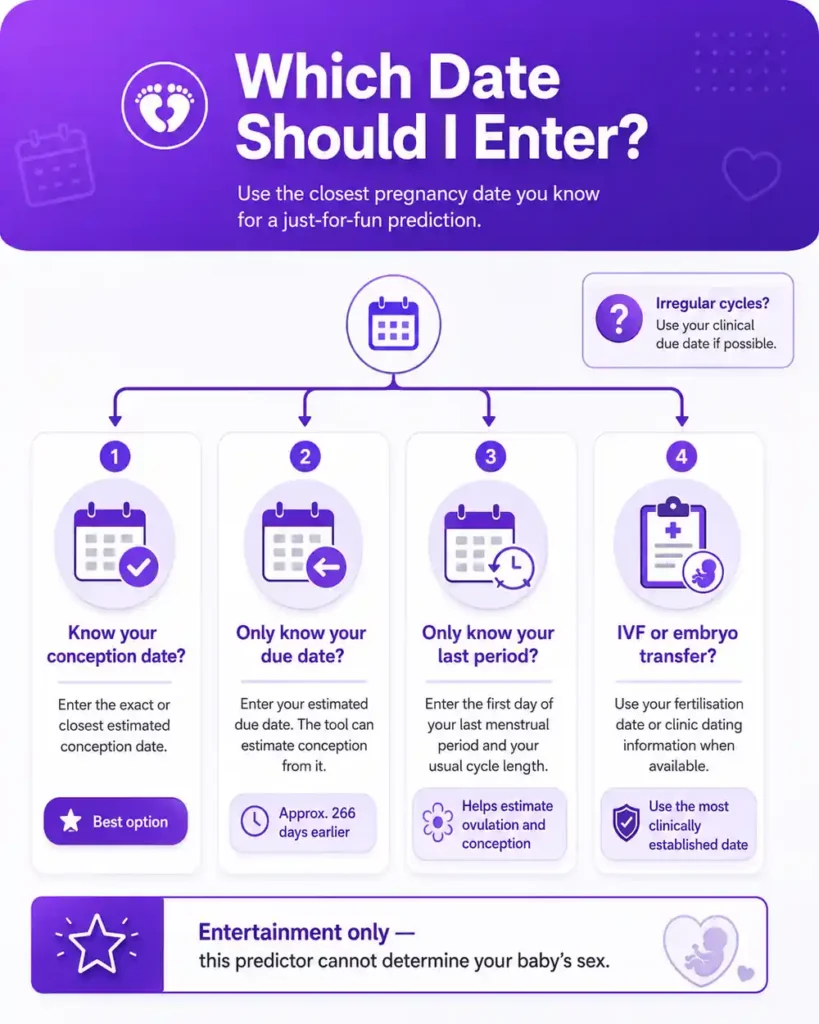
The calculator works best when you provide a complete date of birth and the closest available conception date.
You do not need to calculate your lunar age or lunar conception month yourself. The tool should convert the dates automatically.
| Information you have | What to enter | How the calculator uses it | Main limitation |
|---|---|---|---|
| Exact conception or fertilisation date | Enter that date directly | Uses it as the conception date | Fertilisation timing may still be estimated outside assisted reproduction |
| Only your due date | Enter the clinical estimated due date | Counts back approximately 266 days | A due date is an estimate and may be revised |
| Only your last menstrual period | Enter the first day of your LMP and usual cycle length | Estimates ovulation and conception timing | Less reliable with irregular cycles |
| Irregular cycles | Use your clinically established due date where possible | Creates an estimated conception date | LMP-based calculations may be inaccurate |
| IVF or embryo transfer | Use the fertilisation date or dating information supplied by your clinic | Uses the closest clinically established date | A folklore chart has no validated IVF-specific method |
| Twin or multiple pregnancy | Enter the pregnancy dates only if you want one general folklore result | Produces one shared calendar prediction | Cannot predict the sex of each fetus |
| Planning before pregnancy | Enter a hypothetical conception date | Shows what the chart would predict for that date | Cannot help select or control a baby’s sex |
When You Know the Conception Date
Enter the exact or closest estimated date on which conception occurred.
Conception does not always happen on the day of sexual intercourse. Sperm can survive in the reproductive tract for several days, while the egg remains available for fertilisation for a much shorter period. This means conception timing may still be uncertain unless fertilisation was recorded during assisted reproduction.
A small date difference may also change the Chinese lunar month when conception occurred close to a calendar boundary.
When You Only Know Your Due Date
Your estimated due date can be used to estimate your conception date.
Pregnancy dating conventionally begins from the first day of the last menstrual period, approximately two weeks before conception in a regular 28-day cycle. A due date is commonly calculated as 280 days from the LMP. As a practical estimate, the calculator can count back approximately 266 days from the due date to estimate conception.
This does not identify the exact day fertilisation happened. Your due date may also change after an ultrasound dating scan.
The result should therefore display:
Estimated conception date: This date was calculated from your due date and may not be exact.
When You Only Know Your Last Menstrual Period
Enter the first day of your last menstrual period, not the day your bleeding ended.
For a regular 28-day cycle, traditional pregnancy dating assumes ovulation around day 14. The estimated ovulation date can be adjusted when a different usual cycle length is entered.
For example:
- A 28-day cycle gives an estimated ovulation date around cycle day 14.
- A 32-day cycle gives an estimate around cycle day 18.
- A 24-day cycle gives an estimate around cycle day 10.
These are estimates rather than a reliable way to identify the precise day of conception. Ovulation can change from one cycle to another, and standard LMP dating does not fully account for irregular cycles or variable ovulation timing.
Irregular Cycles
An LMP calculation may be particularly uncertain when:
- Your cycles vary considerably in length
- You recently stopped hormonal contraception
- You were breastfeeding
- You experienced recent pregnancy loss
- You have a condition that affects ovulation
- You do not remember your LMP accurately
Use your clinically established due date or dating-scan information when available. The folklore result will remain entertainment regardless of which date is entered.
IVF and Embryo Transfer
Assisted reproduction can provide more precise clinical dates, but traditional gender charts were not designed for IVF, frozen embryo transfer, donor eggs or embryo testing.
Use the following order of preference:
- The fertilisation date supplied by your fertility clinic
- The clinically calculated conception equivalent
- Your official estimated due date
Do not invent a conception date by treating every embryo-transfer date as fertilisation day. IVF pregnancy dating can depend on the age of the embryo and the date it was transferred.
The Chinese chart has no scientifically validated rule for deciding whose age should be entered in a donor-egg pregnancy. Any result in this situation would be especially arbitrary.
Twins and Multiple Pregnancy
This calculator cannot predict whether individual twins or multiples are boys or girls.
The pregnancy has one conception period, but each fetus may have its own chromosomal pattern. Running the same calendar details more than once would simply repeat the same folklore result; it would not provide separate information about each baby.
How Does the Pregnancy Gender Predictor Work?
This tool uses a version of the traditional Chinese gender chart.
The chart compares:
- Chinese lunar age at conception
- Chinese lunar month of conception
Each age-and-month combination corresponds to a boy or girl result on the chart.
The tool should first convert your Gregorian birth and conception dates into Chinese lunisolar dates. It then calculates the age and month required for the chart lookup.
Actual Age vs Chinese Lunar Age
Your actual age is the number of full years that have passed since your birth.
Traditional Chinese age reckoning works differently. A person is considered age one at birth, and age may increase at the beginning of a new lunar year rather than on the person’s birthday.
A commonly used calculator formula is:
Chinese lunar age at conception = lunar conception year − lunar birth year + 1
This means your lunar age may be one or two years higher than your age under the standard Gregorian system.
| Term | Meaning |
|---|---|
| Current age | Your age today |
| Age at conception | Your actual age when conception occurred |
| Chinese lunar age | A traditional age calculated using lunar years |
| Gregorian conception month | The standard calendar month in which conception occurred |
| Lunar conception month | The month after converting the date to the Chinese lunisolar calendar |
You should not be asked to calculate these values manually. The tool should display them after calculation so you can see exactly how it reached the result.
Conception Month vs Last Menstrual Period
The first day of your last menstrual period is used to date a pregnancy, but it is not normally the conception date.
Gestational age begins from the LMP because the exact day of fertilisation is usually unknown. Conception generally occurs later in the cycle.
Entering your LMP directly as the conception date may therefore place the pregnancy in the wrong calendar month. This matters when the two dates fall on opposite sides of a lunar-month boundary.
Which Chinese Gender Chart Is Used?
Different websites sometimes display different chart versions or apply different date-conversion rules. That is one reason two Chinese predictors may produce different results from identical details.
The final calculator must use one fixed, documented chart rather than mixing results from several versions.
Its methodology should disclose:
- The chart version or source used
- The supported lunar ages
- The supported calendar years
- The date-conversion method
- How leap lunar months are handled
- When the calculator returns an uncertain result
The tool should not force a result when an input falls outside the chart or conversion range.
Is a Pregnancy Gender Predictor Accurate?
No calendar-based pregnancy gender predictor can medically determine fetal sex.
A population-based study assessing the Chinese lunar-calendar method found that it performed no better than tossing a coin.
That does not mean you cannot enjoy using it. It means the result should be understood as a guess rather than evidence.
Claims that these charts are 70%, 90% or 99% accurate are not supported by reliable clinical evidence.
Why Does the Predictor Sometimes Seem Accurate?
A boy-or-girl predictor has only two common result options, so it will frequently appear correct by chance.
It may also feel more accurate because people are more likely to:
- Remember a correct prediction
- Share a correct result
- Forget an incorrect result
- Try several charts and focus on the one that matched
- Interpret an unclear rule in a way that fits the final outcome
A correct result does not prove that the calendar caused or accurately detected the outcome.
Why Do Two Gender Predictors Give Different Answers?
Folklore methods use different rules.
For example:
- A Chinese chart may use lunar age and lunar conception month.
- A Mayan method may compare actual age with the Gregorian conception month.
- A symptom quiz may use cravings, mood, or belly shape.
- Another chart may use a different lunar conversion or leap-month rule.
When methods disagree, it does not mean that one has detected something the other missed. It means their formulas are unrelated and are not measuring fetal biology.
Can Pregnancy Symptoms Predict a Boy or Girl?
Common pregnancy symptoms cannot reliably determine fetal sex.
These folklore signs include:
- Sweet or salty cravings
- Severe or mild morning sickness
- Carrying high or low
- A round or pointed bump
- Clear or spotty skin
- Fast or slow fetal heart rate
- Sleeping on one particular side
- Cold feet
- Mood changes
- The ring test
- The baking-soda test
Symptoms can vary because of hormones, gestational stage, diet, sleep, hydration, individual health, and many other factors. They should not be interpreted as fetal-sex tests.
Do not use symptoms—or the absence of symptoms—to decide whether a pregnancy is progressing normally. Speak to a qualified healthcare professional when you are worried about a symptom.
Fun Predictor vs Medical Confirmation
A folklore predictor, ultrasound, screening test, and diagnostic test do not provide the same type of information.
| Method | Classification | When it may be used | What it does | Main limitation |
|---|---|---|---|---|
| Chinese calendar predictor | Folklore entertainment | Before or during pregnancy | Produces a boy-or-girl guess from age and conception timing | No reliable scientific support |
| Mayan predictor | Folklore entertainment | Before or during pregnancy | Uses an age-and-month rule | No reliable scientific support |
| Symptom quiz | Folklore entertainment | After symptoms begin | Compares symptoms with old wives’ tales | Symptoms do not determine fetal sex |
| Ultrasound | Medical imaging | Commonly during the mid-pregnancy scan | May allow a sonographer to view external anatomy | Position, timing and hospital policy may prevent identification |
| NIPT or cell-free DNA | Prenatal screening | From around 10 weeks for eligible testing | Screens placental DNA for specified chromosomal conditions | A screening result is not a diagnosis |
| CVS | Diagnostic testing | Usually earlier than amniocentesis when clinically offered | Tests placental cells for specified genetic or chromosomal conditions | Invasive and performed for medical reasons |
| Amniocentesis | Diagnostic testing | Later than CVS when clinically offered | Tests cells collected from amniotic fluid | Invasive and performed for medical reasons |
Ultrasound and the 20-Week Scan
In England, ultrasound scans are generally offered at approximately 11–14 weeks and again between 18 and 21 weeks. The later scan is commonly called the 20-week screening or anomaly scan and is primarily used to examine fetal development and screen for certain physical conditions.
You may be able to ask about fetal sex during the 20-week scan, depending on hospital policy.
Identification may not be possible when:
- The fetus is in an awkward position
- The relevant anatomy cannot be seen clearly
- The scan takes place too early
- Image quality is limited
- The hospital does not provide this information
The NHS warns that a sonographer cannot be 100% certain and that some hospitals do not disclose fetal sex.
An ultrasound should not be treated only as a gender-reveal appointment. It is an important medical examination.
NIPT and Cell-Free DNA Screening
Non-invasive prenatal testing, commonly called NIPT or cell-free DNA screening, examines DNA fragments from the placenta in a pregnant person’s blood.
Cell-free DNA screening may be performed from approximately 10 weeks of pregnancy. It is used to screen for specified chromosomal conditions, including certain sex-chromosome abnormalities.
Some test providers may also report information about likely fetal sex. This depends on:
- The test selected
- The healthcare system
- Local regulations
- The laboratory
- Whether the pregnancy involves multiples
- The quality and quantity of DNA in the sample
NIPT is a screening test, not a diagnostic test. A result showing an increased chance of a chromosomal condition may need confirmation through diagnostic testing and professional interpretation.
Ask your midwife, obstetrician, doctor or genetic counsellor what your specific test includes.
CVS and Amniocentesis
Chorionic villus sampling and amniocentesis are diagnostic procedures used to investigate particular genetic or chromosomal conditions.
CVS tests a small sample of placental tissue and is usually performed earlier in pregnancy. ACOG describes CVS as generally taking place between 10 and 13 weeks.
Amniocentesis uses a sample of the fluid surrounding the fetus. Both procedures are offered for medical reasons and involve different timing, methods, benefits, and risks.
They should never be presented as casual gender tests. Decisions about diagnostic procedures should be made with qualified maternity and genetics professionals.
How Chromosomal Sex Is Established
In the most common simplified model, an egg contributes an X chromosome. A sperm may contribute an X or Y chromosome.
An XX combination is typically associated with female development, while XY is typically associated with male development. Human sex development is more complex than these two patterns, and variations in chromosomes, genes, hormones, or anatomy can occur.
Calendar dates, cravings, fetal heart rate, and belly shape do not change or reveal this chromosomal process.
Sex and Gender Are Not the Same
This page uses the phrase “pregnancy gender predictor” because it is the familiar name people search for. Medically, however, the tool is attempting to guess fetal sex—not a child’s future gender identity.
The World Health Organization explains that sex refers to biological and physiological characteristics, while gender involves socially constructed characteristics, roles and identities. Gender identity is an individual’s internal experience and cannot be predicted during pregnancy.
A calendar cannot determine:
- A child’s gender identity
- Personality
- Interests
- Behaviour
- Future appearance
- Health
- Development
Compare Other Folklore Predictors
Trying different traditional methods can be an enjoyable activity, provided each result is treated as entertainment.
Mayan Calendar Gender Predictor
The Chinese method uses a traditional lunar age and lunar conception month. A Mayan-style predictor commonly compares actual age at conception with the Gregorian conception month.
You can compare your result with the Mayan calendar gender calculator, but treat both predictions as fun guesses rather than medical evidence.
Do not combine the results into a percentage.
For example, when the Chinese method says girl and the Mayan method says boy, the responsible conclusion is:
Two folklore methods produced different guesses because they use different rules. Neither method can determine fetal sex.
Why We Do Not Use a Combined Prediction Score
A result such as “78% likely to be a boy” may look scientific, but it would not be justified.
Combining several unsupported methods does not make them more reliable. A score built from cravings, maternal age, lunar months and fetal heart rate would create false precision without measuring a meaningful biological probability.
Each optional folklore method should therefore produce a separate, clearly labelled result.
Common Mistakes to Avoid
Entering Your Current Age
The chart generally needs your age at conception, not your age today.
The calculator should derive this automatically from your complete date of birth and conception timing.
Entering the LMP as the Conception Date
The first day of your last menstrual period normally occurs before conception. Select the LMP option so the tool can estimate conception instead.
Calculating Lunar Age Yourself
Different websites use inconsistent rules. Enter your normal date of birth and allow the tool to perform its documented conversion.
Treating an Estimate as an Exact Date
A conception date calculated from an LMP or due date is approximate. The result should clearly display an “estimated” label.
Changing the Inputs Until You Get the Result You Want
Trying several dates can be fun, but it does not increase accuracy. Dates should not be adjusted to support sex selection or important pregnancy decisions.
Assuming a Correct Prediction Proves the Formula
A binary guess will often be correct by chance. One matching result does not validate the method.
Enjoy the Prediction—But Rely on Medical Care for Confirmation
A pregnancy gender predictor can add a little fun while you wait to learn more about your baby. Enter the best dates you have, see how the traditional chart reaches its result, and compare it with other folklore methods if you enjoy doing so.
Just keep the result in perspective.
Calendar charts, symptoms and old wives’ tales cannot determine fetal sex. For medically reliable information, speak with your midwife, obstetrician, doctor or prenatal-care team about the screening and ultrasound options appropriate for your pregnancy.
Final reminder: This tool is for entertainment only. Do not use its result to make medical, fertility, treatment, sex-selection or pregnancy decisions.
FAQs
How does a pregnancy gender predictor work?
This predictor uses a traditional Chinese calendar chart. It converts your birth date and conception timing into Chinese lunar values, then compares your lunar age at conception with the lunar conception month. The corresponding chart cell produces a boy-or-girl guess.
The method is folklore rather than a medical or diagnostic calculation.
Is a baby gender predictor accurate?
No calendar-based baby gender predictor has been shown to determine fetal sex reliably.
A population-based study found that the Chinese lunar-calendar method performed no better than tossing a coin.
Use the result for entertainment rather than reassurance, planning, or medical decisions.
What age should I enter?
Enter your complete date of birth rather than your current age.
The calculator should use that date to calculate:
- Your actual age at conception
- Your traditional Chinese lunar age at conception
This avoids confusion when a birthday or lunar new year falls close to the conception date.
Should I use my actual age or lunar age?
Enter your normal Gregorian date of birth.
You should not need to calculate lunar age yourself. The calculator should convert the date and show the lunar age used in the result.
Which conception month should I use?
Enter the exact or closest estimated conception date.
The calculator should convert that date into the required lunar month. Do not automatically use the month of your LMP, positive pregnancy test, or due date.
What if I do not know my conception date?
Select the due-date or LMP option.
The calculator can estimate conception by:
- Counting back approximately 266 days from your due date, or
- Estimating ovulation from your LMP and usual cycle length
Either result remains approximate.
Can I use my due date?
Yes. Your due date can be used to estimate conception by counting back approximately 266 days.
The resulting date is not guaranteed to be the exact day of fertilisation. Clinical due dates can also be revised after ultrasound measurements.
What is the difference between conception date and LMP?
The LMP is the first day of your last menstrual period. Pregnancy weeks are conventionally counted from this date, even though conception normally occurs later.
The conception date is the estimated time when an egg was fertilised.