UKMEC Breast Cancer: Contraception Safety Guide
UKMEC Breast Cancer: Quick Answer
If you have current or past breast cancer, or you are worried because breast cancer runs in your family, UKMEC can help you understand which contraception options are considered safer and which need specialist advice. UKMEC is a contraceptive safety guide. It does not predict breast cancer survival, recurrence, or your personal cancer risk.
The main practical point is this: the copper IUD is usually the key non-hormonal option to discuss, while hormonal contraception often becomes restricted if you have current or previous breast cancer. UKMEC 2025 lists current breast cancer as category 4 for hormonal methods and completed breast cancer treatment as category 3 for hormonal methods.
Medical disclaimer
This article is for information only. Please speak with a GP, contraception specialist, breast cancer nurse, or oncology team before choosing contraception, especially if you have breast symptoms, a breast cancer diagnosis, previous treatment, or a known high-risk gene mutation.
What UKMEC Categories Mean
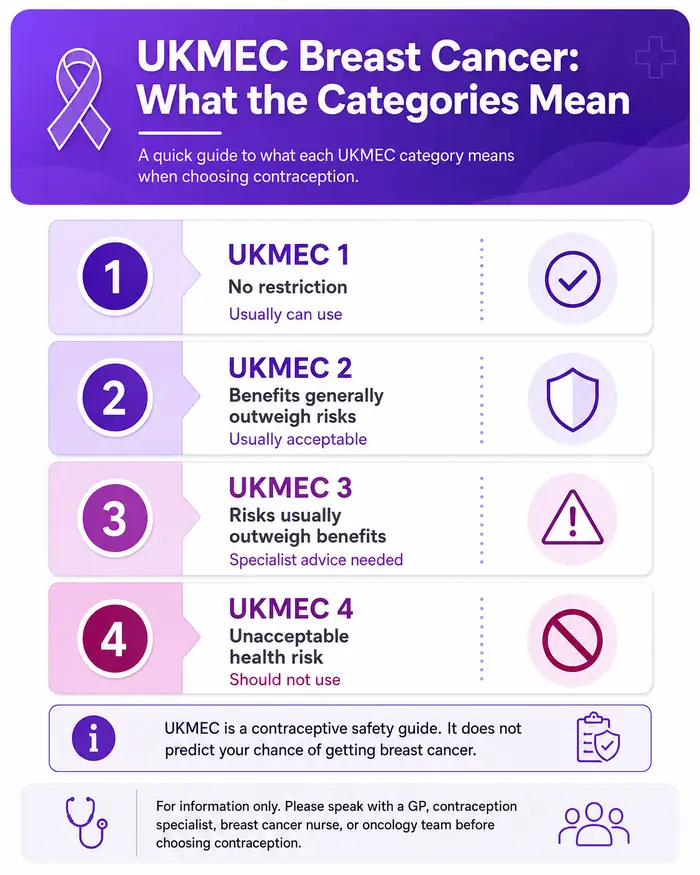
UKMEC categories explain how safe a contraceptive method is in a specific medical situation.
| Category | Meaning | What it means for you |
|---|---|---|
| UKMEC 1 | No restriction | Usually can use |
| UKMEC 2 | Benefits generally outweigh risks | Usually acceptable |
| UKMEC 3 | Risks usually outweigh benefits | Specialist advice needed |
| UKMEC 4 | Unacceptable health risk | Should not use |
UKMEC Breast Cancer Categories by Contraceptive Method
Cu-IUD means copper intrauterine device. LNG-IUD means hormonal intrauterine device. POP means progestogen-only pill. CHC means combined hormonal contraception, such as the combined pill, patch, or ring. The table below is based on the UKMEC 2025 summary table.
| Condition | Cu-IUD | LNG-IUD | Implant | DMPA injection | POP | CHC |
|---|---|---|---|---|---|---|
| Family history of breast cancer | 1 | 1 | 1 | 1 | 1 | 1 |
| High-risk gene mutation, e.g. BRCA1/BRCA2 | 1 | 2 | 2 | 2 | 2 | 3 |
| Currently being treated for breast cancer | 1 | 4 | 4 | 4 | 4 | 4 |
| Completed treatment for breast cancer | 1 | 3 | 3 | 3 | 3 | 3 |
| Undiagnosed breast mass or breast symptoms | 1 | 2 | 2 | 2 | 2 | 3 start / 2 continue |
| Benign breast conditions | 1 | 1 | 1 | 1 | 1 | 1 |
Current Breast Cancer
If you are currently being treated for breast cancer, hormonal contraception is usually not suitable. UKMEC places the LNG-IUD, implant, DMPA injection, POP and CHC in category 4 for current breast cancer. That means they should not be used because the health risk is considered unacceptable. The copper IUD is category 1, so it is usually the main non-hormonal option to discuss.
Your oncology team may also need to consider your cancer treatment, including medicines such as tamoxifen or aromatase inhibitors, where relevant. NICE includes tamoxifen and aromatase inhibitors in endocrine treatment recommendations for certain breast cancers.
Past Breast Cancer or Completed Treatment
If you have completed treatment for breast cancer, hormonal methods are usually UKMEC 3. This does not always mean “never”, but it does mean the risks usually outweigh the benefits. In real life, your final choice should involve specialist judgement, and it is sensible to include your oncology team where possible. The copper IUD remains UKMEC 1 in this situation.
Family History and BRCA
A family history of breast cancer is not the same as having breast cancer yourself. UKMEC lists family history of breast cancer as category 1 for all the main contraceptive methods.
A known high-risk gene mutation, such as BRCA1 or BRCA2, is different. UKMEC lists the copper IUD as category 1, most progestogen-only methods as category 2, and CHC as category 3. This means a combined hormonal method usually needs more caution and specialist advice.
Best Practical Way to Check Your UKMEC Category
The best way to use UKMEC is to start with your exact situation. Are you currently being treated? Have you completed treatment? Do you have a breast lump that has not yet been checked? Do you only have a family history? Or do you have a confirmed high-risk gene mutation?
Then check each contraceptive method separately. A copper IUD and a hormonal IUD are not the same in UKMEC breast cancer guidance. For a quicker method-by-method check, you can use our UKMEC calculator here: https://rentaffordabilitycalculator.co.uk/ukmec-calculator/
What Competitors Usually Miss
UKMEC breast cancer is not a breast cancer risk calculator. It is a safety guide for contraception. Current breast cancer and completed treatment are also different UKMEC situations, so they should not be grouped.
Family history and a BRCA mutation are not the same. Copper IUD and hormonal IUD should not be treated as the same method. UKMEC 3 does not always mean “never”, but it usually means specialist judgement is needed. UKMEC 4 means the method should not be used because the health risk is unacceptable.
Conclusion
UKMEC is a useful safety guide, but it is not a replacement for clinical advice. Use it to understand the likely options, then confirm your final contraception choice with a GP, contraception specialist, breast cancer nurse, or oncology team.
FAQs
Can I use the combined pill if I have breast cancer?
If you are currently being treated for breast cancer, CHC is UKMEC 4. That includes the combined pill, patch, and ring. After completing treatment, CHC is UKMEC 3, so specialist advice is needed.
Is the copper IUD allowed after breast cancer?
UKMEC lists the copper IUD as category 1 for both current breast cancer and completed treatment. You should still check your personal situation with a qualified clinician.
Is family history of breast cancer a UKMEC 4?
No. Family history of breast cancer is UKMEC 1 for the main contraceptive methods.
Does UKMEC tell me my chance of getting breast cancer?
No. UKMEC does not calculate your chance of getting breast cancer. It helps guide whether a contraceptive method is medically suitable for your situation.