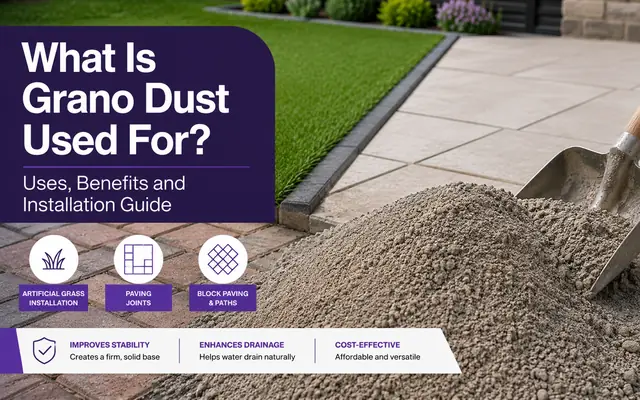
What Is Grano Dust Used For? Uses, Benefits and Tips
If you are not sure whether grano dust is the right material for artificial grass, paving, a garden path or a driveway, the safest answer is: it depends on the job and the full ground build-up. Grano dust is a fine crushed aggregate, usually granite-based, often supplied in 0–4mm or 0–6mm sizes. It is commonly used as a compacted laying, levelling, bedding or capping layer, rather than as a universal deep structural sub-base.
Quick answer: Grano dust is used for creating firm, smooth, compacted layers beneath artificial grass, paths, paving slabs, block paving and other hard-landscaping surfaces. It can also be mixed with cement to make granolithic mortar or screed. It is not normally the main load-bearing sub-base for a vehicle driveway, and it should not be assumed to drain like clean stone or behave like self-binding gravel.
What Is Grano Dust?
Grano dust is a fine aggregate made from crushed stone. In the UK, the term is often used for crushed granite fines, although some suppliers also sell limestone dust or mixed limestone/granite dust under similar wording.
It sits somewhere between sand and small chippings. It is finer than decorative gravel, but more angular and gritty than soft building sand. Because it contains very small particles as well as slightly larger grains, it can compact into a dense, firm and relatively smooth layer.
That compactability is the main reason it is used in hard landscaping.
What Is It Made From?
Most grano dust sold for landscaping is produced by crushing granite rock into fine particles. Depending on the supplier and region, you may also see similar products described as:
- granite dust
- granite fines
- grano to dust
- limestone grano dust
- 0–4mm dust
- 0–6mm granite dust
The exact material matters. Granite, limestone and recycled-content products can behave differently, and colour may also vary from grey to blue-grey or greenish-grey. Always check the supplier’s product description before ordering, especially if the finished appearance or technical performance is important.
What Does 0–4mm Mean?
A 0–4mm grading means the material contains particles from fine dust up to around 4mm in size. In simple terms, it includes both tiny fines and small gritty particles.
That mixed grading is useful because the fines help fill voids between the larger particles. When the layer is spread, levelled and compacted, the particles lock together more tightly than loose decorative gravel.
Some suppliers sell 0–6mm grano or granite dust instead. That does not automatically make it unsuitable, but it does mean you should check the recommended use, depth and compaction guidance for the exact product.
Is Grano Dust the Same as Granite Dust?
In everyday landscaping language, “grano dust” and “granite dust” are often used for the same type of fine crushed granite aggregate. However, they are not always identical across every supplier.
“Granite dust” usually describes the source material more directly. “Grano dust” is a trade-style term that may be used for granite fines, limestone fines, or a fine aggregate intended for compacted layers and granolithic mixes.
The practical rule is simple: do not rely on the name alone. Check:
- the source material
- the grading, such as 0–4mm or 0–6mm
- the recommended applications
- the bag weight or loose-load weight
- the supplier’s density or coverage guidance
What Is Grano Dust Used For?
Grano dust is mainly used where you need a compactable, fine, level layer beneath another surface. It is also used in cement-bound mixes where a dense, smooth mortar or screed is required.
| Use | Typical role | Suitability | Important consideration |
|---|---|---|---|
| Artificial grass | Smooth compacted laying course | Very common | Needs a suitable sub-base and drainage design beneath |
| Garden paths | Compacted path topping or fine surface layer | Suitable for light pedestrian use | Edging and falls help prevent movement and ponding |
| Paving slabs | Bedding or levelling layer in suitable designs | Project-dependent | Many paving systems require sharp sand or mortar instead |
| Block paving | Alternative bedding layer in some designs | Specialist/project-dependent | Conventional flexible block paving usually uses grit/sharp sand |
| Driveways | Capping or bedding support layer | Limited | Not normally the main structural layer or final loose surface |
| Rough sub-bases | Fine capping/blinding layer | Useful | Should not hide poor compaction or unstable ground |
| Granolithic mortar/screed | Cement-bound fine concrete or screed | Suitable when mixed correctly | Different method from loose compacted grano dust |
| Manhole benching/haunching | Cement-bound shaping material | Specialist use | Requires correct mix and drainage knowledge |
Artificial Grass
Artificial grass is one of the most common domestic uses for grano dust. It is often used as the fine laying course above a prepared structural layer, such as MOT Type 1 or clean chippings, depending on the drainage requirement.
For artificial grass, the grano dust layer helps create a smooth, firm surface so the turf does not show bumps, ridges or dips. In practice, the finish depends heavily on preparation. If you can still see footprints, loose ridges or plate-compactor lines, the surface may need further levelling before the grass goes down.
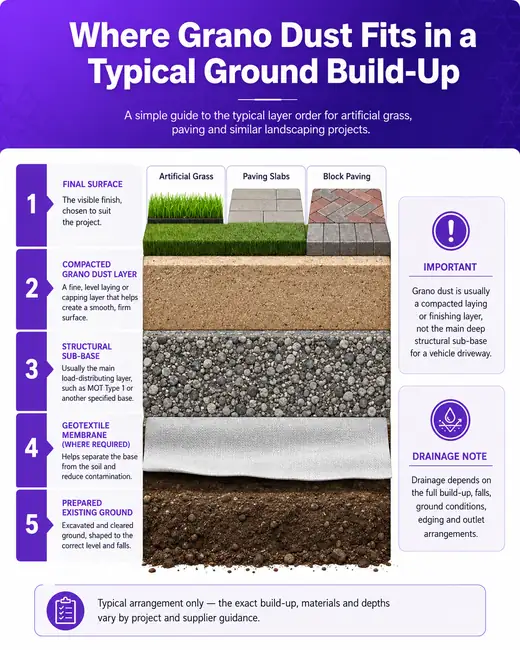
A typical artificial-grass build-up may include prepared ground, a geotextile membrane where appropriate, a compacted sub-base, a compacted grano dust or sharp sand laying course, and the artificial grass. The exact specification depends on ground conditions, pet use, drainage and the turf manufacturer’s guidance.
Garden Paths and Walkways
Grano dust can work well on garden paths and pedestrian areas because it compacts into a firm, close-textured layer. It is especially useful where you want a neater walking surface than coarse hardcore, but do not want a fully paved finish.
For paths, secure edging is important. Without edging, fine aggregate can move sideways during compaction and gradually spread into lawns, beds or borders. Timber, steel, concrete edging or block restraints can all be used, depending on the design.
Falls also matter. A path should not be shaped like a tray. Even a compacted fine aggregate can hold surface water if the levels are wrong or if the edging traps water with no outlet.
Paving Slabs and Block Paving
Grano dust may be used as a bedding or levelling layer under some paving systems, but it is not the default answer for every paving job.
For flexible block paving, conventional guidance often uses a compacted and screeded grit or sharp sand laying course. Some projects use stone dust or grit alternatives, but the design should match the paving manufacturer’s recommendations.
For paving slabs, the correct bedding may be sharp sand, mortar, a proprietary bedding compound or a bound mix, depending on the slab type, traffic, jointing system and site conditions. Grano dust can be useful as a fine levelling material, but it should not be treated as a universal replacement for the specified bedding material.
Driveway Construction
This is where many DIY mistakes happen.
Grano dust can have a role in driveway construction, but it is usually not the main deep structural layer that carries vehicle loads. A vehicle-bearing driveway normally requires a properly prepared subgrade, an appropriate structural subbase, suitable drainage, edge restraints, and a final surface designed for traffic.
Grano dust may be used as a capping, blinding or bedding layer within a broader driveway build-up. It may sit above a compacted MOT Type 1 layer or another engineered sub-base, depending on the project. It is normally not suitable as the only layer beneath vehicles, and it is not usually used as an exposed loose driveway surface unless a specific system has been designed for that purpose.
If the driveway is at the front of a property, you also need to consider drainage and planning rules. For larger front-garden hard surfaces, the surface must generally be permeable or direct water to a permeable area to avoid planning issues.
Capping and Levelling Rough Sub-Bases
Grano dust is useful for capping or blinding a rough, open-textured sub-base. If the compacted hardcore has visible voids, a finer aggregate can help create a tighter surface before the next layer is installed.
This does not mean grano dust can fix a bad sub-base. If the ground below is soft, organic, uneven or poorly compacted, a thin layer of grano dust will not solve the underlying problem. It may simply hide it until the finished surface settles.
Use grano dust as a levelling and smoothing material, not as a disguise for weak ground.
Granolithic Mortar, Screed and Bound Bedding
Grano dust can also be mixed with cement to create a granolithic mortar, fine concrete, screed or bound bedding material.
This is completely different from using loose grano dust as a compacted aggregate. Loose grano dust firms up through compaction. Cement-bound grano hardens because cement hydrates and binds the particles together.
Cement-bound grano mixes are used for jobs such as:
- flooring screeds
- fine concrete toppings
- bound paving bedding in suitable designs
- manhole benching
- haunching
- forming small falls or slopes in drainage chambers
These applications need the correct mix, water control and finishing method. Do not assume that adding a random amount of cement to loose grano dust will automatically make a reliable structural material.
Where Should You Not Use Grano Dust?
Grano dust is not the right material for every job. Avoid using it:
- as the only structural layer beneath a vehicle driveway
- as a guaranteed permeable drainage layer
- directly over soft, wet, organic or unstable soil
- as a replacement for a specified MOT Type 1 sub-base
- as a replacement for clean drainage stone
- as a final loose driveway surface without checking suitability
- under paving where the manufacturer specifies a different bedding system
- in thick, loose layers that cannot be compacted evenly
- where water will be trapped by edging with no outlet
- as a cement-bound material unless you are deliberately mixing a proper mortar or screed
The main point is not that grano dust is “bad”. It is that it has a specific role. It performs best when used as part of the right build-up.
Benefits of Using Grano Dust
Grano dust remains popular because it solves several practical problems in landscaping.
- It compacts firmly. The mix of small particles and fines helps the layer bind together under a plate compactor.
- It creates a smooth laying surface. This is useful beneath artificial grass, slabs and other surfaces where lumps would show through.
- It can cap rough aggregate. A thin, controlled layer can tighten an open-textured sub-base before the next layer is added.
- It is widely available. In many areas, it can be ordered in small bags, bulk bags or loose loads.
- It can be used loose or cement-bound. The same general material can serve different roles, provided you understand the difference between compacted aggregate and cement-bound grano.
- It is often easier to level than coarse sub-base material. Fine particles can be screeded more accurately than large crushed stone.
Limitations You Should Know Before Ordering
Grano dust also has limitations.
Drainage is not guaranteed. Because it contains fines, it will not drain like clean, open-graded stone. Drainage depends on the full build-up, ground conditions, falls, outlets and edging.
It is not the same as MOT Type 1. MOT Type 1 is commonly used as a structural sub-base. Grano dust is usually a finer laying, bedding or capping layer.
It is not the same as self-binding gravel. Some grano dust may compact into a firm pedestrian surface, but self-binding gravel is specifically processed and used as a finished path surface.
Supplier specifications vary. One supplier may sell 0–4mm crushed granite, another may sell 0–6mm granite dust, and another may sell limestone/granite dust.
Bulk bag weights vary. A “bulk bag” is not always one tonne. Many bags are around 800–850kg, but you should check the stated weight.
It does not set hard on its own. Loose grano dust compacts; it does not cure like concrete unless cement or another binder is mixed in.
Grano Dust vs Other Aggregates
| Material | General composition | Main purpose | Compaction | Drainage behaviour | Usually used as | Main limitation |
|---|---|---|---|---|---|---|
| Grano dust | Fine crushed granite or similar dust, often 0–4mm or 0–6mm | Smooth compacted laying, bedding or capping layer | High when correctly placed | Moderate to limited; fines reduce openness | Laying course, capping layer, screed aggregate | Not normally a deep structural sub-base or clean drainage layer |
| MOT Type 1 | Well-graded crushed stone with larger particles and fines | Structural sub-base | Very high | Some water movement, but not an open-drainage aggregate | Structural sub-base | Can hold fines; not the same as clean permeable stone |
| Sharp sand/grit sand | Coarse sand, often used for paving beds | Screeded laying course | Good when correctly prepared | Better than soft sand, but depends on grading | Block paving and slab bedding | Too thick a layer can move or rut under load |
| Limestone dust / limestone fines | Fine crushed limestone | Similar laying/capping uses to granite dust | High | Often limited due to fines | Laying course, blinding, capping | Source material and grading vary |
| Self-binding gravel | Graded aggregate with fines designed for compacted path surfaces | Finished pedestrian path surface | Good | Can shed water; may need maintenance if ponding occurs | Finished surface over sub-base | Not the same as ordinary grano dust |
| Clean open-graded aggregate | Single-sized or open-graded stone with few/no fines | Drainage and permeable systems | Interlocks but keeps voids | High because voids remain open | Drainage layer, permeable sub-base, grid infill | Not as smooth as grano dust for final levelling |
No aggregate is universally best. MOT Type 1 is more appropriate for many structural sub-base layers. Sharp sand or grit sand is often used for conventional flexible block paving. Clean stone is better where drainage voids are required. Grano dust is most useful where a fine, compactable, level layer is needed.
How to Lay Grano Dust
There is no single installation method for every project. Artificial grass, pedestrian paths, paving and driveway layers all have different requirements. The steps below explain the general process, but you should always check the supplier’s guidance and the final surface manufacturer’s specification.
Tools and Materials
You may need:
- spade or turf cutter
- wheelbarrow
- rake
- string line and pegs
- tape measure
- straight edge or screeding board
- plate compactor
- hand tamper for tight corners
- geotextile membrane where appropriate
- MOT Type 1 or specified sub-base material
- grano dust
- edging restraints
- hose or watering can for light moisture control
- gloves, eye protection and suitable respiratory protection when handling dusty material
Step-by-Step Process
1. Plan the finished level
Work backwards from the final surface height. Allow for the final surface, bedding or laying course, structural sub-base and any membrane.
2. Excavate the area
Remove turf, roots, topsoil, soft spots and organic material. Do not lay grano dust directly over unstable soil and expect it to perform like a structural base.
3. Check drainage and falls
Before adding aggregate, decide where water will go. Falls should move water away from buildings and prevent low spots. Do not let edging trap water inside the area.
4. Install membrane where appropriate
A geotextile membrane can help separate the sub-base from the soil and reduce contamination. It is especially useful where soil and aggregate could mix. The correct membrane position depends on the project type and ground conditions.
5. Prepare the structural sub-base
For many projects, grano dust should sit above a compacted sub-base rather than replace it. Spread the sub-base in suitable layers and compact evenly. Check levels before moving on.
6. Add grano dust in manageable layers
Spread the material evenly. Do not dump a large loose depth in one area and try to compact it all at once. Work in manageable sections so the layer can be levelled and compacted consistently.
7. Screed and level
Use a straight edge, rails or a screeding board to create the desired profile. Check against string lines or known level points.
8. Lightly control moisture if needed
Very dry dust can be difficult to compact neatly and may blow around. Light moisture can help reduce dust and aid compaction, but do not saturate the layer. Wet, sloppy material is harder to finish accurately.
9. Compact evenly
Use a plate compactor across the whole area, overlapping passes. Compact in more than one direction where possible. Use a hand tamper in corners or narrow strips.
10. Re-check the finished levels
After compaction, check the surface again. Fill low spots, trim high spots and re-compact as needed.
Compaction and Finished Levels
The compacted level matters more than the loose level. Loose aggregate settles during compaction, so calculate and build from the intended compacted depth.
For paving and artificial grass, an uneven laying course can show through as dips, ridges or movement in the finished surface. If the surface is still soft underfoot, visibly ridged or easy to disturb, stop and correct it before installing the final layer.
Drainage and Edging
Edging keeps the aggregate contained and helps compaction. It is especially important for paths, artificial grass edges and paved areas.
Drainage needs separate thought. Grano dust contains fines, so it should not be treated as a clean drainage layer. The full build-up must allow water to move somewhere useful, such as through a permeable system, towards a lawn or border, or into a designed drainage outlet.
How Much Grano Dust Do I Need?
To estimate grano dust, calculate from the compacted depth rather than the loose depth.
- Calculate the surface area.
- Convert the compacted depth from millimetres to metres.
- Multiply area by depth to get cubic metres.
- Add a waste or compaction allowance.
- Multiply the adjusted volume by a supplier-confirmed bulk density.
- Convert the weight into tonnes or bags.
Formula:
Area × compacted depth = compacted volume
Then:
Compacted volume × allowance × bulk density = estimated weight
For example, a 10m² area at 25mm compacted depth is:
10 × 0.025 = 0.25m³
If you add 10% allowance:
0.25 × 1.10 = 0.275m³
If your supplier density is 2.0 tonnes per cubic metre:
0.275 × 2.0 = 0.55 tonnes, or 550kg
Density, moisture, grading, bag size, compaction and site losses can all affect the final order. Before placing an order, use our grano dust calculator to estimate the volume, weight and number of bags required for your project.
Practical Examples
These examples are for calculation only. They are not universal installation specifications.
| Example project | Dimensions | Compacted depth | Basic volume | With 10% allowance | Approx weight at 2.0 t/m³ |
|---|---|---|---|---|---|
| Rectangular artificial-grass area | 4m × 3m = 12m² | 25mm | 0.30m³ | 0.33m³ | 0.66 tonnes |
| Garden path | 8m × 0.9m = 7.2m² | 40mm | 0.288m³ | 0.317m³ | 0.63 tonnes |
| Circular seating area | 3m diameter = 7.07m² | 30mm | 0.212m³ | 0.233m³ | 0.47 tonnes |
If your supplier gives a different density, use their figure. If bags are 850kg each, divide the estimated kilograms by 850 and round up.
Common Grano Dust Mistakes
| Problem | Likely cause | Practical solution |
|---|---|---|
| Surface sinks after installation | Soft soil or poor sub-base below | Remove unstable material and rebuild the base properly |
| Water sits on the surface | Poor falls, low spots or trapped edging | Re-level with falls and provide an outlet |
| Finished artificial grass shows ridges | Grano dust was not screeded or compacted evenly | Re-screed, compact and check levels before laying turf |
| Driveway surface moves | Grano dust used as the main structural layer | Use an appropriate engineered sub-base and traffic-rated surface |
| Material spreads at edges | Missing or weak edging restraints | Install secure edging before final compaction |
| Quantity ordered is too low | Area calculated but depth/allowance ignored | Calculate volume from compacted depth and add allowance |
| Result is dusty during laying | Material too dry or windy conditions | Lightly dampen and handle with suitable protection |
| Layer does not set hard | Loose grano dust was expected to cure like concrete | Use a proper cement-bound grano mix if a hard set is required |
| Drainage is worse than expected | Fines used where clean stone was needed | Use open-graded aggregate for drainage-sensitive layers |
| Paving moves or joints fail | Wrong bedding system for the paving type | Follow the paving manufacturer’s specification |
How to Buy and Store Grano Dust
You can usually buy grano dust in small bags, bulk bags or loose loads.
Small bags are useful for patching, small paths, screed mixes and tight-access jobs. Bulk bags are more cost-effective for garden projects and artificial grass bases. Loose tonnes can be more efficient for larger sites, but they need suitable delivery access and space for tipping.
Before ordering, check:
- the exact grading, such as 0–4mm or 0–6mm
- whether the material is granite, limestone or mixed
- the stated bag weight
- the supplier’s density or coverage guidance
- whether delivery is kerbside, crane-offload or loose tipped
- whether the lorry can access your property
- where the material will be stored
- whether rain could wash fines into drains or soil
Keep grano dust separate from soil, leaves and general site waste. Contaminated aggregate is harder to compact and may affect the finished surface.
When handling dry dusty material, avoid breathing the dust. Wear suitable eye protection and respiratory protection where needed, follow the supplier’s safety information, and avoid dry sweeping that raises unnecessary dust.
FAQs
What is the main use of grano dust?
The main use of grano dust is to create a firm, smooth and compacted laying or levelling layer. It is commonly used beneath artificial grass, garden paths, paving and other hard-landscaping surfaces.
Is grano dust suitable for artificial grass?
Yes, grano dust is commonly used as a compacted laying course beneath artificial grass. It should usually sit above a properly prepared sub-base, not directly on soft soil.
Can grano dust be used for a driveway?
Grano dust can be used in some driveway build-ups as a bedding, capping or levelling layer, but it is not normally suitable as the only structural layer beneath vehicles or as the final loose surface.
Can you use grano dust as a finished surface?
It can sometimes be used on light pedestrian paths, but it is not the same as self-binding gravel and may not be suitable as a long-term exposed surface in every location. Check the supplier’s recommendation.
Is grano dust permeable?
Grano dust should not be treated as a guaranteed permeable material. Because it contains fines, it will not drain like clean, open-graded aggregate. Drainage depends on the full construction build-up.
Does grano dust set hard?
Loose grano dust does not set hard like concrete. It compacts firmly. It only becomes cement-bound when mixed properly with cement and water.
Is grano dust the same as granite dust?
The terms are often used for similar fine crushed granite aggregate, but not always. Some suppliers may use “grano dust” for limestone or mixed fine dust. Always check the grading and source material.
What is the difference between grano dust and MOT Type 1?
MOT Type 1 is a structural sub-base material with larger crushed stone and fines. Grano dust is much finer and is usually used as a laying, bedding, capping, or screeding material.