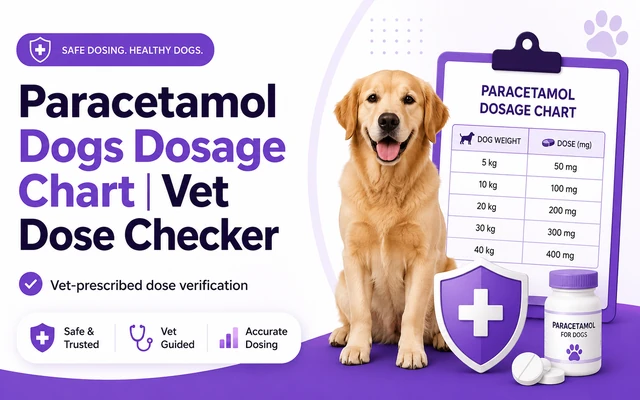
Paracetamol Dogs Dosage Chart | Vet Dose Checker
Your dog may be in pain, you may be trying to check a paracetamol dose your vet gave you, or you may be worried because your dog has swallowed a tablet. Do not give human paracetamol to a dog unless a veterinarian has specifically advised or prescribed it for that exact dog. Vets may use paracetamol in selected dogs, but the right dose, product, frequency, duration, and suitability depend on veterinary assessment, not weight alone.
Dogs Trust states that dogs need individual veterinary clinical assessment before medication choice and dose are decided.
If your dog has eaten paracetamol accidentally, contact your vet or an emergency veterinary service immediately. Do not wait for symptoms.
This page explains how a vet-prescribed paracetamol dose is calculated, how milligrams convert into tablets or liquid, what mistakes to avoid, and what information to prepare before speaking to your vet. It is not a home prescribing chart.
Medical disclaimer: This article is educational veterinary health information. It cannot diagnose your dog, prescribe medicine, confirm safety, or replace advice from your own veterinarian. Before publishing, this page should be reviewed by a qualified veterinary surgeon.
Vet-Prescribed Paracetamol Dose Verification Chart
Use this chart only if a veterinarian has already given you a dog-specific paracetamol dose in mg/kg.
This is a prescription-verification chart, not a recommendation to dose your dog at home.
| Dog weight | Vet-prescribed dose | Calculation | Total milligrams per dose | Verification note |
|---|---|---|---|---|
| 5 kg | D mg/kg | 5 × D | 5D mg | Confirm the exact product and rounding with your vet. |
| 10 kg | D mg/kg | 10 × D | 10D mg | Do not assume a tablet fraction until strength is known. |
| 20 kg | D mg/kg | 20 × D | 20D mg | Frequency is a separate veterinary instruction. |
| 30 kg | D mg/kg | 30 × D | 30D mg | Total daily exposure depends on the prescribed schedule. |
| 40 kg | D mg/kg | 40 × D | 40D mg | Never share another dog’s prescription. |
D = the mg/kg dose your veterinarian gave you.
No number in this chart should be treated as a safe or recommended dose.
Can Dogs Take Paracetamol?
Dogs can only take paracetamol when a veterinarian has specifically prescribed or advised it for that individual dog. This is very different from giving a human paracetamol product at home because your dog seems sore or feverish.
There are three common situations:
| Situation | What it means | What you should do |
|---|---|---|
| Vet-prescribed use | Your vet has examined or assessed your dog and given a specific product, dose, frequency, and duration. | Follow the exact veterinary instructions and ask your vet before changing anything. |
| You are considering giving human paracetamol | You are trying to work out a dose yourself. | Do not give it. Call your vet first. |
| Accidental ingestion | Your dog has swallowed paracetamol without veterinary direction. | Contact your vet or emergency veterinary service immediately. |
Some veterinary medicines may contain paracetamol. For example, the UK Veterinary Medicines Directorate lists Pardale-V 400 mg/9 mg Tablets as a veterinary medicine containing paracetamol and codeine phosphate for dogs. This does not mean human paracetamol tablets, children’s liquids, or combination products are interchangeable.
Never use a dog dosage chart for cats. Cats are especially vulnerable to paracetamol toxicity, and dog guidance must not be applied to them. UK product information for Pardale-V says it is for dogs, and Merck Veterinary Manual states that acetaminophen use in cats is contraindicated.
Paracetamol Dosage for Dogs: The Essential Answer
There is no universal online paracetamol dose that is safe for every dog.
A general chart cannot account for:
- Your dog’s age.
- Accurate body weight.
- Liver or kidney function.
- Heart, blood, or gut conditions.
- Dehydration or poor circulation.
- Other medicines.
- Product strength.
- Liquid concentration.
- Additional active ingredients.
- Dose frequency.
- Treatment duration.
- The reason your dog is in pain or unwell.
UK product information for Pardale-V lists several contraindications and warnings, including cardiac, hepatic or renal disease, possible gastrointestinal ulceration or bleeding, blood dyscrasia, hypersensitivity, and dehydration-related concerns. It also warns not to exceed the stated dose or treatment duration for that specific product.
Quick answer
Do not give your dog paracetamol unless your vet has prescribed or specifically advised it.
If your vet has already given you a dose in mg/kg, the arithmetic is:
Total dose in mg = dog’s body weight in kg × vet-prescribed mg/kg
This formula checks maths only. It does not decide whether paracetamol is appropriate, how often it should be given, how long it should be used, or how tablets or liquid should be rounded.
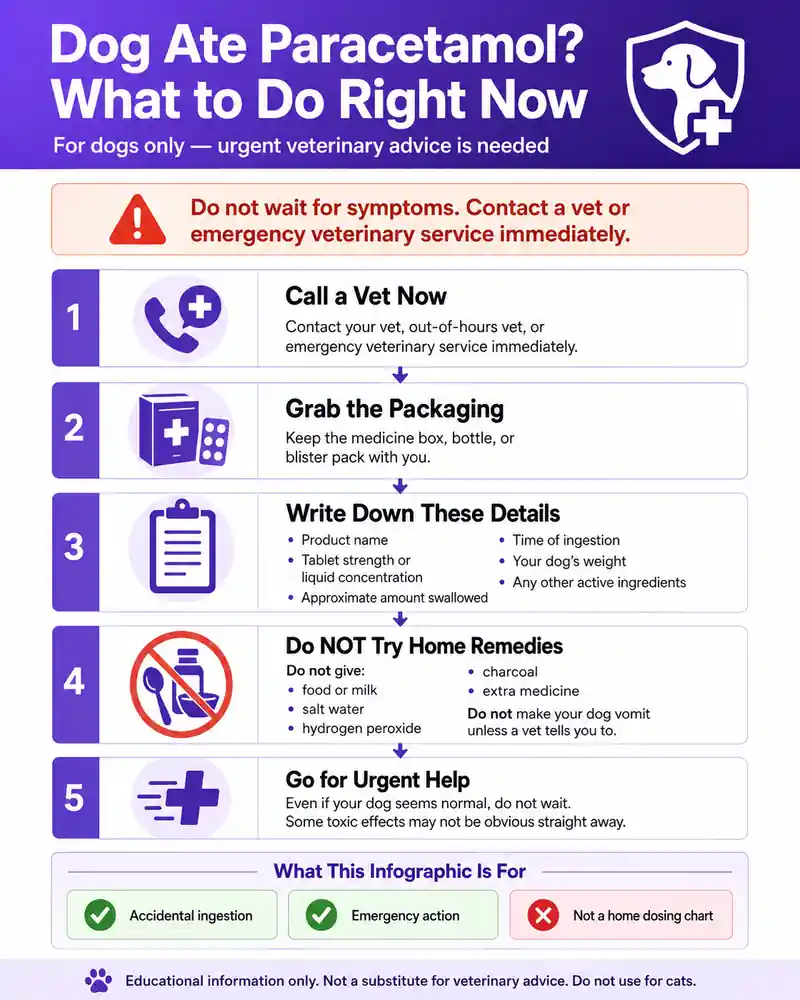
What to Do If Your Dog Ate Paracetamol
If your dog swallowed paracetamol accidentally, treat it as urgent.
Immediate actions
- Contact your vet, out-of-hours vet, or emergency veterinary service now.
- Keep the medicine packaging beside you or take it with you.
- Write down:
- Product name.
- Tablet strength or liquid concentration.
- Approximate number of tablets or amount of liquid swallowed.
- Time of ingestion.
- Your dog’s current or best-known weight.
- Any other active ingredients listed on the packaging.
- Do not wait for symptoms.
RSPCA guidance says to contact a vet immediately if poisoning is suspected, to provide details about what happened, and not to “watch and wait”.
What not to do at home
Do not give:
- Food.
- Milk.
- Charcoal.
- Salt water.
- Hydrogen peroxide.
- Home remedies.
- Extra medicine.
Do not try to make your dog vomit unless a veterinarian explicitly instructs you to do so. RSPCA warns owners never to attempt to make dogs vomit and not to treat or medicate dogs themselves after suspected poisoning.
UK poison advice option
Animal PoisonLine is a UK 24-hour emergency telephone service run by the Veterinary Poisons Information Service for pet owners worried about toxin exposure. Its published fee is currently listed as £35–£45 per call. If your dog is collapsed, struggling to breathe, fitting, or severely unwell, contact an emergency vet immediately.
How Veterinarians Calculate a Dose
The arithmetic is simple. The prescribing decision is not.
Basic equation
Total dose in mg = body weight in kg × veterinarian-prescribed mg/kg
For example, if a dog weighs 12 kg and a vet prescribes D mg/kg, the calculation is:
12 × D = total mg per dose
This only tells you the total milligrams for one prescribed dose. It does not answer:
- Which product should be used.
- How often it should be given.
- Whether it should be given with food.
- How long treatment should continue.
- Whether the dose should be rounded.
- What side effects need urgent advice.
- Whether other medicines must be avoided.
Tablet calculation
Number of tablets = total mg per dose ÷ mg per tablet
A phrase like “half a tablet” is unsafe without the tablet strength.
For example:
| Product example | Half tablet equals |
|---|---|
| 500 mg tablet | 250 mg |
| 400 mg tablet | 200 mg |
| 250 mg tablet | 125 mg |
Those are not the same amount.
Liquid calculation
mL per dose = total mg per dose ÷ liquid concentration in mg/mL
Example for arithmetic only:
If a fictional vet prescription required 60 mg and the prescribed liquid contained 24 mg/mL, the volume would be:
60 ÷ 24 = 2.5 mL
This is not a paracetamol recommendation. It is only a maths demonstration.
Frequency is separate from dose
A dose per administration is not the same as a daily amount.
For example:
| Frequency instruction | Approximate number of doses per day |
|---|---|
| Once daily | 1 |
| Every 12 hours | 2 |
| Every 8 hours | 3 |
Your vet must tell you the frequency. Do not infer it from an online chart.
Rounding needs veterinary approval
Tablet splitting and liquid rounding can change the actual amount your dog receives. Ask your vet exactly what tablet fraction or liquid volume to give. Do not round up because the number looks inconvenient.
You can use this vet-prescribed paracetamol dose calculator for dogs to check the arithmetic after your vet has given you the mg/kg dose and product strength.
Prescription Dose Versus Toxic Exposure
A prescribed dose and a toxic exposure are not simply opposite ends of one universal scale.
Risk depends on:
- The dog.
- The product.
- The dose.
- The number of doses.
- The timing.
- Existing illness.
- Liver and kidney function.
- Other medicines.
- Whether the product contains other active ingredients.
Merck Veterinary Manual notes that acetaminophen toxicosis can occur at lower doses with repeated exposure. It also states that acetaminophen and some NSAIDs are present in many cough and cold products, making accurate product identification essential.
This is why you should not use published toxicity thresholds as a green-light system at home. If your dog has swallowed paracetamol accidentally, call a vet even if the amount seems small.
Signs of Paracetamol Toxicity in Dogs
The absence of symptoms does not prove your dog is safe.
VCA Animal Hospitals states that dogs exposed to acetaminophen may develop liver damage at lower doses and red blood cell changes at higher doses. Merck Veterinary Manual lists signs in dogs including anorexia, abdominal pain, vomiting, lethargy, trembling, facial and paw oedema, tachycardia, and tachypnoea.
| Possible sign | What you may notice | Why urgent veterinary advice is needed |
|---|---|---|
| Vomiting | Being sick or retching | Can occur with poisoning or another serious illness. |
| Reduced appetite | Refusing food or seeming nauseous | May be linked to liver injury or systemic illness. |
| Lethargy | Quiet, weak, unusually tired | Can suggest your dog is becoming unwell internally. |
| Abdominal discomfort | Hunched posture, restlessness, guarding the belly | May indicate abdominal pain. |
| Fast breathing | Panting, breathing difficulty, distress | Red blood cell oxygen-carrying ability may be affected. |
| Fast heart rate | Weakness, distress, rapid pulse | Can occur with systemic toxicity. |
| Facial or paw swelling | Swollen face, paws, or limbs | Reported in acetaminophen toxicosis. |
| Pale, blue, brown, or yellow gums | Abnormal gum colour | May indicate poor oxygen transport, red blood cell changes, or jaundice. |
| Trembling | Shaking or twitching | Can be a sign of serious illness. |
| Collapse | Unable to stand or severely weak | Requires emergency veterinary care. |
Do not wait for these signs to appear before seeking help.
Factors That Affect Paracetamol Risk
Body weight accuracy
A guessed weight can lead to a wrong mg/kg calculation. Small errors matter more in small dogs.
Age and life stage
Young puppies and older dogs may need extra caution. UK product information for Pardale-V says use in animals less than 6 weeks old or aged animals may involve additional risk.
Liver, kidney, heart, blood, or gut problems
Dogs with existing disease may have a different risk profile. Pardale-V product information lists contraindications involving cardiac, hepatic, renal, gastrointestinal, and blood-related conditions.
Dehydration or poor circulation
Pardale-V product information says to avoid use in dehydrated, hypovolaemic, or hypotensive animals because of possible increased renal toxicity.
Other medicines
Other medicines can change risk. Pardale-V product information warns against concurrent administration of potentially nephrotoxic drugs.
Repeated administration
Repeated doses can create a different risk from one accidental exposure. Merck Veterinary Manual states that toxicosis can occur at lower doses with repeated exposure.
Product strength
A 500 mg tablet, 400 mg tablet, 250 mg tablet, capsule, sachet, or liquid may all create different calculations.
Additional active ingredients
Combination medicines may contain other active ingredients. VCA notes that acetaminophen may appear in combination products with aspirin, opioids, antihistamines, decongestants, or caffeine.
Prescription duration
The length of treatment matters. UK product information for Pardale-V includes product-specific duration limits, which should not be turned into a general rule for all paracetamol use.
Paracetamol Tablets and Liquid: Avoiding Measurement Errors
Milligrams are not tablets
A tablet is a physical unit. A milligram is an amount of active drug.
One tablet may contain:
- 120 mg.
- 250 mg.
- 400 mg.
- 500 mg.
- Another strength.
Always check the label.
mg/kg is not mg
mg/kg means milligrams per kilogram of body weight.
mg means the total amount of medicine.
A 5 kg dog and a 25 kg dog given the same mg/kg instruction would receive different total milligram amounts.
mg/mL is not mL
mg/mL means how many milligrams are in each millilitre of liquid.
mL is the volume you measure.
For liquid medicine, you need both:
- The total mg prescribed.
- The concentration in mg/mL.
Do not use kitchen spoons
Kitchen teaspoons are not accurate dosing tools. If your vet prescribes a liquid medicine, ask for the exact mL amount and use a proper oral syringe.
Be careful with tablet splitting
A scored tablet may be easier to split, but that does not mean every fraction is suitable. Ask your vet or veterinary pharmacist how to split, store, and give part-tablets.
Human Paracetamol Versus Veterinary-Prescribed Products
| Feature | Human product | Veterinary-prescribed product | Why it matters |
|---|---|---|---|
| Intended patient | People | A specific animal patient or species | Dogs process medicines differently from people. |
| Strength | Often 500 mg in UK households, but strengths vary | Product-specific | “Half a tablet” depends on the strength. |
| Active ingredients | May be paracetamol alone or combined with other medicines | May also be a combination product | Extra ingredients can change risk. |
| Suitability | Not assessed for your dog | Chosen after veterinary assessment | Weight alone is not enough. |
| Legal status | Human OTC or prescription medicine | Some veterinary products are prescription-only | Prescription context matters. |
| Cats | Not suitable for cat self-medication | Dog guidance must not be used for cats | Cats are at high risk from paracetamol toxicity. |
What Should I Ask My Vet?
Before giving any paracetamol-containing medicine, ask:
- Is paracetamol appropriate for my dog’s condition?
- What exact product should I use?
- What is the dose in milligrams?
- What is the dose in mg/kg?
- What amount is that in tablets or millilitres?
- How often should it be given?
- How many days should it be used?
- Should it be given with food?
- What side effects should I watch for?
- Which other medicines must be avoided?
- What should I do if a dose is missed?
- What should I do if I accidentally repeat a dose?
- Can this prescription be used only for this dog?
Do not use medicine prescribed for one dog on another dog, even if their weights seem similar. The diagnosis, organ function, other medicines, age, hydration status, and product choice may differ.
Final Safety Summary
If your vet has prescribed paracetamol for your dog, follow the exact product, dose, frequency, duration, and rounding instructions they gave you. Use any chart or calculator only to check arithmetic.
If you are thinking about giving human paracetamol because your dog seems painful or feverish, call your vet first. Do not guess a dose from body weight alone.
If your dog has swallowed paracetamol accidentally, contact a vet, emergency veterinary service, or Animal PoisonLine immediately. Take the packaging, record the amount and time, and do not wait for symptoms.
FAQs
Can I give my dog human paracetamol?
No, not unless your veterinarian has specifically advised or prescribed that exact product for your dog. Dogs Trust says dogs require individual veterinary assessment before medication choice and dose are decided.
How much paracetamol can a dog have?
There is no universal online amount. Only your vet can decide whether paracetamol is suitable and what dose, product, frequency, and duration apply.
Is half a 500 mg paracetamol tablet safe for a dog?
Do not assume so. Half a 500 mg tablet is 250 mg, but whether that amount is appropriate depends on the individual dog and the veterinary prescription. If your dog has swallowed half a tablet accidentally, contact a vet.
Can a dog take paracetamol for pain?
A veterinarian may prescribe paracetamol in selected cases, but owners should not use it without veterinary instruction. Pain needs diagnosis, not just dose calculation.
Can a dog take paracetamol for fever?
Only if a vet has assessed your dog and specifically advised it. Fever can indicate an illness that needs diagnosis and treatment.
What should I do if my dog ate one paracetamol tablet?
Call your vet or emergency vet now. Provide the product name, strength, number of tablets, time of ingestion, and your dog’s weight. Do not wait for symptoms.
How quickly do poisoning symptoms appear?
Timing can vary. VCA states that larger doses can cause signs within hours, while liver damage may develop over several days.
Can a small dog have paracetamol?
Only under veterinary prescription. Small dogs are at higher practical risk from measurement errors because a small tablet fraction can represent a large mg/kg difference.
References
- Dogs Trust — Can dogs take paracetamol?
- RSPCA — Dog poisoning advice
- Veterinary Medicines Directorate — Pardale-V product information
- VMD Pardale-V Summary of Product Characteristics
- Merck Veterinary Manual — Toxicoses from human analgesics in animals
- VCA Animal Hospitals — Acetaminophen toxicity in dogs
- Animal PoisonLine — UK poison advice service and fees