How Much Rent Can I Afford?
The rent a letting agent approves is not always the rent your monthly budget can comfortably support.
As a general starting point, many renters compare rent with 25% to 30% of their income. However, the amount you can genuinely afford should also account for your take-home pay, Council Tax, utility bills, debt repayments, transport, food, savings and an emergency buffer.
The safest answer is usually the lower of:
- Your chosen income-based rent limit.
- The amount remaining after your essential monthly costs.
- The maximum rent you are likely to qualify for during tenant referencing.
Use our rent affordability calculator to estimate your comfortable monthly rent, maximum rent, likely letting-agent limit and remaining income.
Quick answer: You can afford a rent that leaves enough money for your essential expenses, financial commitments, savings and unexpected costs. Do not rely on salary alone or assume that passing a letting agent’s affordability check means the rent will be comfortable.
Calculate How Much Rent You Can Afford
A rent affordability calculator should provide more than one maximum number. Your results should distinguish between the following:
Comfortable monthly rent
This is the rent that fits your budget after allowing for:
- Essential living expenses.
- Debt repayments.
- Council Tax and household bills.
- Regular savings.
- An emergency buffer.
- Other financial commitments.
This should normally be the main figure you use when searching for a flat or house.
Suggested safer range
Personal finances are rarely exact. Electricity bills change, travel costs increase and unexpected expenses occur.
A safer range, such as £750 to £825 per month, is often more useful than a precise figure like £813.42.
Maximum personal rent
This is the highest rent your current budget might technically support. It may leave very little room for:
- An unexpected bill.
- A reduction in income.
- A future rent increase.
- Medical or family costs.
- Repairs to belongings.
- Travel or social spending.
Treat this as an upper boundary rather than a recommended target.
Likely letting-agent affordability limit
Landlords and letting agents may use a gross-income multiplier when checking an application.
For example, OpenRent states that its standard affordability assessment requires a tenant to earn at least 2.5 times the annual rent. This is equivalent to annual income being 30 times the monthly rent. Its guarantor threshold is three times the annual rent. Other agencies and referencing providers may apply different requirements.
Passing this check does not prove that a property is affordable for your household. Referencing generally does not understand every detail of your spending, childcare costs, savings plans or personal priorities.
Estimated leftover income
Your result should also show how much money remains after:
- Rent.
- Council Tax.
- Utilities.
- Debt repayments.
- Essential expenses.
- Savings.
A rent may look reasonable as a percentage of gross salary but still leave too little spendable income at the end of the month.
How Much Should You Spend on Rent?
There is no universal percentage that works for every renter.
Two people earning the same salary may have completely different rent budgets. One might have no debt and work from home, while the other may pay for childcare, car finance and an expensive commute.
A reliable calculation should use both an income ratio and your actual monthly budget.
A practical rent affordability formula
Use the lower of these two calculations:
Income-based rent limit =
selected monthly income × selected rent percentage
and:
Budget-based rent limit =
monthly take-home pay
− essential expenses
− debt repayments
− non-rent housing costs
− savings goal
− emergency buffer
Your comfortable rent can then be calculated as:
Comfortable monthly rent =
the lower of the income-based limit
and the budget-based limit
This approach prevents a general percentage from overriding your real financial circumstances.
Comfortable Rent Versus Maximum Rent
Your comfortable rent and maximum rent should not be treated as the same figure.
| Rent figure | What it means | How to use it |
|---|---|---|
| Comfortable rent | Leaves room for bills, savings and unexpected costs | Use it as your main property-search budget |
| Safer range | Allows for changes in monthly spending | Prioritise properties inside this range |
| Maximum personal rent | Uses most of your available housing budget | Treat it as an upper limit |
| Agent affordability limit | Approximate rent you may qualify for based on income | Use it to prepare for referencing |
| Listed rent | Amount requested for a specific property | Compare it with all the figures above |
A property can pass the agent test but fail your personal budget test.
It can also fit your monthly budget but fail referencing if your qualifying gross income is too low or difficult to verify.
Should Rent Be Based on Gross or Take-Home Income?
Use gross income and take-home pay for different purposes.
Use gross income for an approximate referencing check
Gross income is your income before Income Tax, National Insurance, pension contributions, student-loan deductions and other deductions.
Letting agents often ask for gross annual income because it is easier to verify through documents such as:
- Payslips.
- Employment references.
- Tax returns.
- Accounts.
- Contracts.
- Pension statements.
Use take-home pay for your personal budget
Take-home pay is the money that reaches your bank account.
This is the more useful figure for deciding whether you can pay your rent while covering:
- Food.
- Transport.
- Debt.
- Childcare.
- Utilities.
- Savings.
- Everyday spending.
Do not subtract expenses from gross monthly income and treat the remainder as available money. You cannot spend the portion already deducted for tax or other payroll commitments.
The 30% Rent Rule Explained
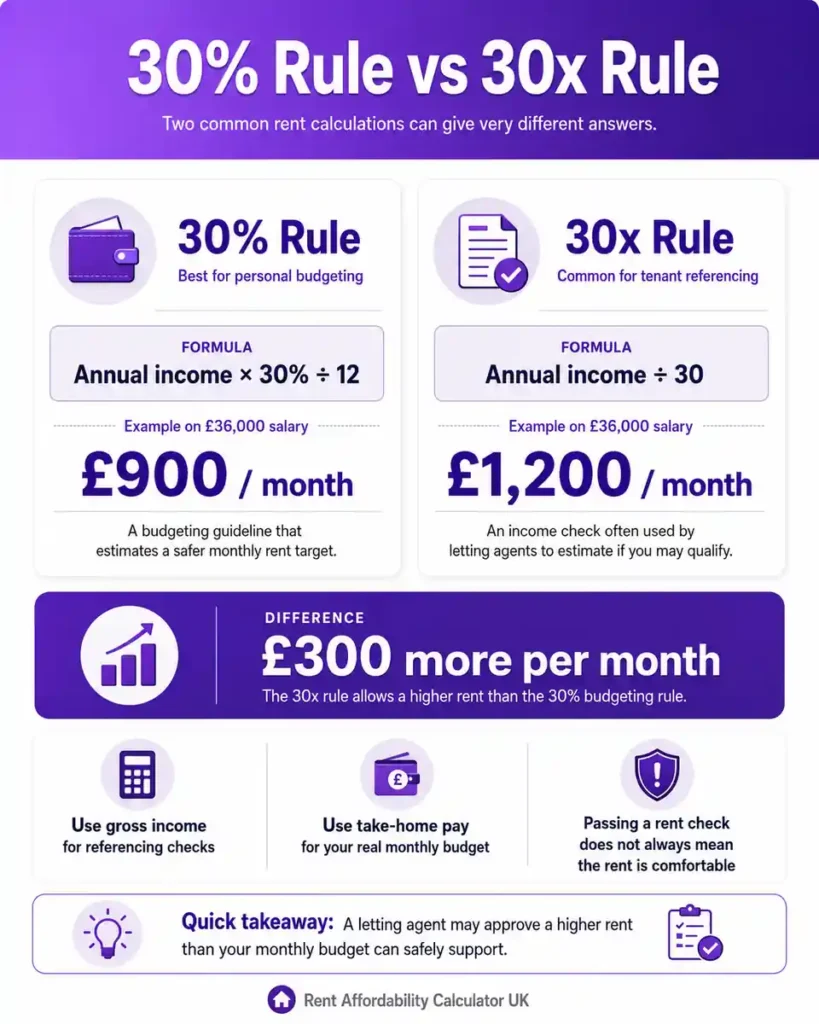
The 30% rule suggests limiting rent to approximately 30% of your income.
The basic formula is:
Monthly rent =
annual gross income × 30% ÷ 12
For an annual gross income of £36,000:
£36,000 × 0.30 ÷ 12
= £900 per month
The Office for National Statistics uses a 30% threshold when discussing private-rental affordability. Its 2024 analysis found that renters on median household incomes could expect an average-priced rental home to represent 36.3% of income in England, 25.9% in Wales and 25.3% in Northern Ireland.
Is 30% always affordable?
No.
Thirty per cent may be too high when you have:
- Large debt payments.
- Childcare expenses.
- High commuting costs.
- Irregular earnings.
- Financial dependants.
- An important savings target.
- Expensive household bills.
It may also be unnecessarily restrictive for someone with a high income and few commitments.
Use 30% as a comparison point, not an automatic instruction.
Should utilities be included in the 30% rule?
You should always calculate your total housing cost, even if a particular rule refers only to rent.
Your total housing cost may include:
Rent
+ Council Tax
+ gas and electricity
+ water
+ broadband
+ contents insurance
+ parking
+ required property charges
MoneyHelper advises prospective renters to consider the rent, bills, Council Tax and deposit before deciding whether a home is affordable.
The 30x Rent Rule Used in Tenant Referencing
A common referencing method requires annual gross income to equal approximately 30 times the monthly rent.
The formula is:
Required annual income =
monthly rent × 30
To rent a property costing £1,000 per month:
£1,000 × 30
= £30,000 required annual income
You can reverse the formula to estimate the rent supported by a salary:
Approximate agent rent limit =
annual gross income ÷ 30
For a salary of £36,000:
£36,000 ÷ 30
= £1,200 per month
OpenRent describes the same calculation as income equal to 2.5 times annual rent, although other agents may use different rules.
The 30% rule and 30x rule are not the same
This is an important distinction.
| Method | Formula on £36,000 salary | Result |
|---|---|---|
| 30% of gross income | £36,000 × 30% ÷ 12 | £900 PCM |
| 30x referencing rule | £36,000 ÷ 30 | £1,200 PCM |
| Difference | £300 PCM |
The 30x referencing result is equivalent to 40% of gross monthly income:
£36,000 ÷ 12 = £3,000 gross monthly income

£1,200 ÷ £3,000 = 40%
Therefore, passing a 30x affordability check may allow considerably more rent than the 30% budgeting guideline.
That does not automatically make the higher figure affordable.
Rent Affordability by Salary
The following figures are general illustrations based on gross annual income. They do not account for tax, bills, debt or individual spending.
| Gross annual income | 25% of gross income | 30% of gross income | 35% of gross income | Approximate 30x limit |
|---|---|---|---|---|
| £20,000 | £417 | £500 | £583 | £667 |
| £25,000 | £521 | £625 | £729 | £833 |
| £30,000 | £625 | £750 | £875 | £1,000 |
| £35,000 | £729 | £875 | £1,021 | £1,167 |
| £40,000 | £833 | £1,000 | £1,167 | £1,333 |
| £50,000 | £1,042 | £1,250 | £1,458 | £1,667 |
| £60,000 | £1,250 | £1,500 | £1,750 | £2,000 |
| £75,000 | £1,563 | £1,875 | £2,188 | £2,500 |
| £100,000 | £2,083 | £2,500 | £2,917 | £3,333 |
These are comparison figures—not personalised recommendations.
A renter earning £40,000 with no debt may be comfortable paying a different amount from someone earning £40,000 with £600 of monthly debt and childcare commitments.
A Better Step-by-Step Rent Calculation
Step 1: Record your reliable monthly income
Include income you can reasonably expect to continue, such as:
- Employment income.
- Self-employed income.
- Pension income.
- Regular maintenance.
- A partner’s qualifying income.
- Regular eligible benefit income.
- Reliable secondary income.
Avoid treating occasional overtime, one-off bonuses or irregular freelance work as guaranteed income.
For variable income, consider averaging several months and using a cautious percentage of that average.
Step 2: Find your actual take-home pay
Use the amount you receive after deductions, not only your headline salary.
Check recent payslips or bank statements rather than relying on memory.
Step 3: Add your debt repayments
Include:
- Personal loans.
- Credit-card minimums.
- Car finance.
- Buy-now-pay-later commitments.
- Maintenance payments.
- Overdraft repayments.
- Other fixed financial agreements.
Debt reduces the amount of income available for rent even when a referencing formula does not fully recognise the effect.
Step 4: Add essential living expenses
Record realistic amounts for:
- Food and groceries.
- Transport.
- Childcare.
- Medical needs.
- Mobile phone.
- Essential subscriptions.
- Clothing.
- Pet care.
- Family commitments.
Look at several months of transactions so you do not build the calculation around an unusually cheap month.
Step 5: Estimate costs on top of rent
Add:
- Council Tax.
- Energy.
- Water.
- Broadband.
- Contents insurance.
- Parking.
- Service charges payable by the tenant.
- Any property-specific costs.
When an advert says “bills included,” check exactly which bills are covered and whether a fair-usage limit applies.
Step 6: Protect your savings goal
Your rent should not automatically consume money intended for:
- Emergency savings.
- A future house deposit.
- Pension contributions.
- Education.
- Family commitments.
- Necessary annual expenses.
If saving is important to your plan, deduct it before deciding your comfortable rent.
Step 7: Keep an emergency buffer
Do not budget down to £0.
A monthly buffer can help cover:
- A higher energy bill.
- Emergency travel.
- Appliance replacement.
- Reduced overtime.
- Unexpected medical costs.
- A future rent increase.
Step 8: Compare the result with the agent threshold
You need to answer two separate questions:
- Can I personally afford this rent?
- Am I likely to meet the agent’s application criteria?
A suitable property should ideally pass both tests.
Rent Affordability Examples
Example 1: Single renter with no major debt
Assume the renter has:
| Item | Amount |
|---|---|
| Gross annual income | £36,000 |
| Assumed monthly take-home pay | £2,400 |
| Essential living expenses | £750 |
| Debt payments | £150 |
| Council Tax and household bills | £250 |
| Savings goal | £300 |
| Emergency buffer | £200 |
The budget-based limit is:
£2,400
− £750
− £150
− £250
− £300
− £200
= £750
The 30% gross-income limit is:
£36,000 × 30% ÷ 12
= £900
The comfortable rent is the lower result:
Comfortable rent = £750 per month
The approximate 30x referencing limit is:
£36,000 ÷ 30
= £1,200
This person might pass a referencing assessment for considerably more than their comfortable personal budget.
Example 2: Couple applying together
Assume:
| Item | Amount |
|---|---|
| Combined gross annual income | £60,000 |
| Assumed combined take-home pay | £4,100 |
| Essential expenses | £1,100 |
| Debt payments | £250 |
| Housing bills excluding rent | £350 |
| Savings goal | £500 |
| Emergency buffer | £300 |
Budget-based limit:
£4,100
− £1,100
− £250
− £350
− £500
− £300
= £1,600
Thirty per cent of gross income:
£60,000 × 30% ÷ 12
= £1,500
The lower figure is:
Comfortable rent = £1,500 per month
Approximate 30x referencing limit:
£60,000 ÷ 30
= £2,000 per month
The couple may qualify for £2,000 rent under the selected referencing rule, but their chosen savings and safety buffer make £1,500 more suitable.
Example 3: Passing referencing but failing the household budget
Assume:
| Item | Amount |
|---|---|
| Gross annual income | £42,000 |
| Assumed take-home pay | £2,800 |
| Proposed rent | £1,400 |
| Essential expenses | £850 |
| Debt repayments | £300 |
| Housing bills | £300 |
| Savings goal | £250 |
| Emergency buffer | £200 |
Approximate agent limit:
£42,000 ÷ 30
= £1,400
The proposed rent passes the selected 30x test.
However, the personal budget supports:
£2,800
− £850
− £300
− £300
− £250
− £200
= £900
The property is approximately £500 above the renter’s comfortable budget despite meeting the income multiplier.
Weekly Rent Versus Monthly Rent
UK rental advertisements may show rent per week or per calendar month.
Do not convert weekly rent by multiplying it by four. A year has 52 weeks but only 12 calendar months.
Use:
Monthly rent =
weekly rent × 52 ÷ 12
For £250 per week:
£250 × 52 ÷ 12
= £1,083.33 per calendar month
The four-week cost would be only £1,000, which understates the true calendar-month equivalent.
Costs to Add on Top of Rent
Council Tax
Council Tax can significantly affect your housing budget.
The amount depends on factors including:
- The property’s Council Tax band.
- The local authority.
- Whether you qualify for a discount or reduction.
- Whether Council Tax is included in the rent.
- The number and status of occupants.
Do not assume that two similarly priced properties have the same Council Tax cost.
Gas and electricity
Ask for the property’s Energy Performance Certificate and, where available, estimated or previous energy costs.
Actual costs depend on:
- Property size.
- Insulation.
- Heating system.
- Energy prices.
- Number of occupants.
- Personal usage.
Water
Water may be metered or charged using another method. Confirm whether it is included before signing the agreement.
Broadband and mobile services
Check:
- Installation costs.
- Contract length.
- Available providers.
- Whether the building restricts suppliers.
- Whether broadband is included.
Contents insurance
Your landlord’s building insurance does not normally protect your personal belongings. Include contents insurance when estimating total housing costs.
Transport and commuting
A cheaper property can cost more overall when it creates a longer or more expensive commute.
Compare:
Rent + bills + transport
rather than rent alone.
Parking and property-specific charges
Check for:
- Parking permits.
- Allocated-space charges.
- Laundry costs.
- Communal heating.
- Storage.
- Required service payments.
- Garden or maintenance obligations.
Ask for a complete list of payments before committing.
Are Bills-Included Properties Better Value?
A bills-included property can make budgeting simpler, but it is not automatically cheaper.
Before comparing it with a rent-only property, ask:
- Which bills are included?
- Is Council Tax included?
- Is broadband included?
- Is there an energy-usage limit?
- What happens when the household exceeds that limit?
- Can the amount change during the tenancy?
- Are all renters jointly responsible for excess usage?
Compare the two total costs:
Bills-included rent
versus:
Rent-only amount
+ Council Tax
+ utilities
+ broadband
+ insurance
A slightly higher rent may be worthwhile when it genuinely covers major bills, but the calculation should use the total annual cost.
How Much Money Do You Need Before Renting?
Monthly affordability is only one part of the decision.
You also need enough money for the initial move.
Possible upfront costs include:
- Holding deposit.
- Tenancy or security deposit.
- Initial rent payment.
- Moving transport.
- Furniture.
- Kitchen and household items.
- Utility or broadband setup.
- Insurance.
- Emergency savings.
England
For many private tenancies in England, a holding deposit can be up to one week’s rent. A tenancy deposit is generally capped at five weeks’ rent when annual rent is below £50,000 and six weeks when annual rent is £50,000 or more.
Following the changes effective from 1 May 2026, landlords can usually request no more than one month’s rent—or 28 days where rent is not paid monthly—during the pre-tenancy period after the agreement has been signed and before the tenancy begins. Limited exceptions apply.
Scotland
Scottish Government guidance states that a private residential tenancy deposit cannot exceed two months’ rent.
Wales
In Wales, a holding deposit is capped at the equivalent of one week’s rent. Security deposits must generally be placed in an approved protection scheme when the applicable requirements are met.
Northern Ireland
For private tenancies entered into under the applicable rules after 1 April 2023, the tenancy deposit cannot exceed one month’s rent.
Rules and exceptions differ across the UK. Check current official guidance for the nation in which the property is located before paying money.
Example Move-In Cost Estimate
Assume a property in England has monthly rent of £1,000 and annual rent below £50,000.
An approximate initial budget might include:
| Cost | Illustrative amount |
|---|---|
| One month’s rent | £1,000 |
| Five-week tenancy deposit | Approximately £1,154 |
| Moving costs | £200 |
| Household setup | £300 |
| Emergency reserve | £1,000 |
| Total suggested available cash | Approximately £3,654 |
A holding deposit may initially be paid to reserve the property, but depending on the agreement and outcome, it may be refunded or applied towards permitted tenancy payments.
Do not assume every property will require exactly these amounts. Confirm the payment schedule in writing.
What Do Landlords and Letting Agents Check?
A landlord or agent may consider more than your salary.
Tenant referencing may include:
- Identity and address information.
- Employment status.
- Income.
- Previous landlord references.
- Public credit information.
- Insolvency records.
- County Court Judgments.
- Ability to meet the rent.
- Guarantor details where relevant.
Equifax explains that a landlord credit check can show public-record information such as electoral-roll data, insolvency information and judgments. Landlords may also request employer and previous-landlord references and evidence of employment.
Documents you may be asked to provide
Depending on your circumstances, you may need:
- Recent payslips.
- Bank statements.
- An employment contract.
- An employer reference.
- Tax calculations or tax returns.
- Business accounts.
- Pension evidence.
- Proof of other reliable income.
- Previous landlord details.
- Identification and address evidence.
Requirements vary, so ask the letting agent which referencing provider and affordability formula they use before applying.
Does passing the calculator guarantee approval?
No.
A calculator can estimate your affordability, but it cannot guarantee that a landlord, insurer, agent or referencing provider will accept your application.
Approval may depend on:
- How your income is earned.
- Whether your income can be verified.
- Your employment situation.
- Your credit and address history.
- The landlord’s criteria.
- Insurance requirements.
- The strength of other applications.
- Whether a guarantor is available.
Guarantor Requirements
A guarantor agrees to meet specified tenancy obligations if the tenant does not.
A guarantor may be requested when:
- Your qualifying income is below the agent’s threshold.
- You are a student.
- You have recently started work.
- You are self-employed without sufficient accounts.
- You have a limited UK address or credit history.
- Part of your income is irregular.
- The referencing provider cannot verify enough income.
Some providers apply a higher income requirement to guarantors. OpenRent, for example, states a guarantor threshold of three times annual rent, equivalent to 36 times the monthly rent.
For rent of £1,000 per month:
£1,000 × 12 × 3
= £36,000 annual guarantor income
This is one provider’s standard—not a universal UK rule.
The guarantor should read the agreement carefully because the guarantee may cover more than unpaid rent and may apply for a significant period.
Rent Affordability for Different Renters
Single renters
A single renter relies on one income and usually carries the full cost of:
- Rent.
- Council Tax.
- Utilities.
- Broadband.
- Insurance.
Keep a stronger emergency buffer because there is no second household income to absorb an interruption.
If you live alone, check whether you qualify for any relevant Council Tax discount.
Couples
Calculate:
- Combined household affordability.
- Each person’s individual contribution.
- What happens if one income stops.
- Whether both incomes qualify for referencing.
- Whether expenses and rent will be divided equally.
A couple should not automatically use the entire maximum supported by both salaries if one income is temporary or uncertain.
Families
Family affordability calculations should include:
- Childcare.
- School travel.
- Food.
- Clothing.
- Medical needs.
- Family transport.
- Bedroom requirements.
- Financial support for dependants.
A rent percentage that works for a child-free household may not work for a family with significant childcare costs.
Students
Students may rely on:
- Student finance.
- Part-time income.
- Family support.
- Scholarships.
- Savings.
- A guarantor.
Check whether the accommodation requires rent by term, monthly payments or another schedule.
A monthly average may appear affordable while the actual payment schedule creates a cash-flow problem.
House shares and roommates
Do not automatically divide rent equally.
Possible methods include:
- Equal split.
- Split according to bedroom size.
- Split according to income.
- Different amounts for couples and single occupants.
- A custom agreed percentage.
MoneyHelper notes that equal division is simple but may not always be fair where rooms differ or a couple shares one bedroom.
Each renter should calculate:
- Their own rent share.
- Their own bills.
- Their own disposable income.
- The household’s joint obligations.
Self-employed and variable-income renters
Use a conservative average rather than your best month.
Consider:
- Averaging income over 6 to 12 months.
- Separating dependable income from uncertain income.
- Allowing for tax that has not yet been paid.
- Keeping a larger emergency reserve.
- Preparing relevant tax and accounting documents.
Do not count a future contract until it is reasonably secure and acceptable to the referencing provider.
Does Location Change How Much Rent You Can Afford?
Your location changes property prices and living costs, but it does not automatically increase your financial capacity.
Provisional ONS figures show that average UK monthly private rent reached £1,383 in May 2026. The average was £1,442 in England, £836 in Wales and £1,009 in Scotland. The latest Northern Ireland figure cited by the ONS was £876 for March 2026.
These averages describe the market. They do not tell you what your household can safely afford.
High-cost areas
In expensive locations, you may need to consider:
- A smaller property.
- A house share.
- A different neighbourhood.
- A longer commute.
- A property with bills included.
- Renting with a partner.
- Reducing the required bedroom count.
ONS analysis found that London’s private-rental affordability ratio was 41.6% in 2024, with the least affordable local authorities concentrated in London.
That does not mean spending 41.6% of your income is safe. It shows the pressure renters may experience in that market.
Compare rent and commuting together
A property outside the city centre may have lower rent but higher transport costs.
Compare:
| Option | Rent | Bills | Transport | Total |
|---|---|---|---|---|
| Central property | £1,300 | £250 | £100 | £1,650 |
| Outer-area property | £1,050 | £260 | £320 | £1,630 |
The second property saves only £20 after transport despite having £250 lower rent.
Also consider the value of travel time, flexibility, and the risk of fare increases.
How Rent Affects Your Savings Goals
Rent affordability is not only about avoiding missed payments.
Rent can be technically payable while preventing you from:
- Building an emergency fund.
- Saving a future home deposit.
- Contributing to retirement.
- Paying off debt.
- Funding education.
- Preparing for annual expenses.
- Supporting family commitments.
Decide which savings contributions are essential before calculating your rent.
For example:
Take-home pay: £2,500
Essential expenses and bills: £1,200
Required monthly savings: £300
Emergency buffer: £200

Rent available:
£2,500 − £1,200 − £300 − £200
= £800
Without protecting the savings and buffer, the renter might incorrectly believe that £1,300 is available.
Stress-Test Your Rent Before Signing
A good rent budget should survive more than one ideal month.
Ask:
- Can I still pay if energy bills increase?
- What if my commute becomes more expensive?
- What if overtime stops?
- What if the rent rises by 5%?
- What if I need emergency travel?
- What if one household member loses income?
- Can I replace essential belongings without borrowing?
- Will I still meet my savings goal?
Example 5% rent increase
For rent of £1,200:
£1,200 × 5%
= £60 increase
New rent:
£1,200 + £60
= £1,260 per month
Test the increased amount before committing to the original rent.
Common Rent Affordability Mistakes
Using gross salary as spendable income
Gross income is useful for referencing, but your actual budget must use take-home pay.
Treating the 30x rule as a recommendation
A referencing threshold estimates application eligibility. It is not a personalised spending plan.
Forgetting Council Tax and utilities
A £1,000 property can create a much higher total housing cost after bills.
Multiplying weekly rent by four
Use weekly rent × 52 ÷ 12 to obtain the calendar-month equivalent.
Ignoring debt payments
Debt reduces your available income even when an agent’s simple formula does not capture it.
Counting irregular income as guaranteed
Bonuses, overtime and freelance work may stop. Use a cautious figure.
Assuming shared rent must be equal
A fair split may depend on income, room size or household arrangements.
Spending every pound left after rent
A budget with no margin is vulnerable to any unexpected cost.
Forgetting upfront costs
Being able to pay the monthly rent does not mean you have enough cash to move.
Increasing the budget because the area is expensive
A high local rent does not increase your salary or reduce your other commitments.
What to Do If You Cannot Afford the Rent
A failed affordability result should lead to an action plan, not just a warning.
1. Set a lower maximum rent
Calculate the difference between the proposed property and your comfortable limit.
For example:
Proposed rent: £1,250
Comfortable rent: £1,000
Required reduction: £250 per month
Use £1,000 as the primary search filter.
2. Compare another area
Look at the complete cost of:
- Rent.
- Council Tax.
- Transport.
- Utilities.
- Parking.
- Travel time.
3. Consider shared accommodation
Sharing can reduce rent and household bills, but confirm:
- Your personal rent share.
- Joint liability.
- Bill arrangements.
- What happens if another renter leaves.
- Whether every renter must pass referencing.
4. Reconsider the property type
A studio, room, smaller flat or property outside the centre may be more manageable than a larger home at your maximum limit.
5. Check what is included
A higher listed rent may be competitive when it includes Council Tax, energy or broadband.
Compare the total cost rather than filtering by rent alone.
6. Prepare a guarantor
A guarantor may help with the application when the issue is referencing rather than your personal cash flow.
A guarantor does not make an unaffordable monthly budget safe.
7. Reduce expensive fixed commitments where realistic
Review:
- Unused subscriptions.
- High-interest debt.
- Insurance.
- Broadband.
- Mobile contracts.
- Transport arrangements.
Do not rely on unrealistic cuts to food or essential costs to justify rent.
8. Build your move-in fund first
Delay the move when paying the deposit and initial rent would empty your savings.
9. Check available support
Depending on your circumstances, you may qualify for help with housing costs, Council Tax or a deposit.
MoneyHelper recommends checking relevant discounts, support, grants and benefits when rent is difficult to afford.
10. Ask the agent which formula they use
Before paying a holding deposit, ask:
- What income multiplier is required?
- Are combined incomes accepted?
- How is self-employed income assessed?
- Is variable income included?
- What is the guarantor threshold?
- What documents are needed?
This can prevent you from spending time or money on a property that does not match your application profile.
Rent Affordability Checklist
Before applying for a property, confirm that you have:
- Calculated your reliable monthly income.
- Checked your actual take-home pay.
- Added all debt repayments.
- Estimated Council Tax.
- Estimated utilities and broadband.
- Included food, transport and childcare.
- Set a realistic savings target.
- Kept an emergency buffer.
- Converted weekly rent correctly.
- Calculated your personal rent share.
- Checked the likely agent threshold.
- Estimated your move-in costs.
- Tested a possible rent increase.
- Asked which bills are included.
- Read the proposed tenancy or occupation agreement.
- Confirmed the required deposit and payment dates.
Final Answer: How Much Rent Can You Afford?
The amount you can safely afford is not simply the highest rent supported by your salary.
A strong rent decision considers:
- Gross income for referencing.
- Take-home income for budgeting.
- Essential monthly expenses.
- Debt repayments.
- Council Tax and utilities.
- Savings goals.
- Emergency reserves.
- Upfront moving costs.
- Household and sharing arrangements.
Use the lower of your income-based limit and your budget-based limit as your comfortable rent.
Then compare that figure with the likely letting-agent threshold.
For a personalised result, use the Rent Affordability Calculator UK to calculate your comfortable rent, maximum rent, suggested safer range and estimated remaining income.
Important: Calculator results are estimates and do not constitute financial, legal or tenancy advice. Affordability and referencing requirements differ between landlords, letting agents, providers and UK nations.
Frequently Asked Questions
How much rent can I afford based on my salary?
Start by comparing rent with 25%, 30% and 35% of your monthly income. Then calculate how much of your take-home pay remains after debts, essential expenses, household bills, savings and an emergency buffer. Your comfortable rent is normally the lower of the income-based and budget-based results.
What percentage of my income should go towards rent?
Thirty per cent is a common benchmark, but it is not suitable for everyone. A lower percentage may be necessary when you have debt, childcare, high transport costs or important savings goals. Always check the actual amount left after rent and other essential costs.
Should I use gross income or take-home pay?
Use gross income to estimate whether you may pass a letting agent’s income test. Use take-home pay to decide whether the rent fits your real monthly budget.
What is the 30% rent rule?
The rule suggests spending approximately 30% of income on rent. For a gross annual salary of £40,000, that equals £1,000 per month. It is a broad guideline and does not include your personal expenses.
What is the 30x rent rule?
Under the 30x rule, your annual gross income needs to equal 30 times the monthly rent. A property costing £1,200 per month would require approximately £36,000 annual income. Not every agent uses the same threshold.
Is the 30x rule the same as spending 30% on rent?
No. Dividing annual salary by 30 produces rent equal to 40% of gross monthly income. Spending 30% of gross income produces a lower figure.
On a £36,000 salary, the 30% result is £900 per month, while the 30x result is £1,200.
How does debt affect rent affordability?
Debt repayments reduce your spendable income. Subtract monthly loan, credit-card, car-finance and other fixed payments before calculating your comfortable rent.
Should Council Tax and utilities be included?
Yes. Even when a rent rule refers only to the rent itself, you should calculate the full housing cost, including Council Tax, energy, water, broadband, insurance and relevant property charges.
Is a bills-included property more affordable?
It can be, but only when the included bills justify the higher rent. Confirm which costs are covered and compare the total with a rent-only property plus separate bills.
How much should I save before renting?
Aim to cover the deposit, initial rent, moving expenses, basic setup costs and an emergency reserve. The exact amount depends on the property, location and nation-specific rules.
Do I need a guarantor?
You may need one when your income is below the agent’s threshold, difficult to verify or irregular. Students and renters with limited employment or UK credit history may also be asked for a guarantor.
Can students use the calculator?
Yes. Enter reliable student finance, work income, support or savings carefully. Also check whether the landlord requires a guarantor and whether rent is paid monthly, termly or in larger instalments.