
Cavity Wall Insulation Cost UK: Complete Guide 2026
If you are planning to insulate your home and want to know how much cavity wall insulation costs in the UK, you have come to the right place. We have prepared this complete guide to help you understand every aspect, from installation prices and material types to government grants and money-saving tips.
Whether you own a flat, live in a semi-detached home, or have a large detached property, this guide provides all the essential information you need to make a confident decision.
What Is Cavity Wall Insulation?
A cavity wall is made up of two separate layers of masonry, usually brick, with a gap between them known as a cavity. This cavity was originally designed to stop rainwater from entering your home. However, without insulation, this same gap allows heat to escape very easily.
Cavity wall insulation fills this gap with insulating material, which traps heat inside your home and prevents it from leaking out. According to the Energy Saving Trust, up to 33% of total heat loss in an uninsulated home can escape through the walls.
How Much Does Cavity Wall Insulation Cost in the UK?
The cost of cavity wall insulation in the UK depends on the size of your property, the type of insulation material you choose, and your location. On average, you can expect to pay between £1,000 and £4,600 for a full installation.
Here is a breakdown of typical costs by property type:
| Property Type | Average Installation Cost | Annual Energy Bill Savings | Payback Period |
|---|---|---|---|
| Flat / Apartment | £1,000 | £110 | ~10 years |
| Mid-Terrace Home | £1,500 | £140 | ~10.5 years |
| Detached Bungalow | £2,100 | £175 | ~12 years |
| Semi-Detached Home | £2,700 | £235 | ~11.5 years |
| Detached Home | £4,600 | £405 | ~11.5 years |
These figures are 2026 market averages. Your actual cost may vary depending on your location, wall condition, and chosen installer. If you want to know the cost based on your property and location, you can use this cavity wall insulation cost calculator. We recommend doing your own research properly before finalising any contractor.
What Factors Affect the Cost of Cavity Wall Insulation?
Several factors affect the final price of cavity wall insulation. Understanding these factors helps you create an accurate budget and avoid unexpected surprises.
1. Property Size
The larger your home, the more wall surface area needs to be insulated, which means higher material and labour costs. A large detached house will naturally cost much more than a flat or a mid-terrace home.
2. Insulation Material
As shown above, different materials come with different price tags. Your installer will recommend the most suitable material based on your cavity width, local weather conditions, and budget.
3. Cavity Width
For standard insulation, your cavity walls should be at least 50mm wide. Most UK homes built after the 1920s have cavities between 100mm and 150mm, which is ideal. If your cavity is narrow, materials such as polystyrene beads can still work well.
4. Wall Condition
If your external walls have cracks, damp issues, or damaged pointing, these must be repaired before installation begins. This adds to your overall cost, but it is essential for the insulation to work properly and last for decades.
5. Location in the UK
Labour costs vary by region. Generally, you will pay more in London and the South East than in the North of England or Scotland. For accurate pricing, always get local quotes.
6. Scaffolding Requirements
Some properties with extensions, conservatories, or unusual architectural features may require scaffolding so the installer can access all walls. Scaffolding can add approximately £300 or more to your total bill.
7. Access Difficulties
Hard-to-reach walls, narrow passages, or complex layouts can increase labour time, which can also increase the overall cost.
Additional Costs to Consider
In addition to the main installation price, there are some other costs that you should include in your budget:
| Additional Cost | Typical Price Range |
|---|---|
| Initial Property Survey | £150 to £300, often free with installation |
| Wall Tie Repairs | £30 to £50 per m² |
| Exterior Wall Crack Repairs | £200 to £600, depending on severity |
| Scaffolding Hire | £300+, depending on property size |
| Old Insulation Removal | £1,600 to £2,600 |
| Combined Loft Insulation | £880 to £1,200, often bundled for savings |
Many professional installers include the initial survey at no extra charge if you proceed with them for the installation. We recommend asking about this upfront so you are not surprised later.
Do I Have Cavity Walls? How to Check
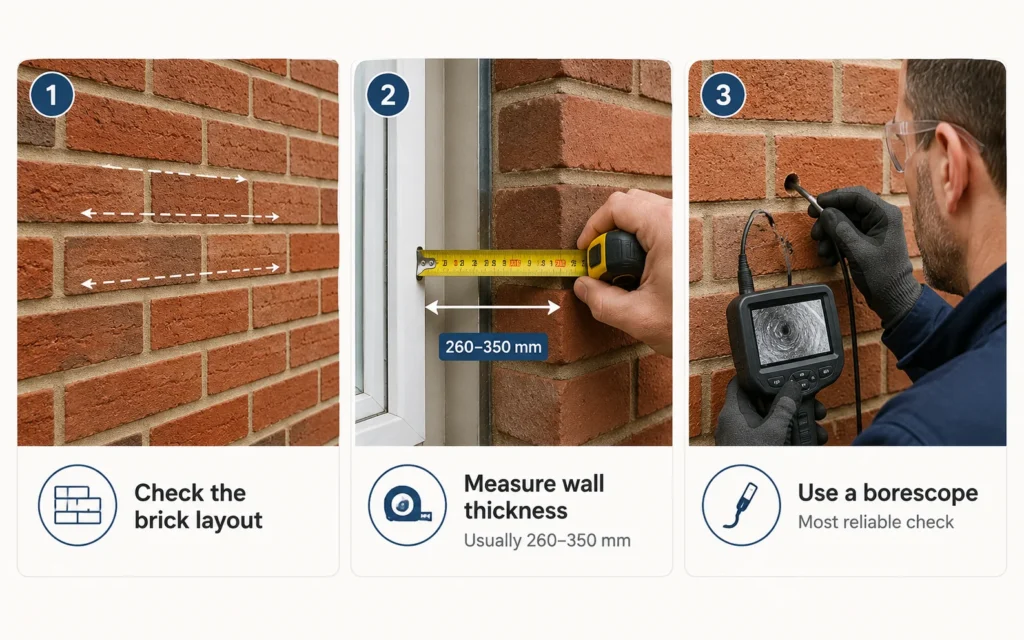
Before getting cavity wall insulation, you need to confirm that your home actually has cavity walls. Here are three simple ways to check:
1. Look at the Brick Pattern
Stand outside your home and look at the brickwork. If the bricks are laid in a uniform and even pattern, with all bricks running lengthways, meaning horizontally, you likely have cavity walls. If the bricks alternate between long and short ends, known as headers and stretchers, your home probably has solid walls.
2. Measure the Wall Thickness
Measure the wall thickness at an open door or window frame. A brick cavity wall is usually 260mm to 350mm thick. If your wall is thinner than this, it is more likely to be a solid wall.
3. Get a Borescope Inspection
A professional installer can drill a small hole in your wall and use a borescope camera to visually inspect the cavity. This is the most reliable method, and most installers include it as part of a free survey.
You can also check your home’s Energy Performance Certificate, also known as an EPC, or contact your local authority’s building control department for historical records.
How Is Cavity Wall Insulation Installed?
You cannot install cavity wall insulation yourself. It should only be carried out by a registered professional installer. The good news is that the process is quick, clean, and causes minimal disruption to your home.
On the day of installation, you can expect the following:
- The installer will first check the property to confirm that the walls are suitable.
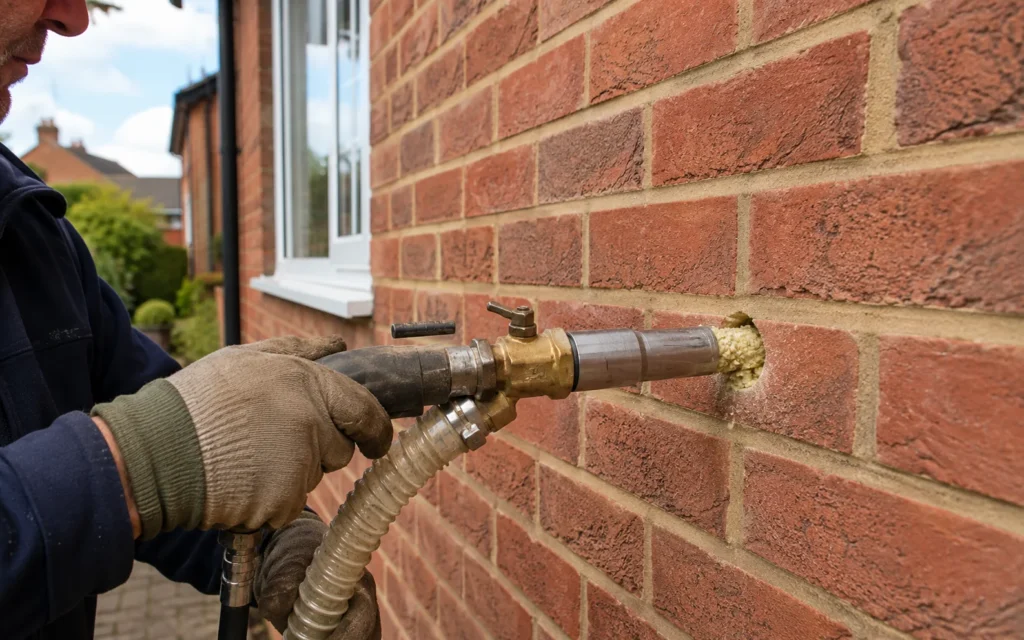
- Small holes are drilled into the external walls. These holes are approximately 22mm in diameter and are usually spaced around 1 metre apart.
- Using specialist equipment, the insulation material is blown or injected into the cavity through these holes.
- Once all the cavities are filled, the holes are sealed with matching mortar or cement.
- For an average semi-detached home, the whole job typically takes around two hours.
After installation, you may notice some small patched areas where the holes were sealed. These usually blend in over time, and you can paint over them if needed.
Types of Cavity Wall Insulation Materials
Choosing the right material is important for performance, longevity, and value for money. Here is a detailed look at the main options:
Mineral Fibre (Blown)
This is one of the most common and cost-effective materials used in the UK. Loose mineral fibres are blown into the cavity using compressed air. They expand to fill the space and effectively trap warm air. Mineral fibre must stay dry to maintain its insulating properties, so it is best suited to properties that are not exposed to extreme rain or moisture.
Polystyrene Beads (EPS)
Expanded polystyrene beads are blown into the cavity with a light adhesive, where they bond together to create a solid, moisture-resistant barrier. They are particularly suitable for narrower cavities and areas with higher rainfall. These beads are fully recyclable and highly effective, which is why they are one of our top recommendations for most UK homeowners.
Polyurethane Foam
Two chemical components are injected into the cavity, where they combine and expand to create an airtight, rigid foam. This provides excellent insulation and can last for the life of the building. However, polyurethane contains toxic chemicals and is not recyclable, which is why many environmentally conscious homeowners avoid this option.
Sheep Wool Fibre
For those who want a premium and fully sustainable option, sheep wool insulation is an excellent choice. It is naturally hypoallergenic, breathable, and entirely recyclable. At £25 to £30 per m², it is more expensive, but its environmental credentials and impressive performance make it worth considering.
Is Cavity Wall Insulation Worth It?
The simple answer is yes. For most UK homeowners, cavity wall insulation is definitely worth the investment. Here is why:
Lower Energy Bills
This is the biggest benefit. By reducing heat loss through your walls by up to 33%, you will need to run your heating system less. A semi-detached home can save around £235 per year, while a large detached house can save up to £405 annually. Over the lifetime of the insulation, which can be up to 100 years when properly installed, these savings can be significant.
Faster Payback Than You Think
Most cavity wall insulation pays for itself through energy bill savings within 10 to 12 years. Since good-quality insulation can last for several decades, you are likely to enjoy more than 50 years of savings after the investment pays off.
A Warmer, More Comfortable Home
We have all experienced the frustrating feeling of a cold home that does not warm up properly. Cavity wall insulation eliminates draughts and cold spots, making your home noticeably warmer and more comfortable, especially during UK winters.
Reduced Carbon Footprint
Insulating a detached UK home can reduce annual CO2 emissions by approximately 1.1 tonnes. At a time when we are all trying to reduce our environmental impact, this is a meaningful contribution.
Increased Property Value
A properly insulated home has a better EPC, or Energy Performance Certificate, rating. Higher EPC ratings make your property more attractive to buyers and renters, and they can potentially increase its market value.
Better Sound Insulation
As a bonus, cavity wall insulation also reduces outside noise. It is not designed as a primary soundproofing solution, but you will likely notice a reduction in road noise and wind.
Can Cavity Wall Insulation Cause Damp?
This is a common concern, and it is important to address it directly. If cavity wall insulation is correctly installed by a qualified professional, it should not cause damp.
Before installation, a good installer will check whether your home is exposed to excessive driving rain or flooding, whether the cavity is too narrow, and whether your brickwork and pointing are in good condition. If any of these issues are present, they will either address them first or advise against insulation.
However, poorly installed insulation, or insulation installed in unsuitable properties, has caused damp problems in some UK homes. That is why it is important to:
- Use a CIGA-certified installer, meaning a Cavity Insulation Guarantee Agency-certified installer.
- Make sure you receive a 25-year CIGA guarantee for your installation.
- Get a thorough survey done before any work begins.
- Address any existing damp, cracked rendering, or damaged guttering before proceeding.
If you experience damp after installation, contact your installer immediately. If they are unresponsive or are no longer trading, check your CIGA guarantee paperwork, as CIGA may be able to help resolve the issue.
Government Grants and Free Cavity Wall Insulation
The good news is that you may not have to pay the full cost of cavity wall insulation yourself. The UK government and energy companies offer several schemes to help eligible homeowners access free or subsidised insulation.
Great British Insulation Scheme (GBIS)
This government-backed scheme helps households improve their home’s energy efficiency. You may be eligible if your home has an EPC rating of D to G, or if your property falls within council tax bands A to D in England, or A to E in Scotland and Wales. Under this scheme, you may receive free or heavily subsidised cavity wall insulation.
Energy Company Obligation (ECO4)
The ECO4 scheme requires large energy suppliers to fund energy efficiency improvements for low-income and vulnerable households. If you receive certain qualifying benefits, such as Universal Credit, Pension Credit, or Child Benefit, you may be eligible for fully funded cavity wall insulation under ECO4.
Warm Homes Plan
The UK government has announced the Warm Homes Plan, which will invest close to £15 billion in improving the energy efficiency of UK homes. For people on low incomes, this means fully funded government support for insulation. Homeowners may also be able to access low-interest and zero-interest loans, regardless of their income level. More details are expected to emerge in the coming months.
Energy Supplier Grants
Many major energy suppliers, including British Gas, EDF Energy, E.ON, Scottish Power, and SSE, offer their own insulation grants and funding schemes. It is worth contacting your current energy supplier to ask what support they can offer.
To find out what financial support is available in your area, we recommend visiting the Energy Saving Trust’s grants and loans finder at energysavingtrust.org.uk, or speaking directly to a certified installer who is often familiar with local schemes.
How to Find a Reliable Cavity Wall Insulation Installer
Choosing the right installer is just as important as choosing the right insulation. Here are the key things to look for:
CIGA Certification
Always make sure your installer is registered with the Cavity Insulation Guarantee Agency, also known as CIGA. CIGA-certified installers follow strict quality standards and provide a 25-year guarantee on their work. This protects you if anything goes wrong in the future.
TrustMark Accreditation
TrustMark is a government-endorsed quality assurance scheme for tradespeople working in and around your home. Using a TrustMark-registered installer gives you extra peace of mind that the work will be completed to a high standard.
PAS 2030-2035 Certification
This is a publicly available specification, known as PAS, that sets the standards for energy efficiency installation work in the UK. Installers certified to this standard have been independently assessed and meet government quality requirements.
Get Multiple Quotes
We strongly recommend getting at least three quotes from different installers before making a decision. Do not choose only the cheapest option. Compare the proposed materials, the guarantee offered, and the installer’s track record. Ask for references or check online reviews.
Final Thoughts
Cavity wall insulation is one of the smartest and most cost-effective home improvements you can make in the UK. The upfront cost is manageable, especially if you qualify for a government grant or energy supplier scheme, and the long-term benefits in terms of lower energy bills, a warmer home, and a reduced carbon footprint are substantial.
If you are not sure whether your home has cavity walls, start by checking the brick pattern or calling a professional for a free survey. After that, get multiple quotes, look for CIGA-certified installers, and make sure you receive a full 25-year guarantee for the work.


