How Many Spindles Do I Need?
Getting the spindle count wrong can leave you with uneven openings, an unfinished staircase, or more materials than you need.
The exact number of spindles depends on three main measurements:
- The clear distance available between the posts.
- The finished width of each spindle.
- The maximum clear opening you want between the spindles.
For a quick and accurate result, use the spindle spacing calculator. It calculates the minimum number of spindles, equal clear gaps, centre-to-centre spacing and the total quantity after adding spares.
How Many Spindles Do You Need?
As a general estimate, many staircase suppliers suggest allowing approximately two spindles per tread. However, this is only a starting point. The exact quantity can change according to the stair going, spindle width, newel-post position, staircase design and required maximum opening.
For a landing, balcony, deck or straight railing, calculate the number from the measured clear distance rather than using a fixed number per metre.
The minimum spindle quantity can be calculated with this formula:
Number of spindles = round up [(clear run − maximum gap) ÷ (spindle width + maximum gap)]
Always round the answer upwards. Rounding down can leave openings larger than your selected maximum.
Quick Example
Suppose you have:
- A clear railing length of 3,000mm.
- 41mm-wide spindles.
- A maximum clear opening of 99mm.
The calculation is:
(3,000 − 99) ÷ (41 + 99) = 20.72
Round this upwards to 21 spindles.
With 21 spindles, the layout contains 22 equal openings:
Clear gap = [3,000 − (21 × 41)] ÷ 22
Clear gap = 97.23mm
You therefore need at least 21 spindles for this particular layout.
This answer is only valid for the stated measurements. A different spindle width or maximum gap may produce a different quantity.
Minimum Versus Recommended Quantity
The minimum quantity is the smallest whole number that keeps the calculated opening within your selected maximum.
The recommended quantity may be higher when you select a smaller preferred gap.
For example, 21 spindles may keep the openings below 99mm, while 22 may be required if you prefer openings no larger than 95mm.
Neither figure should be increased without explanation. The recommended result should always state the preferred-gap target or other reason for adding another spindle.
What Measurements Do You Need?
The measurements depend on the type of project and the information you already have.
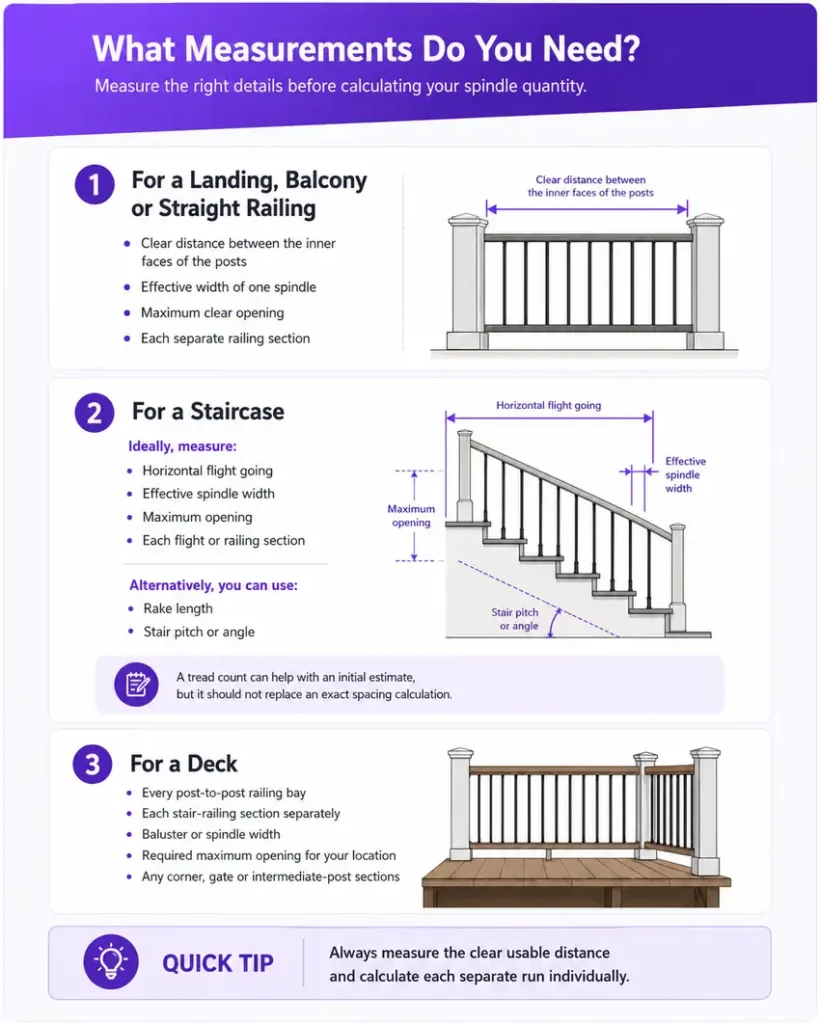
For a Landing, Balcony or Straight Railing
Measure:
- The clear distance between the inner faces of the posts.
- The effective width of one spindle.
- The maximum clear opening.
- Each separate railing section.
For a Staircase
Ideally, measure:
- The horizontal flight going.
- The effective spindle width.
- The maximum opening.
- Each flight or railing section.
Alternatively, you can use:
- The rake length.
- The stair pitch or angle.
A tread count can provide an initial purchasing estimate, but it should not replace an exact spacing calculation.
For a Deck
Measure:
- Every post-to-post railing bay.
- Each stair-railing section separately.
- The baluster or spindle width.
- The required maximum opening for your location.
- Any corner, gate, or intermediate-post sections.
How to Measure the Clear Distance Between Newel Posts
Use the distance available for the spindles and gaps, not the overall length of the handrail.
Place the end of your tape against the inner face of the first newel post and measure to the inner face of the second newel post.
Do not include:
- The width of either newel post.
- Decorative newel caps.
- Rail overhangs.
- Wall returns outside the usable spindle area.
- Sections occupied by intermediate posts.
If your landing contains a middle newel post, divide it into two separate railing runs and calculate each one individually.
For example:
- First run: 1,450mm.
- Second run: 1,920mm.
Do not enter 3,370mm as one continuous run. Each section has its own pair of end gaps, so combining the lengths can produce the wrong total.
Which Spindle Width Should You Enter?
Enter the actual finished width of the spindle where that dimension affects the clear opening.
For a plain square spindle, this is normally straightforward. A nominally 41mm square spindle may be entered as 41mm if that is its confirmed finished dimension.
Take more care with:
- Turned timber spindles.
- Fluted spindles.
- Chamfered designs.
- Twisted metal balusters.
- Decorative iron spindles.
- Products with narrow central sections.
A turned spindle may have a 41mm square block at the top and bottom but a considerably narrower profile in the middle. Entering only the widest block dimension could make the opening appear smaller than it really is.
Check the product drawing or measure the narrowest relevant part of the installed profile. Where the spindle shape creates a complex opening, follow the manufacturer’s system guidance and confirm the finished layout before permanent fixing.
Clear Gap Versus Centre-to-Centre Spacing
These measurements are related, but they are not the same.
Clear Gap
The clear gap is the empty opening between the sides of two adjacent spindles.
This is the value normally used when checking whether the opening stays within a selected maximum.
Centre-to-Centre Spacing
Centre-to-centre spacing is the distance from the centre line of one spindle to the centre line of the next.
It includes:
- One spindle width.
- One clear gap.
The formula is:
Centre-to-centre spacing = spindle width + clear gap
For example:
- Spindle width: 41mm.
- Clear gap: 92mm.
Centre-to-centre spacing:
41 + 92 = 133mm
Centre spacing is useful when marking the baserail, handrail, tread or string.
How Many Stair Spindles Do You Need?
For stairs, you can use either:
- An exact measured calculation.
- A tread-based estimate.
The measured calculation is more dependable because it uses the actual staircase geometry.
Exact Stair-Spindle Calculation
The preferred measurement is the total horizontal flight going between the relevant newel-post positions.
Once you know the horizontal distance, use the same quantity formula as a straight run:
Number of spindles = round up [(horizontal going − maximum gap) ÷ (spindle width + maximum gap)]
Then verify the horizontal clear opening:
Horizontal clear gap = [horizontal going − total spindle width] ÷ number of gaps
This method is especially useful where:
- Tread goings differ.
- Newel posts do not fall neatly on full treads.
- The staircase has an unusual pitch.
- You are replacing an existing balustrade.
- The spindle profile is narrower than a standard square spindle.
- You need exact marking positions.
Calculating From the Stair Rake
The rake is the sloping line followed by the handrail or baserail.
If you measure along the rake, you also need the stair pitch so the calculator can determine the horizontal projection.
Let:
- R = clear rake length.
- θ = stair angle measured from horizontal.
- H = horizontal projection.
The formula is:
H = R × cos(θ)
For example:
- Rake length: 3,200mm.
- Stair pitch: 42°.
Horizontal projection:
3,200 × cos(42°) = approximately 2,378mm
The spindle quantity should then be calculated using the 2,378mm horizontal projection rather than treating 3,200mm as a horizontal run.
Spacing Along the Rake
After calculating the horizontal centre-to-centre distance, convert it back into a marking distance along the rake:
Rake centre spacing = horizontal centre spacing ÷ cos(stair pitch)
This produces positions that can be marked along the sloping rail while keeping the relevant horizontal openings within the selected limit.
Do not subtract ordinary horizontal spindle widths directly from a sloping rail length without accounting for the stair angle.
How Many Spindles Per Tread?
A commonly used estimating rule is to allow approximately two spindles per tread, with adjustments near the top and bottom newel posts. UK stair-parts suppliers publish versions of this rule as an initial estimating method.
For a typical closed-string staircase, an early estimate may be:
Estimated spindles = number of treads × 2 − 2
For example:
- 12 treads × 2 = 24.
- Deduct 2 for common end or newel conditions.
- Estimated quantity = 22 spindles.
This is not a universal formula.
The actual number depends on:
- Tread going.
- Spindle width.
- Newel-post position.
- Stair pitch.
- Closed-string or cut-string construction.
- Winder or straight treads.
- The required maximum opening.
- Whether the upper landing requires additional spindles.
Is Two Spindles Per Tread Always Enough?
No.
Two per tread may produce acceptable-looking spacing on many conventional staircases, but it is not a substitute for checking the actual openings.
A wide tread going with narrow metal balusters may require more than two. A compact staircase with wide timber spindles may produce a different layout.
Use the tread method for:
- An early cost estimate.
- A provisional shopping list.
- A supplier quotation.
- Comparing product prices.
Use the measured method before:
- Final ordering.
- Drilling.
- Cutting infill strips.
- Fixing the spindles permanently.
- Relying on the result as an opening-size check.
Closed-String and Cut-String Staircases
On a closed-string staircase, the spindles usually fit into or above a baserail running along the string.
On a cut-string staircase, the spindles may terminate directly onto individual treads. The required lengths and positions can therefore vary along the flight.
A two-per-tread quantity can still be a useful starting estimate, but a cut-string staircase may require:
- Spindles of several lengths.
- Different fixing details.
- More careful alignment with tread nosings.
- A project-specific set-out.
Calculate quantity and spindle lengths as separate tasks.
Winders and Partial Treads
Do not rely on a uniform two-per-tread rule for:
- Winder stairs.
- Curved flights.
- Fan-shaped steps.
- Half treads.
- Irregular goings.
- Flights interrupted by posts.
Measure the actual usable sections and calculate them separately.
How Many Spindles Do You Need for a Landing?
A landing is normally calculated as a horizontal straight run.
You need:
- The clear distance between the posts.
- The spindle width.
- The selected maximum opening.
Use:
Number of spindles = round up [(clear length − maximum gap) ÷ (spindle width + maximum gap)]
Landing Example
Assume:
- Clear distance: 2,400mm.
- Spindle width: 41mm.
- Maximum opening: 99mm.
Minimum quantity:
(2,400 − 99) ÷ (41 + 99)
2,301 ÷ 140 = 16.44
Round upwards:
17 spindles
Calculate the exact gap:
[2,400 − (17 × 41)] ÷ 18
(2,400 − 697) ÷ 18
1,703 ÷ 18 = 94.61mm
The result is:
- Minimum spindles: 17.
- Number of equal gaps: 18.
- Exact clear gap: 94.61mm.
- Centre spacing: 135.61mm.
How to Calculate Around a Middle Newel Post
A newel post divides a landing into separate sections.
Suppose a return landing contains:
- Run A: 1,500mm.
- Middle newel post.
- Run B: 2,000mm.
Calculate Run A and Run B separately.
Do not:
- Add both lengths together.
- Calculate one continuous spindle pattern.
- Subtract the middle post afterwards.
The post creates two new end-gap conditions, which can change the total quantity.
Your final material quantity is:
Spindles for Run A + spindles for Run B
How Many Decking Spindles Do You Need?
For a deck or external balcony, calculate every clear post-to-post bay separately.
The calculation method is the same as a straight landing:
Number of balusters = round up [(clear bay length − maximum gap) ÷ (baluster width + maximum gap)]
However, the applicable maximum opening depends on the project location, building type, and local requirements.
Deck Example With Multiple Runs
Suppose a deck has three railing bays:
| Railing run | Clear length | Spindle width | Maximum opening |
|---|---|---|---|
| Run A | 1,800mm | 32mm | 99mm |
| Run B | 2,400mm | 32mm | 99mm |
| Run C | 1,200mm | 32mm | 99mm |
Calculate each run independently.
Run A
(1,800 − 99) ÷ (32 + 99) = 12.98
Round upwards to 13 spindles.
Run B
(2,400 − 99) ÷ 131 = 17.56
Round upwards to 18 spindles.
Run C
(1,200 − 99) ÷ 131 = 8.40
Round upwards to 9 spindles.
Total:
13 + 18 + 9 = 40 spindles
Adding a 5% spare allowance:
40 × 1.05 = 42
Order 42 spindles.
What Does a Passing Calculator Result Mean?
A passing result means that the calculated equal clear opening is no larger than the limit selected in the calculator.
It does not confirm that the complete staircase, deck, landing or balustrade satisfies every applicable requirement.
A spindle-spacing calculator does not assess:
- Whether guarding is required.
- Required guarding height.
- Handrail height or shape.
- Structural loading.
- Newel-post strength.
- Fixing type.
- Substrate condition.
- Glass specification.
- Climbability.
- Product-system compatibility.
- Commercial-building requirements.
- Project-specific approval.
Treat the result as an opening-size and material-quantity calculation, not as formal design approval.
Manual Spindle-Spacing Formula
Use the following method to verify a calculator result manually.
Step 1: Record Your Measurements
Write down:
- Clear usable distance.
- Spindle width.
- Maximum clear opening.
Use one unit throughout the calculation.
Step 2: Calculate the Minimum Quantity
Use:
Minimum spindles = round up [(clear length − maximum gap) ÷ (spindle width + maximum gap)]
Step 3: Calculate the Total Spindle Width
Use:
Total spindle width = number of spindles × spindle width
Step 4: Calculate the Remaining Space
Use:
Remaining space = clear length − total spindle width
Step 5: Count the Openings
Use:
Number of openings = number of spindles + 1
Step 6: Calculate the Exact Equal Gap
Use:
Exact gap = remaining space ÷ number of openings
Step 7: Verify the Result
Confirm that:
- The exact gap is no larger than the selected maximum.
- Both end gaps are included.
- Every separate railing run was calculated independently.
- The effective spindle width is correct.
- Units were not mixed.
- The result was not rounded down.
How Spindle Width Affects Quantity
The table below uses:
- A 2,000mm clear run.
- A maximum opening of 99mm.
- Equal end gaps.
| Effective spindle width | Minimum quantity | Exact clear gap |
|---|---|---|
| 13mm | 17 | 98.83mm |
| 32mm | 15 | 95.00mm |
| 35mm | 15 | 92.19mm |
| 41mm | 14 | 95.07mm |
| 56mm | 13 | 90.86mm |
This is why the spindle width must be included in the calculation.
A decorative spindle sold as a 41mm product may require a different quantity if its installed profile narrows to 20mm or 25mm through the section where the opening is checked.
How to Mark Out Equal Spindle Positions
Once you know the quantity and equal gap, you can calculate the position of every spindle.
Let:
- g = clear end gap.
- w = spindle width.
- i = spindle number, beginning with 1.
Near Edge of Each Spindle
Near-edge position = g + (i − 1) × (w + g)
Centre Line of Each Spindle
Centre position = g + (w ÷ 2) + (i − 1) × (w + g)
Far Edge of Each Spindle
Far-edge position = g + w + (i − 1) × (w + g)
Mark From One Datum
Mark every position from the same starting point, such as the inner face of the first newel post.
Do not repeatedly add a rounded centre spacing from one spindle to the next. Small rounding differences can accumulate and leave a noticeably different final end gap.
For example, if the calculated centre spacing is 133.428mm, repeatedly marking an approximate 133mm interval can create a several-millimetre error across a long run.
Instead, calculate:
- First centre from zero.
- Second centre from zero.
- Third centre from zero.
- Continue using the original datum.
Check Before Cutting or Drilling
Before permanent work:
- Mark the first and last spindle.
- Check both end gaps.
- Mark the remaining centres.
- Lay out the spindle or a full-width template.
- Check the narrowest openings.
- Confirm that the layout appears balanced.
- Recheck measurements against the product instructions.
How Many Spare Spindles Should You Order?
The exact quantity may fit the design, but it leaves no allowance for:
- Cutting errors.
- Split timber.
- Transit damage.
- Finishing defects.
- Colour or grain rejection.
- Incorrectly drilled components.
- Future repairs.
- Supplier pack quantities.
A practical allowance is:
| Project size | Suggested starting allowance |
|---|---|
| Up to 20 spindles | Add at least 1 spare |
| 21–50 spindles | Add 1–3 spares or approximately 5% |
| More than 50 spindles | Consider 5–10%, depending on material and return terms |
| Custom-finished or discontinued design | Order additional future-repair pieces where practical |
Round any percentage allowance upwards.
Example:
- Calculated quantity: 37.
- Spare allowance: 5%.
- 37 × 1.05 = 38.85.
- Order at least 39.
Also check:
- Pack size.
- Minimum order quantity.
- Whether opened packs can be returned.
- Whether the product batch or finish may change later.
- Whether staircase and landing spindles require different lengths.
Common Spindle-Calculation Mistakes
Measuring the Full Handrail Length
Problem: The measurement includes the newel posts or rail overhangs.
Correction: Measure the clear usable opening between the inner faces of the posts.
Dividing the Length Only by the Maximum Gap
Problem: This ignores the space occupied by the spindles.
Correction: Include both spindle width and gap in the formula.
Forgetting the Two End Gaps
Problem: A layout with 15 spindles is incorrectly treated as having only 14 or 15 gaps.
Correction: With equal end spacing, 15 spindles create 16 openings.
Rounding the Quantity Down
Problem: The resulting openings may be larger than the selected maximum.
Correction: Round upwards and recalculate the exact gap.
Using Centre Spacing as the Clear Gap
Problem: A centre spacing of 130mm is mistaken for a 130mm empty opening.
Correction: Subtract the spindle width to find the clear gap.
Using the Widest Part of a Turned Spindle
Problem: The narrow section creates a larger opening than the calculation predicts.
Correction: Use the effective minimum profile width or follow the manufacturer’s system guidance.
Treating the Rake Length as a Horizontal Length
Problem: A sloping length is longer than its horizontal projection.
Correction: Enter the horizontal going or convert the rake length using the stair pitch.
Adding Every Railing Run Together
Problem: The calculation loses the extra end gaps created by intermediate posts.
Correction: Calculate every post-to-post section separately.
Assuming Two Spindles Per Tread Is Exact
Problem: The estimate may not suit the actual tread going or spindle profile.
Correction: Verify the result with actual measurements.
Mixing Units
Problem: The run is entered in metres while the spindle width is treated as millimetres.
Correction: Convert all measurements to one unit before calculating.
Rounding Each Marking Position
Problem: Small errors accumulate along the run.
Correction: Calculate every mark from the original datum using full internal precision.
Final Check Before Ordering
- You measured between the inner faces of the posts.
- You used the correct finished spindle width.
- You included both end gaps.
- You calculated every railing run separately.
- You converted stair-rake measurements correctly.
- You rounded the spindle quantity upwards.
- You checked the exact unrounded opening.
- You distinguished a tread estimate from an exact calculation.
- You added a suitable spare allowance.
- You checked the current guidance for your project location.
- You reviewed the product manufacturer’s fitting instructions.
Once these details are confirmed, use the calculator result to prepare a clear material summary showing the quantity for each run, the total required, and any extra spindles being ordered.
FAQs
How Many Spindles Do I Need Per Metre?
There is no single number that works for every spindle.
For a 1,000mm clear run using 41mm spindles and a 99mm maximum gap, the minimum is seven spindles, producing eight gaps of approximately 89.13mm.
Narrower spindles or a smaller preferred gap can increase the quantity.
How Many Spindles Do I Need for a Three-Metre Run?
Using:
- A 3,000mm clear run.
- 41mm spindles.
- A 99mm maximum gap.
You need at least 21 spindles. This produces 22 equal gaps of approximately 97.23mm.
For a preferred maximum gap of 95mm, you would need 22 spindles.
How Many Spindles Do I Need Per Tread?
Two per tread is a common early estimate, with adjustments around newel posts. It is not an exact formula for every staircase.
Measure the actual flight before final ordering or installation.
Is Two Spindles Per Tread Enough?
It may be enough for some conventional staircase layouts, but not all.
The answer depends on:
- Tread going.
- Spindle width.
- Stair pitch.
- Newel positions.
- Maximum permitted opening.
Check the actual horizontal opening rather than relying only on the tread count.
Do I Include the Spindle Width in the Formula?
Yes.
The spindles and the clear openings both occupy part of the available railing length. Ignoring the spindle width normally produces an incorrect quantity.
Do I Measure Along the Stair Rake or Horizontally?
Use the horizontal flight going where possible.
If you measure the sloping rake, also enter the stair pitch so the horizontal projection can be calculated.
Can I Use the Calculator for a Deck or Balcony?
Yes, provided you enter every clear post-to-post run separately and select the opening limit applicable to your project location.
The calculator does not assess the structural design, guarding height, or fixings.