Work Capability Assessment: WCA50, LCW & LCWRA
If you have received a Work Capability Assessment form, you may feel worried about what to write, what evidence to send, and whether the decision will affect your Universal Credit or ESA payments.
The Work Capability Assessment, also called the WCA, is used to decide how much your health condition or disability affects your ability to work. GOV.UK explains that the WCA looks at what you can do as well as what you cannot do.
In this guide, I will explain everything in simple English:
- What a Work Capability Assessment is
- Who needs a WCA
- What the WCA50 form is
- How to fill in the form properly
- What evidence you should send
- What happens in the assessment
- What LCW and LCWRA mean
- How WCA points work
- What happens after the decision
- How LCWRA back pay may work
- What to do if the decision is wrong
What Is a Work Capability Assessment?
A Work Capability Assessment is a health and disability assessment used by the Department for Work and Pensions.
It helps the DWP decide whether:
- You are fit for work
- You have limited capability for work
- You have limited capability for work and work-related activity
- You may meet severe lifelong condition rules
The assessment does not only look at your diagnosis. It looks at how your condition affects your daily life.
For example, the DWP may consider whether you can:
- Walk or move around safely
- Stand or sit for long enough
- Pick things up
- Use your hands
- Understand information
- Learn simple tasks
- Cope with change
- Travel alone
- Speak to people
- Manage social situations
- Stay safe
- Complete activities repeatedly
- Do things without serious pain, fatigue or risk
A diagnosis matters, but your real-life difficulties matter more.
Work Capability Assessment Quick Answer
The Work Capability Assessment is the process used to decide how your illness, disability, or mental health condition affects your ability to work or prepare for work.
You may need to:
- Complete a WCA50 form
- Send medical evidence
- Attend a telephone, video, face-to-face, paper-based, or home assessment
- Wait for the DWP decision
- Challenge the decision if it is wrong
After the assessment, you may be placed into one of these groups:
| WCA Result | What It Means |
|---|---|
| Fit for work | DWP says you can work with suitable requirements |
| LCW | You have limited capability for work now |
| LCWRA | You cannot work or do work-related activity |
| Severe lifelong condition | You may not need regular reassessments |
Who Needs a Work Capability Assessment?
You may need a Work Capability Assessment if you claim Universal Credit or ESA and your health condition affects your ability to work.
You may need a WCA if:
- You have reported a health condition on your Universal Credit account
- You have sent fit notes
- You claim New Style ESA
- Your condition affects your work ability
- Your work coach needs to understand what activities are suitable for you
- The DWP needs evidence before changing your claimant commitment
You may have a physical health condition, mental health condition, learning difficulty, neurodivergent condition, chronic illness, or long-term disability.
Examples include:
- Anxiety
- Depression
- PTSD
- Autism
- ADHD
- Arthritis
- Chronic pain
- ME/CFS
- Fibromyalgia
- Epilepsy
- Heart conditions
- Breathing problems
- Mobility problems
- Learning difficulties
- Neurological conditions
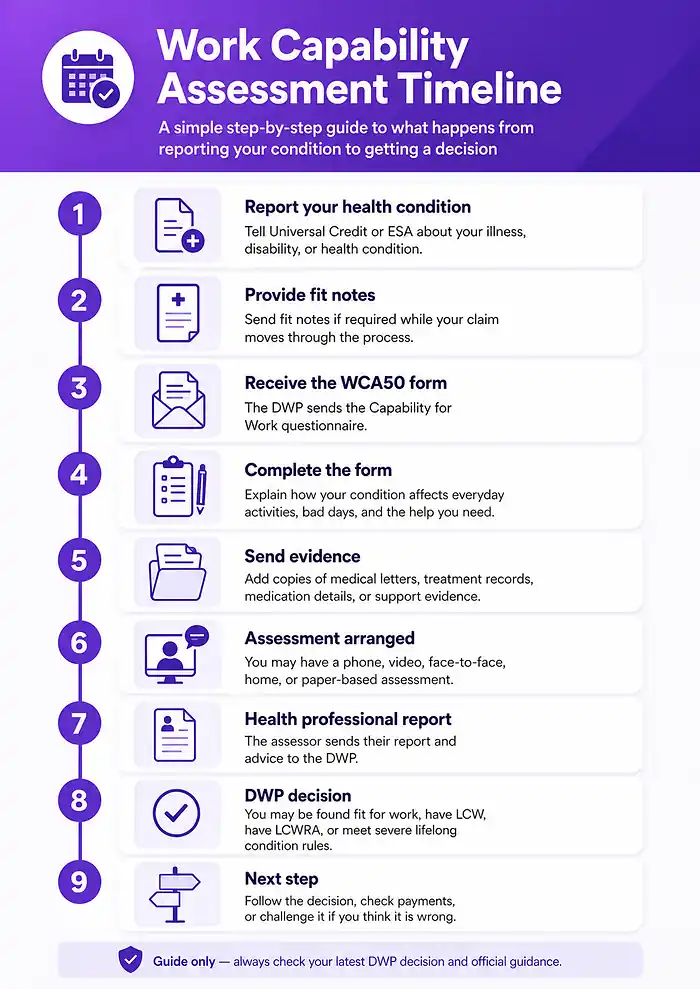
How the Work Capability Assessment Process Works
The WCA process can feel confusing, but it usually follows these steps.
Step 1: You Report Your Health Condition
You tell Universal Credit or ESA that you have a health condition or disability.
This may involve:
- Reporting your condition in your Universal Credit account
- Sending fit notes
- Telling your work coach how your condition affects you
- Explaining what activities you cannot do safely
Step 2: You Receive the WCA50 Form
The DWP may send you the WCA50 form.
GOV.UK says the WCA50 has replaced the older ESA50 and UC50 capability for work questionnaires.
The WCA50 asks how your condition affects your ability to complete everyday tasks.
Step 3: You Fill In the WCA50 Form
You complete the form and explain your difficulties clearly.
You should explain:
- What you struggle with
- Why you struggle with it
- How often it happens
- What help you need
- What happens if you try anyway
- Whether you can do the activity safely
- Whether you can repeat the activity
- Whether the activity causes pain, fatigue or distress
Step 4: You Send Medical Evidence
You can send copies of evidence with your form. GOV.UK says you can send medical information such as treatment plans or test results with the WCA50.
Useful evidence can include:
- GP letters
- Hospital letters
- Consultant reports
- Medication lists
- Care plans
- Therapy notes
- Mental health team letters
- Occupational therapy reports
- Physiotherapy reports
- Support worker letters
- Carer statements
- Symptom diaries
- Fit notes
Step 5: You May Have an Assessment
The assessment can be:
- In person
- By phone
- By video call
GOV.UK confirms that the assessment can be in person, by video call, or on the phone.
In some cases, the provider may decide your claim using the form and evidence only.
Step 6: DWP Makes the Decision
The health professional gives advice to the DWP.
The final decision is made by the DWP, not by the assessor.
The DWP then decides whether you are:
- Fit for work
- LCW
- LCWRA
- Treated under severe lifelong condition rules
What Is the WCA50 Form?
The WCA50 is the Capability for Work questionnaire.
It asks how your illness, disability, or mental health condition affects your ability to do everyday activities.
The form may ask about:
- Walking and moving around
- Standing and sitting
- Reaching
- Picking things up
- Using your hands
- Speaking
- Hearing or understanding communication
- Learning tasks
- Awareness of danger
- Starting and finishing tasks
- Coping with change
- Getting around
- Social interaction
- Behaviour with other people
- Eating and drinking
- Bladder or bowel control
- Loss of consciousness
- Mental health difficulties
Important Point
Do not fill in the WCA50 like a short medical form.
You should use it to explain your real daily problems.
For example, do not only write:
- “I have anxiety.”
- “I have back pain.”
- “I have depression.”
- “I have arthritis.”
Instead, explain:
- What happens when you leave home
- What happens when you walk
- What happens when you speak to people
- What happens when you try to complete tasks
- What happens after physical or mental effort
- Whether you need help from another person
How to Fill In the WCA50 Form Properly
Many people make the mistake of writing very short answers. That can make the condition look less serious than it really is.
A strong answer should include:
- The activity you struggle with
- The reason you struggle
- How often the problem happens
- How long it lasts
- What help you need
- What aids you use
- What happens afterwards
- Whether the activity is safe
- Whether you can repeat it
- Whether it causes pain, fatigue, panic, confusion or risk
Weak Answer Example
“I can walk but I get pain.”
Better Answer Example
“I can walk about 30 metres before the pain becomes severe. I need to stop and rest. If I continue walking, I feel unstable and may fall. After walking, I often need to sit down for 20 to 30 minutes before I can do anything else.”
This answer is better because it explains:
- Distance
- Pain level
- Risk
- Rest time
- Repeatability
- Real-life impact
Explain Good Days and Bad Days
If your condition changes from day to day, explain that clearly.
You should mention:
- How many bad days you have each week
- What a bad day looks like
- What a better day looks like
- What triggers your symptoms
- How long recovery takes
- Whether you cancel plans or appointments
- Whether you need help on bad days
Example:
“On a good day, I may manage one short trip outside with support. On a bad day, I cannot leave the house because I feel dizzy, exhausted, and anxious. I have around 4 bad days each week.”
Explain Safety, Pain, Fatigue and Repeatability
This is one of the most important parts of a WCA claim.
You should not only say whether you can do something once.
You should explain whether you can do it:
- Safely
- Repeatedly
- Reliably
- Within a reasonable time
- Without serious pain
- Without serious fatigue
- Without needing long recovery
- Without risk to yourself or others
Example:
“I can sometimes cook a simple meal, but I cannot do it safely every day. I forget pans on the hob when my concentration is poor. My partner usually checks on me when I cook.”
Mention Help From Another Person
If someone helps you, write it clearly.
This person may be:
- A partner
- Parent
- Friend
- Carer
- Support worker
- Neighbour
- Mental health worker
- Social worker
- Family member
Explain:
- What they help with
- How often they help
- Why you need help
- What happens without help
- Whether they remind, prompt, supervise, encourage or physically support you
Example:
“My sister reminds me to attend appointments and helps me travel. Without her, I often cancel appointments because I become too anxious to leave home.”
What Evidence Should You Send?
Evidence should support what you write in the WCA50.
You do not always need a long medical report. Even simple evidence can help if it shows how your condition affects you.
Useful Evidence Checklist
| Health Problem | Useful Evidence | What It Shows |
|---|---|---|
| Mobility problems | Physiotherapy report, OT report, hospital letter | Walking distance, falls, aids, pain |
| Mental health condition | GP letter, psychiatrist letter, therapy notes | Anxiety, depression, risk, daily impact |
| Chronic pain | Pain clinic letter, medication list, symptom diary | Pain level, fatigue, side effects |
| Autism or ADHD | Diagnostic report, support plan, education records | Communication, change, social interaction |
| Memory problems | Neurology report, carer statement | Forgetting tasks, needing supervision |
| Seizures or blackouts | Neurology letter, seizure diary | Frequency, safety risk |
| Fatigue condition | GP notes, diary, consultant letter | Energy limits, recovery time |
| Social difficulties | Support worker letter, mental health notes | Distress, isolation, communication problems |
Evidence You Can Send
You can send:
- Medical letters
- Appointment letters
- Test results
- Treatment plans
- Medication lists
- Care plans
- Support plans
- Therapy records
- Letters from professionals
- Letters from people who support you
- Daily symptom diary
- Photos of aids or adaptations, if relevant
Evidence Tips
Keep these points in mind:
- Send copies, not original documents
- Keep a copy of everything you send
- Write your National Insurance number on copied documents if required
- Keep proof of postage if you post the form
- Upload evidence through your online account if available
- Ask for help if you do not understand the form
Types of Work Capability Assessment
Your assessment may happen in different ways.
Telephone Assessment
A telephone assessment happens over the phone.
Before the call, keep these things near you:
- Your WCA50 form
- Medical evidence
- Medication list
- Notes about your condition
- A glass of water
- Someone to support you, if needed
During the call, explain:
- Your normal day
- Your bad days
- Your symptoms
- Your treatment
- Your medication side effects
- What activities you cannot do safely
- What help you need
Video Assessment
A video assessment happens through an online video call.
Before a video assessment:
- Charge your phone, tablet or laptop
- Check your internet connection
- Sit in a quiet place
- Keep your notes nearby
- Ask someone to help if you need support
- Tell the provider if video calls make your condition worse
Face-to-Face Assessment
A face-to-face assessment happens at an assessment centre.
You may be asked about:
- Your health condition
- Your medication
- Your daily routine
- How you travelled to the appointment
- How you manage personal care
- How you interact with people
- How long you can sit, stand or walk
You should also explain:
- If travelling made your symptoms worse
- If someone came with you
- If you needed rest before or after travel
- If you only attended because someone helped you
Paper-Based Assessment
A paper-based assessment means the provider makes a recommendation using your form and evidence only.
This may happen when:
- Your evidence is strong
- Your condition is clear
- An appointment is not needed
- The provider has enough information
This is why detailed answers and good evidence matter.
Home Assessment
A home assessment may happen if you cannot attend an assessment centre and cannot manage a phone or video assessment.
You may need evidence showing why you need a home visit.
Can Someone Go With You to the Assessment?
Yes. You can usually have someone with you.
This may be:
- A friend
- Family member
- Carer
- Support worker
- Advocate
- Adviser
They can help by:
- Taking notes
- Reminding you of details
- Helping you stay calm
- Explaining support they give you
- Helping you understand questions
Are Work Capability Assessments Recorded?
From 29 June 2026, GOV.UK says telephone and face-to-face health assessment appointments are audio recorded, including ESA Work Capability Assessments. GOV.UK also says you can ask for your appointment not to be recorded and you will not be disadvantaged if you opt out.
This is useful because a recording can help if there is later confusion about what was said.
Before your assessment, check:
- Whether your appointment will be recorded
- How to get a copy of the recording
- Whether video assessments are handled differently
- Whether you need to request anything in advance
Work Capability Assessment Points Explained
The WCA uses activities and descriptors.
A descriptor is a statement that describes a level of difficulty.
Some descriptors score points.
In many LCW cases, you need 15 points or more. However, LCWRA can also depend on specific descriptors or risk rules.
Physical Activities May Include
- Mobilising
- Standing and sitting
- Reaching
- Picking up and moving objects
- Manual dexterity
- Making yourself understood
- Understanding communication
- Getting around safely
- Continence
- Consciousness
Mental, Cognitive and Social Activities May Include
- Learning tasks
- Awareness of hazards
- Starting and finishing tasks
- Coping with change
- Getting about
- Coping with social engagement
- Behaviour with other people
Important Points About WCA Points
Keep these points in mind:
- You do not get points just because you have a diagnosis
- You get points based on how your condition affects activities
- The same activity may have different point levels
- Usually, the highest descriptor in one activity counts
- You should explain the worst relevant difficulty that applies most of the time
- You should explain if the activity causes risk, pain, fatigue or distress
LCW vs LCWRA: What Is the Difference?
LCW and LCWRA are two different WCA outcomes.
LCW Meaning
LCW means limited capability for work.
This means:
- You are not fit for work now
- You may not need to look for work
- You may still need to prepare for work in the future
- Your work coach may set suitable work preparation activities
Examples of work preparation may include:
- Preparing a CV
- Talking to your work coach
- Discussing future work options
- Taking suitable training
- Building confidence slowly
LCWRA Meaning
LCWRA means limited capability for work and work-related activity.
This means:
- You do not need to look for work
- You do not need to prepare for work
- You may get extra Universal Credit
- Your condition has a serious impact on your ability to work or do work-related activity
GOV.UK says if you have limited capability for work and work-related activity, you do not need to look for work or prepare for work, and you may get extra money.
LCW vs LCWRA Table
| Feature | LCW | LCWRA |
|---|---|---|
| Full meaning | Limited capability for work | Limited capability for work and work-related activity |
| Work search | Usually not required | Not required |
| Work preparation | May be required | Not required |
| Extra UC payment | Usually not for new UC claims | Usually yes, depending on rules |
| Claimant commitment | Adjusted to your condition | No work search or preparation |
| Best for | People who may prepare for future work | People who cannot work or prepare for work |
What Happens After a Work Capability Assessment?
After the assessment, the DWP sends you a decision.
The decision may say:
- You are fit for work
- You have LCW
- You have LCWRA
- You meet severe lifelong condition rules
If You Are Found Fit for Work
This means the DWP thinks you can work or look for work with suitable conditions.
You may need to:
- Agree to a claimant commitment
- Look for suitable work
- Attend work coach appointments
- Complete work search activities
If you think this is wrong, you can challenge the decision.
If You Are Given LCW
This means the DWP accepts that your condition limits your ability to work now.
You may need to:
- Attend some work coach appointments
- Prepare for possible future work
- Complete suitable activities
- Keep the DWP updated about changes
You usually do not have to do full work search if your requirements are adjusted.
If You Are Given LCWRA
This means the DWP accepts that you cannot work or do work-related activity because of your condition.
You should not need to:
- Look for work
- Prepare for work
- Attend work-related activity appointments
You may also receive an extra Universal Credit amount.
If You Meet Severe Lifelong Condition Rules
Some people may be treated as having a severe lifelong condition or disability.
This may apply where the condition is:
- Severe
- Lifelong
- Highly unlikely to improve
- Supported by medical evidence
GOV.UK explains that people with severe lifelong health conditions or disabilities, or people nearing the end of life, can receive the higher LCWRA amount regardless of when they claim.
Will You Get Extra Universal Credit After WCA?
You may get extra Universal Credit if you are awarded LCWRA.
From 6 April 2026, GOV.UK says the LCWRA extra amount has 2 rates: a higher rate and a lower rate. The amount depends on your circumstances, including when you reported your health condition and whether severe lifelong condition rules apply.
The amount may depend on:
- When you reported your health condition
- When you provided fit notes
- Whether you already had LCWRA before 6 April 2026
- Whether you have a severe lifelong condition
- Whether you are nearing the end of life
- Whether you live with a partner
- Whether your partner also has LCWRA
- Whether transitional protection applies
LCWRA Back Pay and Backdated Payments
If you are awarded LCWRA, you may receive backdated money.
This is often called:
- LCWRA back pay
- LCWRA arrears
- Backdated LCWRA payment
- Universal Credit health element back pay
Back pay may depend on:
- The date you first reported your health condition
- The date you started providing fit notes
- Your Universal Credit assessment periods
- The date of the LCWRA decision
- Whether the waiting period applies
- Whether your claim had gaps
- Whether your circumstances changed
- Whether DWP made any deductions
If your decision says you have LCWRA and you want to estimate possible arrears, you can use this LCWRA back pay calculator to check what your backdated amount may look like.
Use it as a guide only. The final amount depends on your exact Universal Credit claim and DWP calculation.
What If You Disagree With the WCA Decision?
If you think the decision is wrong, you can challenge it.
You should not ignore the decision.
Step 1: Ask for a Mandatory Reconsideration
A mandatory reconsideration means asking the DWP to look at the decision again.
In your request, explain:
- Why the decision is wrong
- Which activities affect you
- What points or descriptors apply
- What the assessor misunderstood
- What evidence supports your case
- What happens when you try to do the activity
- Why work or work-related activity may be unsafe
Step 2: Send More Evidence
You can send more evidence if you have it.
Useful evidence may include:
- New GP letter
- Specialist letter
- Mental health team letter
- Care plan
- Support worker statement
- Carer statement
- Symptom diary
- Medication side effect evidence
- Hospital appointment records
Step 3: Appeal to a Tribunal
If the DWP does not change the decision, you may be able to appeal.
A tribunal is independent from the DWP.
At the tribunal, you can:
- Explain your condition in your own words
- Submit evidence
- Correct mistakes
- Explain daily difficulties
- Ask for support from an adviser or welfare rights service
Common Work Capability Assessment Mistakes to Avoid
Avoid these common mistakes.
Mistake 1: Writing Very Short Answers
Do not write one-line answers if your condition has a serious impact.
Instead, explain:
- What happens
- How often it happens
- How long it lasts
- What help you need
- What happens afterwards
Mistake 2: Only Writing Your Diagnosis
Do not only write:
- “I have depression.”
- “I have arthritis.”
- “I have anxiety.”
- “I have chronic pain.”
Write how it affects you.
Mistake 3: Ignoring Bad Days
If you have bad days, explain them.
Mention:
- How often they happen
- What symptoms are worse
- What you cannot do
- Whether you need help
- How long recovery takes
Mistake 4: Saying “I Can Do It” Without Explaining the Cost
If you can do an activity but it causes pain, exhaustion, panic, or risk, write that.
Example:
“I can walk to the shop sometimes, but I need to rest several times, and I am exhausted afterwards.”
Mistake 5: Not Mentioning Mental Health
Mental health can affect:
- Motivation
- Concentration
- Memory
- Leaving the house
- Talking to people
- Coping with change
- Attending appointments
- Managing tasks
- Staying safe
Mistake 6: Not Keeping Copies
Always keep copies of:
- Your WCA50 form
- Evidence
- Letters
- Appointment notices
- Decision letters
- Journal messages
- Mandatory reconsideration request
- Appeal documents
Work Capability Assessment Checklist
Use this checklist before sending your WCA50 form.
WCA50 Form Checklist
- Have I answered every relevant question?
- Have I explained my condition in daily-life terms?
- Have I described good days and bad days?
- Have I explained pain, fatigue, distress or risk?
- Have I said whether I can repeat activities?
- Have I mentioned help from another person?
- Have I included real examples?
- Have I explained what happens after activity?
- Have I mentioned aids or adaptations?
- Have I included medication side effects?
- Have I checked the deadline?
- Have I kept a copy?
Evidence Checklist
- GP letter
- Hospital letter
- Consultant report
- Medication list
- Treatment plan
- Therapy notes
- Care plan
- Support worker letter
- Carer statement
- Symptom diary
- Fit notes
- Occupational therapy report
- Physiotherapy report
Assessment Day Checklist
- Keep your notes nearby
- Keep your medication list nearby
- Have evidence copies ready
- Ask someone to support you if needed
- Be honest about bad days
- Explain if the assessment itself is difficult
- Take your time before answering
- Do not say “fine” if you are not fine
- Explain what happens after the activity
- Ask for a break if you need one
Work Capability Assessment Examples
Example 1: Mobility Problem
Weak answer:
“I cannot walk far.”
Better answer: “I can walk around 30 metres before my knee and hip pain becomes severe. I need to stop, lean on something and rest. If I continue, I feel unstable and may fall. After walking, I usually need 20 to 30 minutes to recover.”
This answer explains:
- Distance
- Pain
- Risk
- Rest
- Recovery
- Repeatability
Example 2: Anxiety and Depression
Weak answer:
“I have anxiety.”
Better answer: “I have severe anxiety and depression. I struggle to leave the house alone. If I have an appointment, my brother usually travels with me. Without support, I often cancel because I panic and cannot cope with unfamiliar places.”
This answer explains:
- Mental health impact
- Travel difficulty
- Need for support
- Real-life consequence
Example 3: Fatigue Condition
Weak answer:
“I get tired.”
Better answer: “After showering and getting dressed, I often need to rest before I can do anything else. If I push myself, my symptoms flare, and I may spend the next day mostly in bed. I cannot repeat activities reliably throughout the day.”
This answer explains:
- Activity limit
- Fatigue
- Recovery time
- Repeatability
Experience-Based Tips for a Strong WCA Claim
When I look at weak WCA answers, the biggest problem is usually not the condition itself. The problem is that the form does not explain the condition clearly.
Use this simple formula:
- What activity do you struggle with?
- What happens when you try?
- How often does it happen?
- How long does it last?
- Do you need help?
- Is it safe?
- Can you repeat it?
- What happens afterwards?
A strong answer is honest, detailed and practical.
Do not exaggerate. Do not hide important problems either. Explain your normal reality.
Final Thoughts
The Work Capability Assessment can feel stressful, but you can make the process easier by preparing properly.
Remember these key points:
- Do not only write your diagnosis
- Explain your daily difficulties
- Use real examples
- Describe bad days
- Explain pain, fatigue, risk, and recovery
- Mention help from another person
- Send useful evidence
- Keep copies of everything
- Challenge the decision if it is wrong
A strong WCA form is not about using complicated words. It is about clearly showing how your condition affects your real life.
FAQs
What does WCA mean?
WCA means Work Capability Assessment. It is used to decide how your health condition affects your ability to work or prepare for work.
What is the WCA50 form?
The WCA50 is the Capability for Work questionnaire. GOV.UK says it has replaced the ESA50 and UC50 forms.
Do I need to fill in the WCA50 form?
Yes, if the DWP asks you to complete it. GOV.UK says you should fill in the WCA50 only if you have been asked to do a Work Capability Assessment.
What should I write on the WCA50?
You should explain how your condition affects everyday activities. Include examples, bad days, help you need, risk, pain, fatigue, and whether you can repeat activities.
Can I send evidence with the WCA50?
Yes. You can send copies of medical evidence such as treatment plans, test results, reports, letters, medication lists, and support evidence.
Will I always have an assessment?
No. Some people may have a paper-based assessment if there is enough evidence. Others may have a phone, video, face-to-face, or home assessment.
Can someone support me during the assessment?
Yes. GOV.UK says you can have someone else with you, such as a friend or support worker.
What is LCW?
LCW means limited capability for work. It means your condition limits your ability to work now, but you may still need to prepare for work in the future.
What is LCWRA?
LCWRA means limited capability for work and work-related activity. It means you do not need to look for work or prepare for work because of your condition.
Does LCWRA give extra Universal Credit?
Usually, LCWRA can give extra Universal Credit. From 6 April 2026, LCWRA has higher and lower rates depending on your circumstances.
Can LCWRA be backdated?
Yes, LCWRA may be backdated depending on when you reported your condition, sent fit notes, your assessment periods, and the DWP decision date.
What if my WCA decision is wrong?
You can ask for a mandatory reconsideration. If the DWP does not change the decision, you may appeal to an independent tribunal.
Can I work if I have LCWRA?
You can work if you feel able to do so, but you should understand how earnings, reporting rules, and your condition may affect your Universal Credit.
Is the assessor the final decision maker?
No. The assessor gives advice. The DWP makes the final decision.