How Much Rent Should I Charge? UK Rent Calculator
The rent you should charge is usually the amount that similar local properties are realistically achieving, adjusted for your property’s size, condition, furnishing, bills, parking, outdoor space and tenant demand.
A sensible way to set rent is:
- Check at least three genuinely comparable rental properties.
- Give more weight to recent let-agreed or achieved rents than old advertised listings.
- Adjust for differences between your property and the comparables.
- Test whether a slightly higher rent is worth the risk of a longer void period.
- Check gross yield, net yield, monthly cash flow and break-even rent.
- Check tenant affordability separately.
Do not base the rent only on your mortgage payment, the property value, or what one tenant says they can afford. Those figures matter, but they do not decide the open-market rent.
UK Rent Calculator: Estimate How Much Rent to Charge
Not sure whether your rent is too high, too low, or just right for the local market?
Use this UK rent calculator to estimate a sensible monthly guide rent using your property details, condition, features and letting setup. For the strongest result, enter a postcode district such as SW11, M1, B1 or LS1.
Your Rent Estimate
Suggested Monthly Rent
per calendar month
Includes estimated billsLower Range
£0 Faster enquiriesUpper Range
£0 Premium positioningWeekly Equivalent
£0 per weekWhat this means
Estimated Gross Yield
0% Based on valueLetting Readiness Checklist
- Before advertising, compare your result with 3–5 similar live rental listings in the same postcode district.
- Check EPC ratings and ensure the property meets current minimum energy efficiency standards.
- Prepare bright, clear photos and an honest description highlighting key features.
- Review current UK regulations around deposit protection, gas safety, and tenancy agreements.
This calculator gives a guide estimate only. It does not use live valuation data, so always compare similar active rental listings in the same postcode district and check current UK landlord rules before advertising or increasing rent.
What you need before using the calculator
For the best result, gather:
| Information | Why it matters |
|---|---|
| Your property type | A studio, flat, terraced house, detached house, HMO room, and lodger room should not be priced the same way. |
| Number of bedrooms and bathrooms | Bedroom count is one of the strongest rent filters tenants use. |
| Approximate floor area | Two properties with the same bedroom count can rent differently if one is much larger. |
| Condition and finish | A newly refurbished property may attract more demand than a tired one. |
| Furnishing | Furnished, part-furnished and unfurnished homes appeal to different tenants. |
| Bills included or excluded | Bills-included rents must cover the landlord’s real costs. |
| Parking and outdoor space | These can matter strongly in some locations. |
| Three to six comparable rents | Comparable evidence is the foundation of the estimate. |
| Expected landlord costs | Gross rent can look good while net profit is weak. |
| Expected vacant weeks per year | A slightly higher rent can earn less if the property sits empty. |
Calculator inputs
The calculator should ask for:
Property details
- Location or postcode description
- Property type
- Number of bedrooms
- Number of bathrooms
- Approximate floor area
- Furnished, part-furnished or unfurnished
- Property condition
- Parking
- Garden, balcony, terrace or no outdoor space
- Bills included or excluded
- Whole-property letting, HMO room or lodger room
Comparable rents
Add at least three and ideally up to six comparable properties. For each one, enter:
- Monthly rent
- Asking, let-agreed or achieved rent
- Distance from your property
- Property type
- Bedrooms
- Floor area, if known
- Condition
- Furnishing
- Date of evidence
- Whether it is available, let agreed, confirmed let or long-listed
Financial details
- Property value or purchase price
- Expected monthly rent
- Expected vacant weeks per year
- Letting or management fee percentage
- Annual maintenance reserve
- Annual insurance
- Annual service charge
- Annual licence or compliance costs
- Utilities or council tax paid by the landlord
- Other annual expenses
- Monthly mortgage payment, if you want a cash-flow estimate
Tenant affordability
Keep this separate from the market rent estimate. The affordability check should ask for:
- Proposed monthly rent
- Applicant’s gross annual household income
- Optional guarantor income
- Affordability multiplier
Money Helper describes the “30% rule” as a guide suggesting rent of up to 30% of income before tax, while also noting that sticking to 30% is not always possible. You can also check the proposed rent against household income using a dedicated rent affordability calculator; use this as an initial affordability check, not a guarantee that the tenant will pass referencing.
How to calculate a fair rent using comparable properties
The best starting point is not your mortgage, your ideal income, or a national average. It is the rent that similar properties in the same local market are likely to achieve.
The ONS reported that average UK monthly private rent was £1,383 in May 2026, with averages of £1,442 in England, £836 in Wales, £1,009 in Scotland and £876 in Northern Ireland, but these national figures are only broad context. They are not enough to price a single flat, house, or room.
A two-bed flat near a railway station can have a different rent from another two-bed flat a few streets away if the layout, condition, building, parking, schools or commuter links are different.
Step 1: collect comparable rental evidence
Look for properties that match your property as closely as possible.
Strong comparables usually have:
- Similar location
- Similar property type
- Same or very similar bedroom count
- Similar floor area
- Similar condition
- Similar furnishing
- Similar parking and outdoor space
- Similar bills arrangement
- Recent listing or tenancy evidence
Try to use at least three comparables. Five or six is better if they are genuinely similar.
Step 2: separate asking rent from achieved rent
Advertised rent is not always the rent a tenant finally pays. Some advertised listings are priced optimistically. Others remain online because the property has not let. A recently let-agreed or confirmed achieved rent is usually stronger evidence than a property that has been sitting online for weeks.
Use this evidence hierarchy:
| Evidence type | How much weight to give it |
|---|---|
| Confirmed achieved rent | Strongest evidence |
| Recently let-agreed property | Strong evidence |
| Recently advertised similar property | Useful, but check whether it is still available |
| Long-listed property | Treat carefully; the price may be too high |
| Old listing | Weak evidence unless the market has been stable |
The calculator should reduce the influence of weak, old or unusually high comparables rather than averaging everything blindly.
Step 3: use the median, not just the average
If your comparable rents are:
- £1,250
- £1,275
- £1,300
- £1,325
- £1,800
The unusually high £1,800 listing pulls the average up. The median is £1,300, which may be a more realistic starting point.
Use the median as your base, then adjust for property differences.
Step 4: score comparable quality
A nearby property is not automatically a good comparable. A weak comparable can mislead your rent decision.
Use this simple scoring method:
| Comparable factor | Strong match | Weak match |
|---|---|---|
| Distance | Same street, block or immediate neighbourhood | Different town, school catchment or transport zone |
| Evidence date | Listed or let recently | Several months old |
| Property type | Same type | Different type |
| Bedrooms | Same number | Different number |
| Floor area | Similar size | Much smaller or larger |
| Condition | Similar standard | Much better or worse |
| Furnishing | Same arrangement | Different arrangement |
| Bills | Same bills treatment | Bills included in one but excluded in another |
| Outdoor space | Similar | One has garden/parking and the other does not |
A good calculator should explain its confidence level. For example:
“Moderate confidence: you entered four comparable rents, but two are asking rents and one is more than six months old.”
How to adjust rent for property features
After you have a comparable-rent starting point, adjust carefully. Avoid universal rules such as “add 10% for furnishing” unless you have local evidence. In some areas furnishing increases demand. In others, good unfurnished properties let just as well.
Location and transport
Location is often the biggest factor. Consider:
- Distance to railway, Tube, tram or bus links
- Commuting time
- Schools and catchment demand
- Local shops, parks and amenities
- Parking pressure
- Noise, traffic and building surroundings
- Local tenant profile
Two homes with the same bedroom count can rent differently if one is closer to transport, schools or major employers.
Property type and layout
Compare like with like where possible:
| Property | Rent-setting note |
|---|---|
| Studio | Compare with studios, not one-bed flats. |
| Flat | Building condition, floor level, lift, balcony and service charges may affect demand. |
| Terraced house | Garden, parking and family suitability matter. |
| Semi-detached/detached house | Larger outdoor space and parking can be important. |
| HMO room | Compare room rents, not whole-house rents. |
| Lodger room | Compare spare rooms with resident landlords and bills included. |
Bedrooms, bathrooms and floor area
Bedroom count matters, but layout can matter just as much. A small three-bed house with one box room may not achieve the same rent as a larger three-bed with three usable bedrooms.
Bathrooms also matter. A two-bathroom property may be more attractive for sharers, families or HMOs than a similar one-bathroom property.
Furnished, part-furnished or unfurnished
| Furnishing type | Best suited to | Pricing note |
|---|---|---|
| Furnished | Students, short-stay professionals, relocating tenants | Compare against furnished properties. Include replacement costs. |
| Part-furnished | Flexible tenants | Be clear what is included. |
| Unfurnished | Families and longer-term tenants | May reduce maintenance/replacement risk. |
Do not assume furnished always means higher profit. Furniture costs money to buy, maintain and replace.
Bills included or excluded
For whole-property lets, rent is commonly advertised excluding utilities and council tax. For rooms, lodgers and HMOs, bills-included pricing is more common.
If bills are included, build in realistic costs for:
- Gas and electricity
- Water
- Broadband
- Council tax, where paid by the landlord
- TV licence, if relevant
- Cleaning or communal-area costs
- Seasonal energy variation
A bills-included rent that looks high may still produce lower profit if costs are underestimated.
Parking, garden and outdoor space
Parking, gardens, balconies and terraces can affect rent, but their value depends on location. Parking may be very valuable near city centres, stations or controlled parking zones. In rural areas, it may be expected rather than premium.
Use comparable evidence rather than guessing a fixed percentage.
EPC and property condition
Energy performance can affect tenant appeal and legal compliance. For domestic private rented property covered by Minimum Energy Efficiency Standards in England and Wales, GOV.UK guidance says landlords can no longer let or continue to let covered properties with an EPC below E unless a valid exemption is in place.
A poor EPC may not always reduce advertised rent directly, but it can affect tenant running costs, demand and whether the property can legally be let.
Quick-let price, recommended market price and premium-test price
A good rent decision is not just one number. It is a pricing strategy.
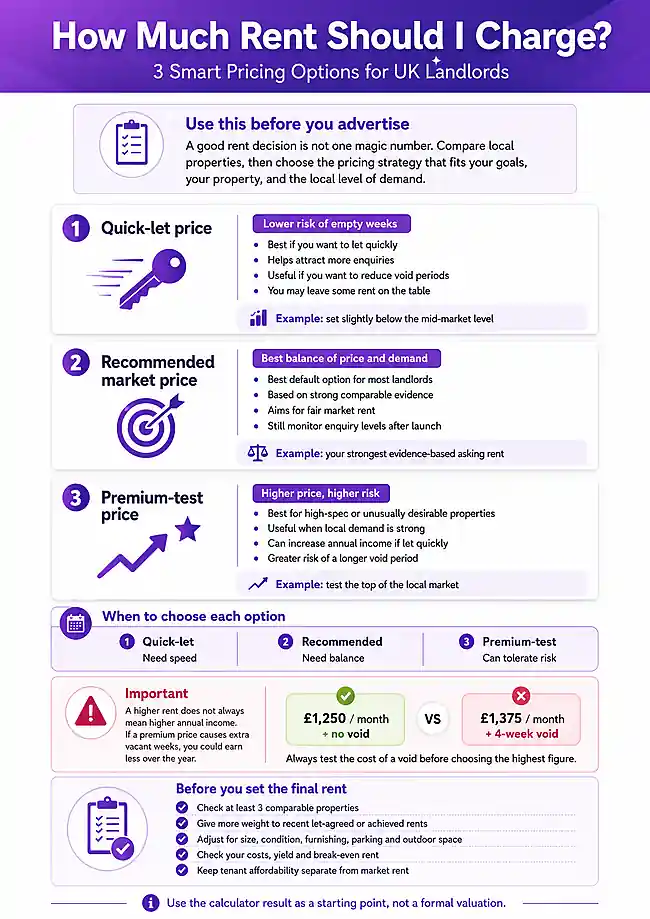
| Price option | Purpose | Best used when | Main risk |
|---|---|---|---|
| Quick-let price | Attract interest faster | You want to reduce void time or secure a tenant quickly | You may leave some rent on the table |
| Recommended market price | Balanced asking rent | You have reasonable comparable evidence | Still needs monitoring after launch |
| Premium-test price | Test the top of the market | Property is high quality, demand is strong and you can tolerate a short void | Longer vacancy and weaker enquiries |
In England, be careful how you advertise. Current GOV.UK guidance for assured periodic tenancies says a written advert must state a specific rent amount and a price range is not allowed. It also says landlords or agents cannot ask for, encourage or accept an offer above the advertised rent.
That means your calculator can show a range for your private decision-making, but your advert should use one clear asking rent where those rules apply.
The void-cost test: why a higher rent can earn less
An overpriced property can earn less over a year if it stays empty.
Imagine three options:
| Scenario | Monthly rent | Void period | Approx. annual income |
|---|---|---|---|
| Quick-let | £1,250 | 0 weeks | £15,000 |
| Recommended | £1,300 | 2 weeks | £15,000 |
| Premium-test | £1,375 | 4 weeks | £15,231 |
At first, £1,375 looks much better than £1,250. But if the premium price causes a month-long void, the annual gain may be small.
Use this formula:
Vacancy-adjusted annual income = monthly rent × 12 × occupied weeks ÷ 52
For example:
£1,300 × 12 × 50 ÷ 52 = £15,000
That means a property at £1,300 with two vacant weeks earns about the same annual rent as a property at £1,250 with immediate occupancy.
Rent needed to recover a void period
Use this formula:
Rent needed = target annual income ÷ 12 ÷ occupied-week percentage
If your target is £15,600 per year and you expect two vacant weeks:
- Occupied-week percentage = 50 ÷ 52
- Rent needed = £15,600 ÷ 12 ÷ (50 ÷ 52)
- Rent needed = £1,352 per month
This shows why a small overpricing decision can be expensive. We recommend checking enquiries after the first week of advertising. If views and enquiries are weak compared with similar listings, the asking rent may be too high.
Gross yield, net yield, expenses and cash flow
Rent is not the same as profit.
A landlord should check:
- Annual gross rent
- Gross rental yield
- Annual operating costs
- Net operating income
- Net yield
- Monthly pre-tax cash flow
- Break-even monthly rent
- Vacancy-adjusted income
Gross rental yield
Gross yield shows rent before costs.
Gross yield = annual rent ÷ property value × 100
Example:
- Property value: £250,000
- Monthly rent: £1,300
- Annual rent: £15,600
£15,600 ÷ £250,000 × 100 = 6.24% gross yield
Gross yield is useful for a quick comparison, but it can be misleading because it ignores costs.
Net rental yield
Net yield is more realistic because it deducts operating expenses.
Net yield = net operating income ÷ property value × 100
Example:
- Annual rent: £15,600
- Vacancy-adjusted income: £15,000
- Annual operating costs: £3,000
- Net operating income: £12,000
- Property value: £250,000
£12,000 ÷ £250,000 × 100 = 4.8% net yield
Landlord expenses to include
HMRC says residential landlords pay tax on rental profit after allowable expenses, and GOV.UK lists examples of day-to-day letting costs such as letting agent fees, legal fees for short lets or lease renewals, accountant fees, buildings and contents insurance, maintenance and repairs, utility bills, ground rent, service charges, council tax, cleaning, gardening and advertising.
For rent-setting, include costs such as:
| Cost | Include when relevant |
|---|---|
| Letting-agent fee | If an agent finds the tenant |
| Management fee | If an agent manages the property |
| Maintenance reserve | Always sensible |
| Buildings insurance | If paid by landlord |
| Contents insurance | If furnished |
| Service charge | Common for flats |
| Ground rent | Where applicable |
| Licence or compliance costs | HMOs or local licensing schemes |
| Utilities | If bills are included |
| Council tax | If landlord pays it |
| Cleaning/gardening | If landlord provides it |
| Advertising | If paid separately |
| Safety checks | Gas, electrical and other compliance costs |
This article does not calculate your tax bill. Tax treatment depends on ownership structure, finance, personal circumstances and current rules.
Monthly pre-tax cash flow
Cash flow shows what is left before tax after operating costs and mortgage payments.
Monthly pre-tax cash flow = (net operating income − annual mortgage payments) ÷ 12
Example:
- Net operating income: £12,000
- Mortgage payment: £700 per month
- Annual mortgage payments: £8,400
£12,000 − £8,400 = £3,600
£3,600 ÷ 12 = £300 monthly pre-tax cash flow
Do not set rent only to cover your mortgage. Tenants pay market rent, not your financing cost. However, mortgage coverage matters when deciding whether the investment works for you.
Break-even monthly rent
Break-even rent helps you understand the lowest rent that covers your costs before tax.
Break-even monthly rent = annual costs ÷ 12 ÷ occupied-week percentage
If annual operating costs and mortgage payments total £12,000, and you expect two vacant weeks:
- Occupied-week percentage = 50 ÷ 52
- Break-even rent = £12,000 ÷ 12 ÷ (50 ÷ 52)
- Break-even rent = £1,040 per month
If the realistic market rent is below your break-even figure, the property may not work financially unless costs, finance or expectations change.
Tenant affordability is a separate check
Do not use tenant income to decide the property’s market rent.
Market rent answers:
“What is this property worth in the rental market?”
Tenant affordability answers:
“Can this applicant reasonably afford this rent?”
Those are different questions.
A tenant might love the property but not pass affordability checks. Another tenant might easily afford the rent, but that does not mean the property is worth more than comparable evidence supports.
Use the affordability section of the calculator after you have chosen a proposed rent. It should show:
- Proposed monthly rent
- Annual rent
- Applicant gross annual household income
- Rent-to-income ratio
- Income needed under your chosen multiplier
- Guarantor income check, if relevant
- Pass, stretch or fail estimate
Label the result clearly:
“This is an initial affordability estimate only. It does not guarantee referencing approval.”
MoneyHelper’s 30% rent-affordability guide can be useful for budgeting, but affordability rules vary by agent, landlord, household costs and tenant circumstances.
Existing-tenancy rent reviews and UK jurisdiction warning
Setting rent for a new advert is different from increasing rent for an existing tenant. Rent-increase rules differ across England, Wales, Scotland and Northern Ireland, and tenancy type matters.
This section is only a rent-setting warning, not a full legal guide.
England
For assured periodic tenancies, current GOV.UK landlord guidance says landlords should first discuss any increase with the tenant, must use Form 4A, and must give the completed form at least two months before the increase starts. The guidance also says the section 13 process must be followed every time rent is increased, even if the increase has already been agreed with tenants.
If the tenant thinks the proposed rent is above open-market rent, GOV.UK says they can challenge it by going to the First-tier Tribunal.
Wales
In Wales, rent variation uses the Renting Homes framework. GOV.WALES provides Form RHW12 for notice of variation of rent.
Scotland
For a private residential tenancy in Scotland, my gov. scot says a landlord can only increase rent once in 12 months and must give at least three months’ written notice.
Northern Ireland
nidirect states that from 1 April 2025, a landlord cannot increase rent within 12 months of granting a tenancy or within 12 months of the last increase, and landlords must give three months’ written notice of the rent increase.
Practical rent-review advice
For an existing tenant, do not simply jump to the highest advertised listing you can find. Use open-market evidence, consider the tenant’s history, check the correct legal process and keep records of your comparable evidence.
Whole property, HMO room, lodger or adult-child rent
The right method depends on what you are renting.
Whole-property letting
For a whole house, flat or studio, compare similar whole properties. The rent is usually advertised monthly, and the tenant usually pays utilities and council tax unless stated otherwise.
Use:
- Comparable whole-property rents
- Property features
- Void risk
- Landlord expenses
- Yield and cash-flow checks
- Separate tenant affordability check
HMO room rent
An HMO room should be priced against similar room lets, not whole-property rents.
Consider:
- Room size
- Private or shared bathroom
- Number of sharers
- Quality of kitchen and communal areas
- Bills included
- Broadband
- Cleaning
- Furnishing
- Local student or professional demand
- Licensing costs
GOV.UK describes an HMO as a property rented by at least three people who are not from one household and share facilities such as a bathroom or kitchen. It also says large HMOs in England and Wales need a licence, and smaller HMOs may still need a licence depending on the area.
Lodger rent
A lodger arrangement is different because you live in the property too. Compare similar spare rooms with resident landlords, not self-contained flats.
Check:
- Whether bills are included
- Whether the room is furnished
- Bathroom access
- Shared kitchen/living space
- House rules
- Parking
- Local room demand
The Rent a Room Scheme can be relevant for resident landlords. GOV.UK says the scheme allows up to £7,500 per year tax-free from letting furnished accommodation in your home, with the threshold halved to £3,750 if you share the income with someone else.
Charging an adult child rent
Charging an adult child rent is usually a household-budget decision, not a market-rent decision.
A fair approach is to discuss:
- Their income
- Their savings goals
- Household bills
- Food costs
- Council tax impact, if any
- Whether the contribution is rent, board, savings support or a mix
You can look at local room rents for context, but the final figure should reflect the family arrangement rather than treating your child as a normal lodger.
10 Common rent-setting mistakes
Avoid these mistakes before advertising.
1. Using one high listing as proof
One expensive listing does not prove the market. It may be overpriced, stale or unusually high spec.
2. Ignoring achieved rent
A property can be advertised at £1,500 and let for less, or remain empty. Let-agreed and achieved evidence is stronger than hopeful asking rent.
3. Forgetting void periods
A higher monthly rent can produce lower annual income if it creates a long empty period.
4. Confusing gross rent with profit
Always deduct likely costs. Service charges, management fees, maintenance and insurance can change the result dramatically.
5. Including bills without costing them
Bills-included rent can be risky if energy use, council tax, broadband or cleaning costs are underestimated.
6. Letting the mortgage decide the rent
Your mortgage affects your investment return, but tenants compare your property with other available homes.
7. Pricing an HMO room like a whole property
Room rents need room-level comparables and bills-inclusive cost checks.
8. Ignoring legal advertising rules
Where England’s rental-bidding rules apply, your written advert should state one specific rent, and you must not encourage or accept offers above it.
9. Using old market data
The rental market can change. Recent comparable evidence is usually more useful than old listings.
10. Treating the calculator result as final
The result is a starting range. Monitor actual enquiries, viewing requests and tenant feedback.
3 Worked examples
The examples below use fictional figures to show the method. They are not market data.
Example 1: two-bedroom flat
A landlord is preparing to let a two-bedroom flat.
Comparable rents:
| Comparable | Rent | Evidence | Notes |
|---|---|---|---|
| Flat A | £1,250 | Let agreed | Similar size, similar condition |
| Flat B | £1,300 | Asking | Slightly better finish |
| Flat C | £1,275 | Achieved | Same building |
| Flat D | £1,375 | Asking | Has parking; still available |
| Flat E | £1,225 | Asking | Smaller floor area |
Median comparable rent: £1,275
The landlord’s flat is similar to Flat C and slightly better than Flat A, but does not have parking like Flat D. A reasonable recommended price may be around £1,275–£1,300.
Possible pricing:
| Strategy | Monthly rent |
|---|---|
| Quick-let price | £1,250 |
| Recommended market price | £1,295 |
| Premium-test price | £1,350 |
If the landlord must advertise one price, £1,295 may be the balanced option.
Example 2: three-bedroom house with higher costs
A landlord expects £1,600 per month.
Annual rent:
£1,600 × 12 = £19,200
Expected costs:
| Cost | Annual amount |
|---|---|
| Management fee | £1,920 |
| Maintenance reserve | £1,500 |
| Insurance | £350 |
| Licence/compliance | £300 |
| Other costs | £430 |
| Total operating costs | £4,500 |
Expected void: two weeks.
Vacancy-adjusted income:
£19,200 × 50 ÷ 52 = £18,462
Net operating income:
£18,462 − £4,500 = £13,962
If the property is worth £300,000:
Net yield = £13,962 ÷ £300,000 × 100 = 4.65%
This is more useful than gross yield because it includes void and operating costs.
Example 3: lodger room with bills included
A homeowner wants to rent a furnished spare room.
Similar local rooms:
- £550 bills included
- £575 bills included
- £600 bills included
- £625 with ensuite
- £525 smaller room
The median is £575.
If the room is furnished, average size, with shared bathroom and bills included, the recommended rent might be around £575 per month. If household bills are rising, the homeowner should check whether £575 still covers a fair share of utilities, broadband and council tax.
If the homeowner qualifies for Rent a Room, they should also check the current threshold and tax position. GOV.UK states the Rent a Room threshold is £7,500 per year, or £3,750 if the income is shared.
Final rent decision checklist
Before you advertise, check:
- Have you reviewed at least three comparable properties?
- Are your comparables recent?
- Have you separated asking rents from let-agreed or achieved rents?
- Have you ignored or downweighted obvious outliers?
- Have you adjusted for condition, furnishing, floor area, parking and outdoor space?
- Have you checked whether bills are included or excluded?
- Have you calculated annual rent?
- Have you checked gross yield?
- Have you checked net yield after realistic costs?
- Have you included expected vacant weeks?
- Have you calculated break-even rent?
- Have you kept tenant affordability separate from market rent?
- Have you checked the relevant rent-increase or advertising rules for your UK jurisdiction?
- Have you chosen one clear asking rent for the advert where required?
- Have you decided when to reduce the rent if enquiries are weak?
- Have you asked for a professional rental valuation if the evidence is weak?
FAQs
How do I calculate how much rent to charge?
Start with three to six recent comparable rental properties, use the median rent as your base, adjust for differences such as size, condition, furnishing, parking and bills, then check void risk and landlord costs before choosing your asking rent.
Is rent based on property value?
Property value is useful for calculating rental yield, but it should not be the main way to set rent. Market rent should come from comparable rental evidence.
What percentage of a property’s value should rent be?
There is no universal percentage that works for every UK property. You can calculate gross yield by dividing annual rent by property value, but comparable local rents are more useful for setting the actual asking rent.
Should I use asking rents or achieved rents?
Use both if available, but give more weight to achieved rents and recently let-agreed properties. Asking rents can be optimistic, especially if a property has remained advertised for a long time.
How many comparable properties should I check?
Check at least three genuinely similar properties. Five or six is better if they are recent, nearby and similar enough to your property.
Should I charge rent weekly or monthly?
Most private residential lets are advertised monthly, but showing the weekly and annual equivalent helps you understand affordability, yield and cash flow.
How often can I increase rent?
It depends on the UK jurisdiction and tenancy type. For example, current Scotland guidance for private residential tenancies says rent can only be increased once in a 12-month period with at least three months’ written notice. Always check the current official guidance for the property location and tenancy type.
What expenses should I deduct from rental income?
Include landlord-paid costs such as letting-agent fees, management fees, insurance, maintenance, service charges, ground rent, utilities, council tax, cleaning, gardening, advertising and compliance costs where relevant. HMRC’s GOV.UK guidance lists several examples of allowable day-to-day rental expenses.
How do I know whether a tenant can afford the rent?
Run a separate affordability check using the proposed rent and the applicant’s gross household income. Treat this as an initial guide only, because referencing criteria vary.