How Much Do You Need to Earn to Rent?
You have found a rental you like, but the real question is whether your income will satisfy the letting agent and still leave enough money to live on.
In the UK, a common rental affordability estimate is that your gross annual household income should be around 30 times the monthly rent. So, if the rent is £1,000 per month, the rough income figure is £30,000 a year before tax. This is also the same as saying your income should be around 2.5 times the annual rent. Many UK rent-affordability tools and letting pages use this kind of benchmark, but it is not a universal legal rule or a guarantee that your application will be accepted.
Quick Answer: How Much Do You Need to Earn to Rent?
Use this simple estimate first:
Monthly rent × 30 = approximate gross annual income required
Or, if you know your income:
Gross annual income ÷ 30 = approximate maximum monthly rent
Another way to calculate the same result is:
Annual rent × 2.5 = approximate gross annual income required
For example, if a property costs £1,200 per month, the annual rent is:
£1,200 × 12 = £14,400
Then:
£14,400 × 2.5 = £36,000
So, for a £1,200-a-month rental, a letting agent may expect around £36,000 gross annual household income.
This number is useful for checking whether you may pass a referencing affordability test, but it does not tell you whether the rent is comfortable after Council Tax, energy, water, food, transport, debt repayments, savings and other costs. MoneyHelper describes the 30% rent guideline as a budgeting rule of thumb rather than a fixed answer for everyone.
For a more personalised result based on income, location, sharing arrangement and monthly commitments, you can use this UK rent affordability calculator.
How Much Do You Need to Earn to Rent in the UK?
As a quick estimate, many renters can start with the 30 times monthly rent calculation.
That means:
- For £800 rent, you may need around £24,000 gross annual income.
- For £1,000 rent, you may need around £30,000 gross annual income.
- For £1,200 rent, you may need around £36,000 gross annual income.
- For £1,500 rent, you may need around £45,000 gross annual income.
- For £2,000 rent, you may need around £60,000 gross annual income.
The important word is household. If you rent alone, the income usually comes from you. If you apply as a couple or with housemates, the agent may consider combined income, individual rent shares, or both.
The amount you need can change depending on:
- The monthly rent.
- Whether you are renting alone or with others.
- Whether the tenancy is joint or individual.
- The landlord’s or letting agent’s criteria.
- The referencing provider’s rules.
- Your employment type and income evidence.
- Whether you need a guarantor.
- Your real monthly expenses.
London and higher-rent areas can make this calculation feel much harder. ONS data released in June 2026 showed average rent was highest in London at £2,294 and lowest in the North East at £776 in May 2026.
Quick Salary-to-Rent Table
This table uses the common 30× monthly rent referencing estimate. It is based on gross income before tax, not take-home pay.
| Monthly rent | Annual rent | Approx. gross annual income needed | Approx. gross monthly income | Affordability note |
|---|---|---|---|---|
| £600 | £7,200 | £18,000 | £1,500 | Lower rent, but bills can still be tight on a modest income. |
| £700 | £8,400 | £21,000 | £1,750 | Often relevant for rooms, shared homes or lower-cost areas. |
| £800 | £9,600 | £24,000 | £2,000 | Common search: salary needed for £800 rent. |
| £900 | £10,800 | £27,000 | £2,250 | Check transport, utilities and Council Tax carefully. |
| £1,000 | £12,000 | £30,000 | £2,500 | Common search: salary needed for £1,000 rent. |
| £1,200 | £14,400 | £36,000 | £3,000 | Common search: salary needed for £1,200 rent. |
| £1,500 | £18,000 | £45,000 | £3,750 | Common search: salary needed for £1,500 rent. |
| £1,800 | £21,600 | £54,000 | £4,500 | Often needs a stronger single income or combined income. |
| £2,000 | £24,000 | £60,000 | £5,000 | Common search: salary needed for £2,000 rent. |
| £2,500 | £30,000 | £75,000 | £6,250 | Common in higher-rent areas or larger properties. |
| £3,000 | £36,000 | £90,000 | £7,500 | Stress-test carefully before applying. |
These figures are estimates. A landlord, letting agent or referencing provider may use a different income multiple, request extra evidence, ask for a guarantor, or assess your application in another way.
How Rental Affordability Is Usually Calculated
The Income-Multiple Method
The income-multiple method compares your gross annual income with the rent.
The common calculation is:
Monthly rent × 30 = gross annual income required
So, if rent is £1,000 per month:
£1,000 × 30 = £30,000
This is also the same as:
Annual rent × 2.5
For £1,000 monthly rent:
£1,000 × 12 = £12,000 annual rent
£12,000 × 2.5 = £30,000
Some UK letting and calculator pages describe this as a common affordability rule, while some also use a higher estimate for guarantors, such as 36 times monthly rent.
What this means for you: use the 30× figure as a first check, but always confirm the agent’s actual criteria before assuming you will pass.
Rent as a Percentage of Income
Another way to judge affordability is to compare rent with gross income.
The 30× monthly rent calculation means rent is about 40% of gross annual income.
Example:
- Monthly rent: £1,000
- Annual rent: £12,000
- Gross annual income: £30,000
- Rent-to-income ratio: 40%
A more cautious budget might aim for rent closer to 30% of gross income. MoneyHelper explains that the 30% rule suggests spending up to 30% of income before tax on rent to avoid straining your budget, but it is only a guide.
A practical way to compare the numbers:
| View | Rent as share of gross income | Income needed for £1,000 monthly rent |
|---|---|---|
| Conservative budget | 30% | About £40,000 |
| Common referencing estimate | 40% | About £30,000 |
| Stretch budget | Over 40% | Below £30,000 |
What this means for you: the salary that passes referencing may be lower than the salary that gives you a comfortable monthly budget.
Gross Income Versus Take-Home Pay
Letting agents and referencing providers often ask for gross income, which means your income before tax, National Insurance, pension contributions and other deductions.
For your personal budget, use take-home pay. That is the money actually available for rent, bills, food, transport, savings and everyday spending.
What this means for you: enter gross income when checking a referencing-style calculation, but use take-home pay when deciding whether the rent is safe for your real life.
Weekly Rent and Monthly Rent Conversions
If a rent is advertised weekly, do not multiply it by four. That understates the true monthly cost because most months are longer than four weeks.
Use this method:
Weekly rent × 52 = annual rent
Then:
Annual rent ÷ 12 = monthly rent
Example:
- Weekly rent: £250
- Annual rent: £250 × 52 = £13,000
- Monthly equivalent: £13,000 ÷ 12 = £1,083.33
- Approximate income required: £1,083.33 × 30 = £32,500
What this means for you: weekly rent can look cheaper than it really is if you convert it incorrectly.
Passing Referencing Versus Comfortably Affording the Rent
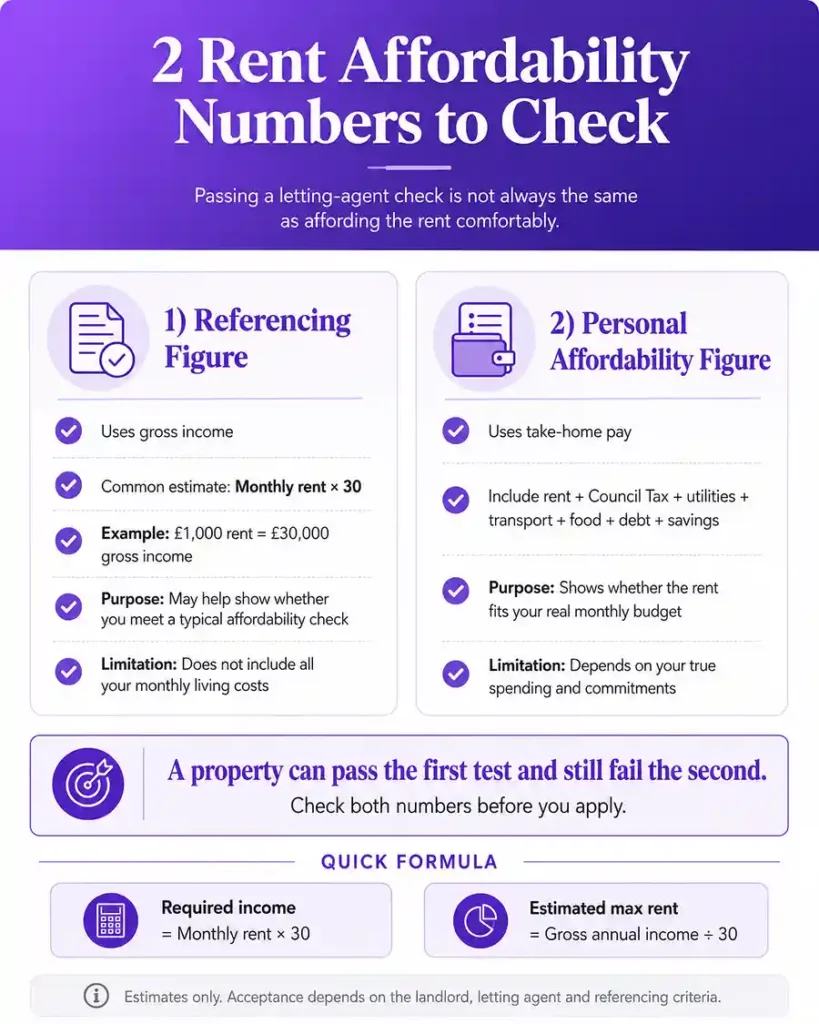
This is the most important distinction.
A letting-agent affordability check asks: does your income meet the application benchmark?
Your personal affordability check asks: can you pay the rent and still live safely after essential costs?
| Assessment | Question being answered | Income basis | Costs considered | Purpose | Main limitation |
|---|---|---|---|---|---|
| Letting-agent affordability | Do you meet the income benchmark? | Usually gross income | Mainly rent and income evidence | Tenant screening | May not reflect your full monthly budget. |
| Personal affordability | Can you live comfortably after rent? | Take-home pay | Bills, food, debt, transport, savings | Real-life budgeting | Requires honest spending estimates. |
| Stress-tested affordability | Could you cope if costs rise or income drops? | Take-home pay and savings | Emergency costs, income changes, repairs, rent increases | Risk management | More cautious than many basic calculators. |
You may pass a 30× affordability estimate and still struggle if you have high commuting costs, childcare, car finance, credit-card payments, professional fees or little emergency savings.
What this means for you: treat referencing as the entry test, not the full decision.
Costs to Include Beyond the Advertised Rent
The rent on the advert is only one part of the cost of moving and living in a property.
Recurring Monthly Costs
Include:
- Council Tax or local rates.
- Gas and electricity.
- Water.
- Broadband.
- Mobile phone.
- Contents insurance.
- TV Licence, where needed.
- Transport and commuting.
- Food and household essentials.
- Debt repayments.
- Childcare, where relevant.
- Parking or service-related charges.
- Subscriptions and regular commitments.
- Savings and emergency-fund contributions.
MoneyHelper lists rent, Council Tax, energy, water, internet, TV Licence where relevant, contents insurance, food, mobile and travel as costs to consider when renting.
One-Off Moving Costs
Also budget for:
- Tenancy deposit.
- Holding deposit, if required.
- Rent in advance.
- Removals or van hire.
- Cleaning costs.
- Basic furniture if the property is unfurnished.
- Initial household items.
- Utility overlap between old and new homes.
In England, GOV.UK says a holding deposit can be up to one week’s rent. GOV.UK also says the maximum tenancy deposit is usually five weeks’ rent where annual rent is under £50,000, or six weeks’ rent where annual rent is £50,000 or more.
Deposit and rent-in-advance rules can differ across England, Scotland, Wales and Northern Ireland, so check the rule that applies where the property is located. MoneyHelper notes that rent-in-advance and deposit rules vary across the UK.
How Much Income Do Letting Agents Consider?
A letting agent may consider different types of income, but acceptance depends on the landlord, agent, referencing provider and evidence.
Possible income sources include:
- Employment salary.
- Combined income from joint applicants.
- Regular overtime.
- Bonuses or commission, if accepted as reliable.
- Contractor income.
- Self-employed income.
- Pension income.
- Benefits, where accepted and evidenced.
- Maintenance payments.
- Other regular income.
OpenRent says tenant referencing can include affordability, income and employment checks, and that self-employed tenants or guarantors may be assessed using accountant details or bank transactions.
Some providers may accept certain benefits if they can be verified, while others may apply stricter rules. OpenRent’s landlord guidance says some providers accept Universal Credit if verified by Open Banking, while others include only certain benefits and may require award notices or bank statements.
What this means for you: do not assume every income source will count. Ask the agent exactly what evidence is accepted before you apply.
Renting Alone, as a Couple, or in a House Share
Renting on One Income
Renting alone is simple to calculate but often harder to afford because you carry all the rent and bills yourself.
Example:
- Monthly rent: £1,100
- Approximate income required: £1,100 × 30 = £33,000
If you earn £35,000, you may appear close to the required referencing figure. But you still need to check take-home pay after Council Tax, utilities, transport, food and debts.
What this means for you: a single renter should stress-test the budget more carefully because there is no second income to absorb unexpected costs.
Renting as a Couple
Couples can often use combined income.
Example:
- Applicant 1 income: £32,000
- Applicant 2 income: £24,000
- Combined income: £56,000
- Estimated maximum rent: £56,000 ÷ 30 = £1,866 per month
Both applicants may still be checked. The agent may look at employment, identity, credit history and references for each person.
What this means for you: combined income can improve affordability, but both applicants should understand the tenancy obligations before signing.
Renting with Housemates
In a house share, affordability may be assessed by:
- The total property rent.
- Each tenant’s individual share.
- Combined household income.
- The structure of the tenancy.
Example:
- Total rent: £2,400 per month
- Three tenants sharing equally: £800 each
- Combined income estimate required: £2,400 × 30 = £72,000
- Individual income estimate per equal share: £800 × 30 = £24,000
The tenancy type matters. Citizens Advice explains that shared accommodation may involve a joint tenancy, separate tenancies or a lodger-style arrangement. With a joint tenancy, tenants can be liable for the rent jointly and individually.
What this means for you: in a joint tenancy, your financial risk may be bigger than your own room share.
What If You Are Self-Employed, a Contractor, or Have Variable Income?
Self-employed renters, contractors and people with variable income may need more evidence than salaried employees.
An agent or referencing provider may ask for:
- Tax calculations.
- Filed tax returns.
- Accountant reference.
- Personal bank statements.
- Business bank statements.
- Contracts or evidence of ongoing work.
- Evidence of regular invoices.
- Open Banking verification.
- Proof of savings, where the agent accepts it.
OpenRent says self-employed tenants or guarantors may be assessed using accountant details or bank transactions. Its wider guidance also explains that employment, income and benefit evidence can vary depending on the applicant and provider.
For your own budget, avoid using your best month as your normal month. A safer method is:
- Add up 12 months of income after business expenses.
- Remove unusual one-off payments.
- Divide by 12.
- Set aside tax, National Insurance and pension money.
- Test the rent against an average or lower month, not only your best month.
What this means for you: variable income does not automatically stop you renting, but you should prepare stronger evidence and use conservative figures.
Worked Rent-Affordability Examples
Example 1: One Person Renting Alone
- Gross annual income: £36,000
- Target monthly rent: £1,000
- Approximate referencing income required: £30,000
- Annual rent: £12,000
- Rent-to-income percentage: 33.3%
This applicant may pass a common 30× estimate. The next check is whether their take-home pay can cover rent, Council Tax, utilities, food, commuting, debts and savings.
Practical conclusion: likely workable on the referencing figure, but still needs a full personal budget.
Example 2: A Couple Using Combined Income
- Applicant 1 income: £34,000
- Applicant 2 income: £26,000
- Combined income: £60,000
- Target monthly rent: £1,600
- Approximate referencing income required: £48,000
- Annual rent: £19,200
- Rent-to-income percentage: 32%
The combined income is above the 30× estimate. However, the couple should still check transport, childcare, debt repayments and savings goals.
Practical conclusion: the referencing figure looks comfortable, but personal affordability depends on monthly commitments.
Example 3: Three Tenants Sharing
- Combined income: £72,000
- Property rent: £2,400 per month
- Equal rent share: £800 each
- Approximate combined income required: £72,000
- Annual rent: £28,800
- Rent-to-income percentage: 40%
This is exactly on the 30× estimate. If the tenancy is joint, each person should understand their possible liability if another housemate does not pay.
Practical conclusion: the numbers may pass, but the tenancy structure matters.
Example 4: Self-Employed Renter
- Average annual income after business expenses: £42,000
- Target monthly rent: £1,250
- Approximate referencing income required: £37,500
- Annual rent: £15,000
- Rent-to-income percentage: 35.7%
This renter appears above the 30× estimate, but evidence is crucial. The agent may want tax documents, accountant details, bank statements or contract evidence.
Practical conclusion: the income may be enough, but the application depends heavily on proof and consistency.
Common Rent-Affordability Mistakes
Avoid these mistakes before applying:
- Entering take-home pay when the agent asks for gross income.
- Assuming every agent uses the same calculation.
- Treating agent approval as proof that rent is comfortable.
- Ignoring Council Tax and utilities.
- Forgetting water, broadband and contents insurance.
- Underestimating commuting costs.
- Counting uncertain bonuses as guaranteed income.
- Multiplying weekly rent by four.
- Dividing shared rent incorrectly.
- Forgetting rent in advance.
- Forgetting the deposit.
- Leaving no emergency buffer.
- Assuming a guarantor only covers your share.
- Applying before checking what documents are needed.
Citizens Advice recommends having documents ready when you start renting, but also says you should get the landlord’s or letting agent’s name and contact details before giving them documents.
Final Takeaway
The quick answer is simple: multiply the monthly rent by 30 to estimate the gross annual income a letting agent may look for.
But the smarter answer is to check two numbers:
- The referencing number: the income that may help you pass the application check.
- The real affordability number: the rent you can manage after bills, debts, savings and everyday living costs.
A property can pass the first test and fail the second. Before applying, check the agent’s criteria, prepare your income evidence, calculate your full monthly costs, and leave room for emergencies.
These calculations are guidance only. They do not guarantee that a landlord, letting agent, referencing company or rent-guarantee insurer will accept your tenancy application.
FAQs
How much do I need to earn to rent a £1,000-a-month property?
As a rough UK referencing estimate, you may need around £30,000 gross annual income to rent a £1,000-a-month property. The calculation is £1,000 × 30. This does not guarantee acceptance, and your comfortable income figure may be higher once bills, debts and savings are included.
What salary do I need for £1,200 monthly rent?
Using the common 30× monthly rent estimate, £1,200 rent points to around £36,000 gross annual income. A more cautious personal budget may need a higher income if you have high Council Tax, energy bills, transport costs, childcare or debt repayments.
What is the 30x rent rule?
The 30x rent rule means your gross annual income is estimated as 30 times the monthly rent. For example, £900 rent would suggest £27,000 gross annual income. It is a common referencing benchmark, not a legal requirement.
Is annual income 2.5 times the yearly rent?
Yes. The 2.5× annual rent method gives the same result as the 30× monthly rent method. If rent is £1,000 per month, annual rent is £12,000. Multiply £12,000 by 2.5, and the result is £30,000.
Do benefits count as income for renting?
Sometimes. Some referencing providers may accept benefits if they can be verified, while others may apply stricter criteria. MoneyHelper says landlords in the UK cannot refuse to rent to you because you receive benefits if you can afford the rent.
How do self-employed tenants prove income?
Self-employed tenants may be asked for tax calculations, tax returns, accountant references, bank statements, business statements, contracts or Open Banking evidence. The exact evidence depends on the agent and referencing provider. Use conservative average income when judging your own affordability.
What happens if I fail an affordability check?
If you fail an affordability check, ask the agent why. You may be able to provide stronger income evidence, add eligible combined income, use a suitable guarantor, choose a lower-rent property or apply for a house share. Do not give misleading information.
Should bills be included in my rent budget?
Yes. Bills should always be included unless the tenancy clearly includes them. Council Tax, gas, electricity, water, broadband, mobile, insurance, food and transport can make a property much more expensive than the advertised rent.
How much should I save before renting?
You should save for the deposit, rent in advance, moving costs, basic furnishings and an emergency buffer. The exact amount depends on the property, UK nation, tenancy terms and your personal situation. Avoid using every penny on moving costs if it leaves no backup.