FSRH UKMEC Explained: Categories & Calculator Guide
FSRH UKMEC: What It Means and How to Use It Safely
If you are trying to understand whether a contraceptive method may be medically suitable for you, the term FSRH UKMEC can feel confusing at first.
You may see UKMEC mentioned by a doctor, nurse, pharmacist, sexual health clinic, NHS service, or online contraception tool. In simple terms, UKMEC stands for UK Medical Eligibility Criteria for Contraceptive Use. It is a clinical guidance system used to help assess whether different contraceptive methods can be used safely by people with particular medical conditions or personal characteristics.
This article explains what FSRH UKMEC means, how the UKMEC categories work, which contraceptive methods are covered, and how to use a UKMEC calculator responsibly.
Important medical note: This article is for general educational information only. It is not medical advice, diagnosis, or a prescription recommendation. Contraception decisions should be discussed with a qualified healthcare professional, such as a doctor, nurse, pharmacist, or sexual health clinician.
What Does “FSRH UKMEC” Mean?
The phrase FSRH UKMEC usually refers to the UK contraception safety guidance known as the UK Medical Eligibility Criteria for Contraceptive Use.
The official UKMEC guidance is associated with the UK professional body for sexual and reproductive healthcare. Many people still search for it using the older term FSRH, while the official UKMEC page is now hosted under CoSRH, the College of Sexual and Reproductive Healthcare. The official UKMEC 2025 guidance explains that UKMEC helps clinicians decide which contraceptives they can safely recommend based on a patient’s medical conditions and characteristics.
Quick definition
UKMEC is a clinical eligibility framework that classifies contraceptive methods from Category 1 to Category 4 depending on whether a method is medically suitable for a person with a specific condition or characteristic.
For example, UKMEC may be used when considering contraception for someone who has migraine with aura, high blood pressure, obesity, a history of venous thromboembolism, breast cancer, diabetes, epilepsy medicines, or other clinical factors.
Is UKMEC the Same as FSRH?
No. FSRH and UKMEC are not exactly the same thing.
| Term | Meaning | Simple explanation |
|---|---|---|
| FSRH / CoSRH | Professional body for sexual and reproductive healthcare guidance | The organisation associated with UK contraception guidance. |
| UKMEC | UK Medical Eligibility Criteria for Contraceptive Use | The clinical framework used to assess contraceptive medical eligibility. |
| WHO MEC | World Health Organization Medical Eligibility Criteria | International guidance on the safety of contraception in relation to health conditions and personal characteristics. |
The WHO describes Medical Eligibility Criteria as recommendations on the safety of contraceptive methods for people with specific health conditions and personal or physiological characteristics. UKMEC applies this type of eligibility approach in a UK clinical context.
What Is UKMEC Used For?
UKMEC is used to help healthcare professionals assess whether a contraceptive method is medically suitable for a person.
It does not simply tell someone “this is the best contraception for you.” Instead, it helps answer a more specific question:
Is this contraceptive method medically safe to use in this person’s situation?
The official UKMEC guidance states that UKMEC categories relate to the safety of contraceptive use, not contraceptive effectiveness. It also explains that the effectiveness of contraception may be affected by a medical condition or medication, but the UKMEC category itself does not reflect effectiveness.
That distinction matters because a method may be medically suitable but not the most effective option, or it may be effective but not suitable for someone with a particular health condition.
UKMEC Categories Explained
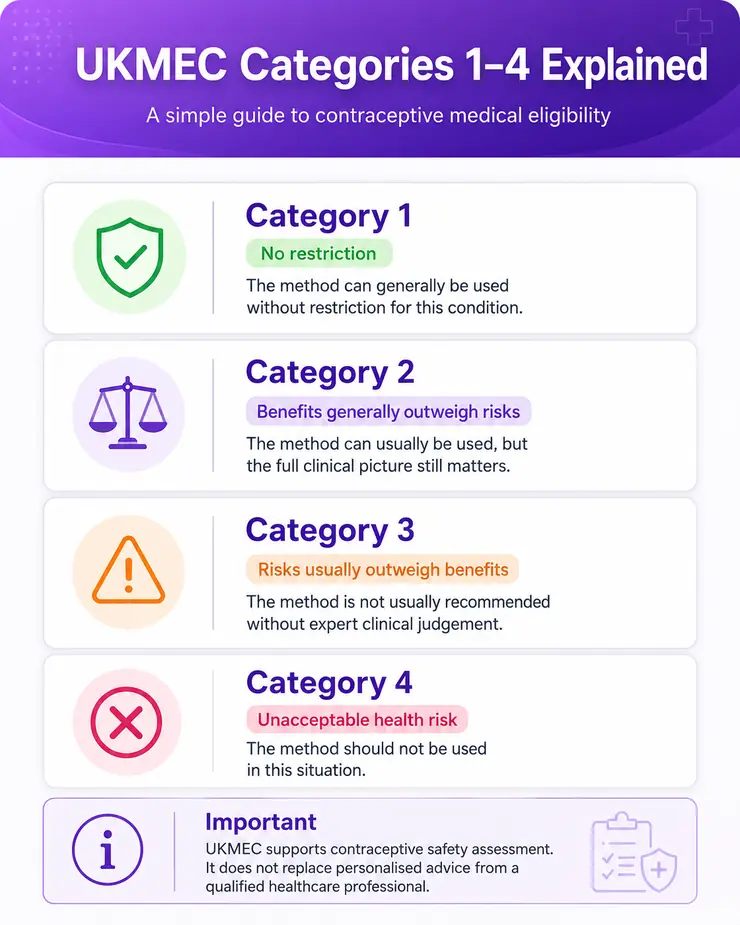
UKMEC uses four main categories: Category 1, Category 2, Category 3, and Category 4.
These categories help healthcare professionals judge whether the advantages of using a contraceptive method outweigh the possible risks for a person with a specific condition or characteristic.
| UKMEC Category | Official meaning | Plain-English meaning | What it usually means for the user |
|---|---|---|---|
| Category 1 | No restriction for use of the method | The method can generally be used without restriction for that condition | Usually suitable from a medical eligibility point of view |
| Category 2 | Advantages generally outweigh theoretical or proven risks | The method can generally be used, but some risk factors may need consideration | Usually acceptable, but context matters |
| Category 3 | Risks usually outweigh advantages | The method is not usually recommended unless other options are unavailable or unacceptable | Needs expert clinical judgement or specialist advice |
| Category 4 | Unacceptable health risk if the method is used | The method should not be used in that situation | A healthcare professional should discuss safer alternatives |
The official UKMEC 2025 guidance defines Category 1 as no restriction, Category 2 as advantages generally outweighing risks, Category 3 as risks usually outweighing advantages and requiring expert clinical judgement or referral, and Category 4 as an unacceptable health risk if the method is used.
UKMEC Category 1
UKMEC Category 1 means there is no restriction for using that contraceptive method in relation to the condition or characteristic being considered.
In plain English, this usually means the medical condition being checked does not create a restriction for that method.
However, Category 1 does not mean the method is automatically the best choice for every person. It only means that, for the specific condition being assessed, there is no medical restriction under UKMEC.
UKMEC Category 2
UKMEC Category 2 means the advantages of using the method generally outweigh the theoretical or proven risks.
This does not mean “dangerous.” It means the method is generally acceptable, but a healthcare professional may still need to consider the full picture.
For example, one Category 2 factor may not be a major concern by itself. But if several risk factors are present, clinical judgement may be needed.
The UKMEC guidance specifically warns that multiple Category 2 conditions may indicate cumulative risk, and categories should not simply be added together mathematically.
UKMEC Category 3
UKMEC Category 3 means the theoretical or proven risks usually outweigh the advantages of using that method.
This category is important because it does not always mean “never use.” Instead, it usually means the method is not normally recommended unless other more appropriate methods are unavailable or unacceptable.
The official UKMEC guidance states that Category 3 provision requires expert clinical judgement and/or referral to a specialist contraceptive provider.
If a UKMEC calculator shows Category 3, the safest next step is to discuss the result with a qualified healthcare professional before making any decision.
UKMEC Category 4
UKMEC Category 4 means the method represents an unacceptable health risk if used in that situation.
In practical terms, Category 4 usually means the method should not be used for that person’s circumstances, and a healthcare professional should help identify safer alternatives.
If a calculator result shows UKMEC Category 4, do not treat the result as something to ignore or override yourself. Speak to a doctor, nurse, pharmacist, or specialist contraception provider.
Which Contraceptive Methods Does UKMEC Cover?
The UKMEC guidance covers several major contraception groups, including:
- Intrauterine devices, such as copper IUD and LNG-IUS
- Progestogen-only contraception, such as progestogen-only pills, implants, and injections
- Combined hormonal contraception, such as the combined pill, contraceptive patch, and vaginal ring
- Emergency contraception
The NHS lists common contraception methods available in the UK, including the combined pill, progestogen-only pill, IUD, IUS, implant, injection, contraceptive patch, vaginal ring, condoms, internal condoms, sterilisation, diaphragm or cap, natural family planning, and emergency contraception.
Common method groups in UKMEC
| Method group | Examples | What UKMEC helps assess |
|---|---|---|
| Intrauterine contraception | Copper IUD, LNG-IUS / hormonal coil | Whether a person’s medical condition affects safe use or insertion |
| Progestogen-only contraception | Progestogen-only pill, implant, injection | Whether specific conditions or medicines affect eligibility |
| Combined hormonal contraception | Combined pill, patch, vaginal ring | Whether oestrogen-containing contraception is medically suitable |
| Emergency contraception | Emergency contraceptive pill, copper IUD | Whether emergency contraception options are medically suitable |
How UKMEC Helps in Contraceptive Decision-Making
UKMEC is one part of contraceptive decision-making. It helps with medical eligibility, but it does not replace a full contraception consultation.
A complete contraception discussion may include:
- Medical history
- Current medicines
- Blood pressure
- BMI or weight-related risk factors where relevant
- Smoking status
- Migraine history
- Personal preference
- Bleeding pattern preferences
- Future pregnancy plans
- Ease of use
- Side effects
- STI protection needs
- Access to fitting or follow-up services
- Effectiveness of different methods
UKMEC focuses mainly on whether a method is medically suitable in relation to health conditions and characteristics. It should be interpreted alongside clinical judgement and personal circumstances.
Safety vs Effectiveness: A Key UKMEC Point
One of the most important things to understand is this:
UKMEC categories are about medical safety, not how effective a contraceptive method is at preventing pregnancy.
For example, a method could be UKMEC Category 1 for a particular condition but still require correct and consistent use to be effective. Another method may be highly effective but unsuitable for someone because of a specific medical risk.
The NHS contraception pages explain that contraception methods vary in how they are used and how well they work. UKMEC should therefore be understood as a safety framework, not a full “best contraception” ranking system.
Initiation vs Continuation: Why Results Can Differ
UKMEC may classify starting a method and continuing a method differently.
The official UKMEC guidance explains that initiation and continuation can sometimes receive different classifications. It also notes that the duration of use before a new medical condition appears may influence decisions about continued use, and clinical judgement may be required.
This means a person who is already using a method may need a different clinical discussion than someone who is starting that method for the first time.
Example of the concept
A person might begin using a contraceptive method when they have no relevant medical condition. Later, if they develop a new condition, the decision may not simply be “stop immediately” or “continue forever.” A clinician may need to assess risks, alternatives, urgency, and personal circumstances.
Why UKMEC Categories Cannot Be Added Together
UKMEC categories are not simple numbers that can be added up.
For example:
- Category 2 + Category 2 does not automatically become Category 4.
- Several Category 2 factors affecting the same risk area may still require careful clinical judgement.
- Multiple medical issues can change the overall risk-benefit discussion.
The official UKMEC guidance states that UKMEC categories cannot simply be added together to indicate safety. It explains that if multiple Category 2 conditions relate to the same risk, clinical judgement must be used to decide whether the risks may outweigh the benefits.
This is one of the main reasons online tools must be used responsibly.
What Is a UKMEC Calculator?
A UKMEC calculator is an online tool that helps users check how different contraceptive methods may be categorised under UKMEC based on selected medical conditions or characteristics.
A calculator can make UKMEC easier to understand because the official guidance is detailed and written primarily for clinical use.
However, a calculator is not a medical consultation. It can support learning and preparation, but it cannot fully assess an individual’s personal medical history.
You can use our UKMEC calculator as an educational tool to explore category results and understand which contraceptive methods may need further clinical discussion.
How to Use UKMEC Information Responsibly
Follow this simple process:
1. Start with the correct condition or characteristic
UKMEC categories depend on accurate information. If you choose the wrong condition, leave out a medicine, or misunderstand a diagnosis, the result may not reflect your real clinical situation.
2. Compare results by method
Different contraceptive methods may have different UKMEC categories for the same condition. For example, combined hormonal contraception may be treated differently from progestogen-only contraception or intrauterine contraception.
3. Check whether the result is for initiation or continuation
Starting a method and continuing a method may be classified differently in some situations. The official UKMEC guidance explains that initiation and continuation can sometimes differ and clinical judgement may be needed.
4. Treat Category 3 and 4 as “speak to a clinician” results
Category 3 and Category 4 should not be treated as casual online answers. They are signals that professional advice is important.
5. Remember that UKMEC is not the full contraception decision
UKMEC is about medical eligibility. A final contraception choice may also depend on effectiveness, convenience, bleeding changes, side effects, STI protection, personal preference, and access to services.
Examples of Factors That May Affect Contraceptive Eligibility
UKMEC considers many medical conditions and personal characteristics. The following are examples of factors that may affect eligibility for some contraception methods.
These examples are not personal advice. Your own eligibility depends on your full medical history and should be discussed with a qualified healthcare professional.
Migraine with aura
Migraine history can matter, especially when considering methods that contain oestrogen. UKMEC tables differentiate some conditions by severity or type, such as migraine with or without aura.
High blood pressure
Hypertension is one of the medical conditions considered in UKMEC. Blood pressure may affect the suitability of some contraceptive methods, especially where cardiovascular risk is relevant.
Smoking and age
Smoking status and age can affect contraceptive eligibility because they may influence cardiovascular risk. This is particularly important when considering combined hormonal contraception.
BMI and obesity
BMI may affect eligibility for some methods and may also be relevant when considering wider risk factors, such as venous thromboembolism risk.
Venous thromboembolism
A personal or family history of blood clots may affect suitability for some methods. This should be reviewed carefully by a healthcare professional.
Breast cancer
Current or previous breast cancer can affect eligibility for hormonal contraception. This is a specialist clinical area and should not be assessed using an online tool alone.
Epilepsy medicines and drug interactions
Some medicines can interact with hormonal contraception or affect contraceptive effectiveness. UKMEC categories are about safety, while separate clinical guidance may be needed to assess effectiveness and drug interactions.
STIs and pelvic inflammatory disease
Sexually transmitted infections and pelvic inflammatory disease can be relevant when considering intrauterine contraception. A clinician may need to assess infection risk, symptoms, and timing.
UKMEC and Emergency Contraception
UKMEC also includes emergency contraception. The UKMEC 2025 guidance lists emergency contraception as one of the method groups considered.
Emergency contraception can include emergency contraceptive pills and the copper IUD. The NHS states that the IUD does not contain hormones and can be used as emergency contraception, while emergency contraceptive pills are taken within 3 or 5 days after sex depending on the type of pill.
If you need emergency contraception, seek advice promptly from a pharmacist, GP, sexual health clinic, or NHS service. NHS contraception services, including emergency contraception, are free and confidential, and contraception can be obtained from sexual health clinics, some GP surgeries, some young people’s services, and most pharmacies.
FSRH UKMEC Key Takeaways
- FSRH UKMEC usually refers to UK contraception eligibility guidance.
- UKMEC stands for UK Medical Eligibility Criteria for Contraceptive Use.
- UKMEC categories help assess whether contraceptive methods can be used safely in relation to specific health conditions or personal characteristics.
- Category 1 means no restriction.
- Category 2 means advantages generally outweigh risks.
- Category 3 means risks usually outweigh advantages and expert clinical judgement may be needed.
- Category 4 means the method represents an unacceptable health risk if used.
- UKMEC categories are about safety, not contraceptive effectiveness.
- A UKMEC calculator can support understanding, but it cannot replace a qualified healthcare professional.
Final Safety Reminder
UKMEC is a valuable clinical guidance framework, but it is not a substitute for individual medical advice.
A UKMEC calculator can help you understand eligibility categories, compare method groups, and prepare better questions. However, contraception decisions should always be made with support from a qualified healthcare professional who can consider your full medical history, medicines, preferences, and current health needs.
To explore UKMEC categories in a simpler format, try our UKMEC calculator and use the results as a starting point for an informed discussion with a clinician.
FAQs
What does FSRH UKMEC mean?
FSRH UKMEC usually refers to the UK Medical Eligibility Criteria for Contraceptive Use. It is a clinical guidance framework used to assess whether contraceptive methods are medically suitable for people with specific health conditions or characteristics.
Is UKMEC the same as FSRH?
No. FSRH / CoSRH is the professional body associated with UK sexual and reproductive healthcare guidance. UKMEC is the eligibility criteria framework used to assess contraceptive medical suitability.
What are UKMEC categories 1, 2, 3, and 4?
UKMEC Category 1 means no restriction. Category 2 means advantages generally outweigh risks. Category 3 means risks usually outweigh advantages and expert clinical judgement may be required. Category 4 means the method represents an unacceptable health risk if used.
Is UKMEC a contraception recommendation tool?
UKMEC helps assess medical eligibility, but it does not choose the best contraceptive method for a person. A full contraception decision may also include effectiveness, personal preference, side effects, STI protection, and access to services.
Can I use UKMEC to choose contraception myself?
You can use UKMEC information to understand eligibility categories and prepare questions, but you should not use it as a replacement for professional medical advice. Speak to a doctor, nurse, pharmacist, or sexual health clinician before making personal contraception decisions.
Which contraception methods are covered by UKMEC?
UKMEC covers intrauterine devices, progestogen-only contraception, combined hormonal contraception, and emergency contraception.
What is the difference between initiation and continuation?
Initiation means starting a contraceptive method. Continuation means continuing a method already being used. UKMEC explains that initiation and continuation can sometimes be classified differently, and clinical judgement may be required.