How Location Affects Courier Business Costs
Location has a direct effect on almost every major cost in a courier business. Rent, fuel, driver wages, parking, insurance, route length, customer density, and even failed delivery rates can change significantly depending on where the operation is based.
A cheap warehouse on the edge of a city may look attractive until drivers spend extra time reaching the first delivery zone each morning. A more expensive urban location may reduce mileage but create higher parking, congestion, and property costs.
The right location should therefore be evaluated based on total operating cost, not rent alone.
Compare Rent With Route Efficiency
Property cost is usually the most obvious location expense.
Courier businesses may need office space, parking, vehicle storage, loading areas, or a small warehouse. Central locations tend to cost more, while industrial areas farther from the city center may provide more space at lower rent.
However, cheaper rent can create longer route starts and finishes.
If drivers spend 45 minutes every morning traveling from the depot to the main customer area, the business is paying for labor, fuel, and vehicle use before the first delivery is completed.
Model depot-to-route travel before signing a lease.
Compare Different Courier Depot Locations
The cheapest location is not always the most cost-effective option. Courier businesses should compare rent, customer access, traffic conditions, parking availability, and delivery efficiency before selecting a depot.
| Location Type | Advantages | Potential Challenges | Best Suited For |
|---|---|---|---|
| City Center Location | Close to dense customer areas, shorter delivery distances, faster access to businesses | Higher rent, limited parking, congestion, loading restrictions | Same-day delivery, urban business deliveries, time-sensitive parcels |
| Suburban Location | Balanced property costs, easier parking, good access to residential areas | Longer travel time to some central business districts | Mixed residential and commercial delivery routes |
| Industrial Area Location | Lower rent, larger warehouse spaces, easier vehicle access and loading | Greater distance from some customers, possible longer first-mile travel | Large fleets, regional courier operations, high parcel volumes |
| Location Near Customer Clusters | Reduces delivery mileage, improves response times, supports route efficiency | Suitable locations may have higher demand | Businesses serving concentrated customer areas |
| Near Transport Hubs | Better connectivity, easier vehicle movement, useful for regional distribution | Space may be more expensive due to demand | Courier networks with wider delivery coverage |
Measure Delivery Density Around the Location
Courier economics improve when stops are close together.
A depot surrounded by dense residential and commercial areas can make routes more productive because drivers spend less time between deliveries.
Using courier delivery software can help businesses analyze route structure, assign stops more efficiently, and understand how geography affects daily driver workload.
Location should be evaluated against actual customer distribution.
Do not assume a central address is automatically best. If most customers are concentrated in one suburban corridor, a depot near that area may outperform a more prestigious city-center location.
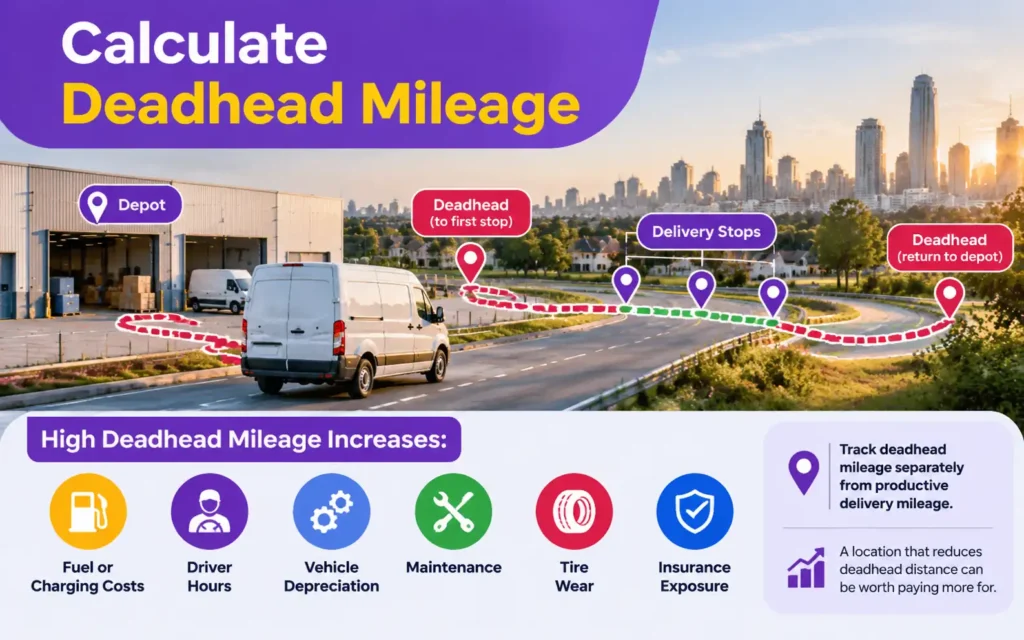
Calculate Deadhead Mileage
Deadhead mileage refers to distance traveled without carrying out productive delivery work.
This includes driving from the depot to the first stop, returning after the final stop, repositioning between service areas, and traveling to collect packages without an efficient return load.
High deadhead mileage increases:
- Fuel or charging costs
- Driver hours
- Vehicle depreciation
- Maintenance
- Tire wear
- Insurance exposure
Track this separately from productive delivery mileage.
A location that reduces deadhead distance can be worth paying more for.
Factor in Traffic Congestion
Distance alone does not determine route cost.
Five miles through a congested city center may take longer than 15 miles on a clear suburban road.
Traffic increases driver labor cost because drivers complete fewer stops per hour. It can also make delivery windows less reliable.
When comparing locations, review typical travel times during the actual hours drivers will operate.
Morning and evening traffic patterns matter more than midday conditions if most routes start early or return during peak periods.
Account for Parking and Loading Restrictions
Urban delivery operations often face additional costs from limited loading space.
Drivers may spend time searching for legal parking, walking longer distances to buildings, or dealing with access restrictions.
These delays reduce route capacity.
Before choosing a facility location or service area, investigate:
Common Access Costs
- Paid parking
- Loading-zone restrictions
- Permit requirements
- Vehicle size limits
- Low-emission or congestion charges
- Restricted delivery hours
- Secure-building access delays
A route with short geographic distances can still be expensive if every stop requires several extra minutes of access time.
Consider Driver Labor Markets
Location affects hiring costs as well.
A depot that is difficult to reach by public transportation may require higher wages or create recruitment problems.
Workers may also prefer jobs with shorter commutes, predictable shifts, and easy parking.
If the business needs drivers to report to a central depot each morning, accessibility matters.
Compare local wage expectations, labor availability, commute patterns, and turnover risk.
A low-rent facility can become expensive if the company constantly struggles to recruit and retain staff.
Evaluate Vehicle Storage and Security
Courier businesses often need overnight vehicle parking.
Secure parking can affect both insurance and theft risk.
A location with fenced access, lighting, cameras, and controlled entry may cost more but reduce operational exposure.
Consider where vehicles will be parked when not in use.
Street parking may create additional risk, while underground or tightly constrained parking can limit vehicle size.
If the fleet includes electric vehicles, determine whether charging infrastructure can be installed at the site.
Calculate Fuel and Energy Differences
Fuel cost depends partly on route geography.
Stop-and-go urban driving can increase consumption for combustion vehicles. Long suburban routes may create more mileage even if traffic is lighter.
Electric fleets introduce different location factors.
Charging availability, electricity rates, depot electrical capacity, and route distance all matter.
A depot with inexpensive overnight charging may improve operating economics even if rent is slightly higher.
Use real route data rather than manufacturer efficiency estimates when modeling vehicle cost.
Look at Customer Proximity
A location near important commercial customers can reduce pickup time.
This is especially valuable for courier businesses handling same-day, scheduled, or time-critical deliveries.
If a large share of revenue comes from several business districts, hospitals, legal offices, retailers, or e-commerce warehouses, map those customers before choosing the operating base.
Customer proximity can also improve service responsiveness.
Drivers may be able to handle late requests without disrupting the rest of the route.
Include Insurance and Local Operating Costs
Business insurance and vehicle-related costs can vary by location.
Areas with higher theft, collision, or claims frequency may produce higher premiums.
Property insurance, business rates, utilities, and security costs can also differ.
Do not compare lease prices in isolation.
Build a location cost model that includes all recurring expenses.
A more expensive property can sometimes produce a lower total cost once transportation and operating efficiency are included.
Compare Warehouse Size With Actual Needs
Courier operations often overpay for space they do not use.
If parcels move through the facility quickly, the business may need only a small sorting area rather than a full warehouse.
Measure daily parcel volume, peak-season volume, storage duration, vehicle count, and loading requirements.
Avoid paying for large amounts of unused floor space.
At the same time, a site that is too small can create congestion during sorting and loading.
The right property should support peak operations without creating high fixed costs.
Model Location Cost Per Delivery
The most useful comparison is cost per completed delivery.
Add rent, utilities, wages, vehicle costs, fuel, parking, insurance, and local charges.
Then divide those costs across realistic delivery volume.
A central depot may have higher rent but lower cost per delivery because drivers complete more stops per hour.
A cheaper outer-city site may produce the opposite result.
Run several scenarios before committing to a property.
Choose Location Based on Total Operating Cost
Courier business location decisions should be driven by operations, not just property prices.
The best site is one that supports route density, reduces unnecessary mileage, gives drivers practical access, provides secure vehicle storage, and keeps total delivery cost under control.
Model rent alongside traffic, labor, parking, fuel, customer concentration, and deadhead mileage.
A slightly more expensive location can be the better choice if it improves route productivity and reduces hidden operating costs.
For a courier business, location is not simply where the company rents space. It is part of the delivery system itself.